Let’s make this fun. Use the comments section below to enter your guess for the date when Donald Trump’s campaign finally collapses.
For the purposes of this game, Trump’s campaign is officially dead when his national polling average tracked by Real Clear Politics at this link, drops below 3% and stays there for seven consecutive days.
Whoever enters a guess closest to that date wins a free copy of The Politics of Crazy. Understanding of course that most of you who haven’t downloaded a copy already probably don’t intend to, let me add this detail. The free copy is delivered in the form of an Amazon gift certificate for the cost of the book, $7, which you can actually use on anything you want.
So, what’s your best guess? How much longer will The Donald be sucking the air out of the GOP primaries?
Our most frustrating and dangerous political problems are emerging from the tension between complexity and liberty. The rising tide of crazy sweeping across our political landscape reflects a single core difficulty. The 20th century bureaucratic regulatory state simply does not work in a world of rapidly accelerating technological and cultural dynamism. We have to find an alternative.
Expanding democracy and increasingly complex global capitalism have led to the emergence of new demands. The devolution of power that accompanies expanding personal liberty is stifling the ability of government to actually create and administer the services demanded by the public. Call it the ‘Death Panel’ problem. We cannot administer the public services along the lines of the old 20th Century template without creating unaccountable bureaucracies, sufficiently insulated from political pressure to conduct their mission. These bureaucracies can get the job done, but only by becoming so expensive and unaccountable as to threaten public sovereignty.
Accountability erodes effectiveness and vice versa. Meanwhile the public grows frustrated as their demand for public services goes unmet, despite ever larger electoral mandates. The Politics of Crazy: How America Lost Its Mind and What We Can Do About It describes two sets of initiatives that could help us move beyond the spasm of irresponsible, dysfunctional politics that has seized public life.
Simplify Government Services
The most obvious public policy solution to the challenge of complexity is to build public programs in a way that dramatically lowers their administrative burden. That doesn’t mean stripping government to an 18th century model. Capitalism, liberty, and public safety would be immediate casualties of such a retreat. Instead, we should explore ways to deliver the core public services we need with a thinner, more nimble layer of bureaucratic administration.
Instead of maintaining a massive bureaucracy of regulators to enforce carbon emissions, build markets to “price-in” the climate impact of carbon fuels. Instead of trying to ban firearms, require registration and liability insurance. A vast web of social safety net programs employing tens of millions of bureaucrats to deliver could be replaced with a basic income. Our drift toward a massive government bureaucracy for health care administration could yield to universal, tax-funded insurance delivered vouchers for the purchase of private insurance. A well-structured market could even resolve our immigration problems, cheaply and peacefully.
Wherever possible, use carefully crafted markets to internalize the externalities so many government programs are designed to address. Markets let us meet public demands without creating government bureaucracies too expensive, unaccountable, and complex to maintain. With less need for direct public sector oversight, governments can deliver vital services without the need for heavy-handed, expert oversight. Market driven public services can effectively be ‘hardened’ against a potential decline in political effectiveness.
The public hasn’t embraced these ideas mostly because no one has had the courage or insight to present them. Between a Democratic Party with no ideas and a Republican Party with terrible ideas, the public is left in the gap. Whichever party is first to seize on this approach could enjoy a significant advantage in coming years.
Address the Decline of Social Capital
The devolution of power that has come with a faster, freer, more prosperous world has delivered some unintended consequences. We have not just been freed from government. The bonds that tied us together in local communities have also been weakened.
Our political system is built from the ground up on the assumption that we are tied together in a deep web of local social networks. The steady of decline of those networks, often described as “social capital,” has opened up new windows through which extremists, opportunists, and your garden-variety weirdos have been able to gain public influence. Without powerful social networks, we are largely defenseless against the politics of crazy.
Recreating some of the institutional firewalls that we’ve lost in the transition to a faster, richer world will not be easy, but technology offers us some fascinating opportunities. The book explains what some of these opportunities look like, but also seeks to make the public more aware of some the “old school” public capital institutions that can still offer an avenue to greater involvement.
Neither party offers any unique protection from the politics of crazy and neither party has a lock on the potential solutions the book describes. In fact, neither party has at this point demonstrated any general awareness of the problem.
Needless to say, the political bloc that recognizes and responds to this problem first will have an advantage going forward. For all the dysfunction that has gripped the GOP, it may actually have an advantage.
Being pressed to the breaking point may force the party into a reckoning on this issue. Many of the most obvious solutions, with their emphasis on carefully crafted markets, may be a unique fit for the Republican Party’s traditional base. Being the first of the major party’s driven to the breaking point by the politics of crazy might turn out to be a long-term edge.
This has been a tough few weeks for Republicans. Donald Trump is emerging as a far more complex threat to the party’s viability than most people had initially recognized, your humble blogger included. There remains almost no possibility that the man can secure the nomination and he probably lacks the attention span to launch or sustain an independent bid. This offers no comfort as viability is not what makes him dangerous.
Our two-party system has been more or less stable since the Civil War. For all the difficulties the GOP has faced in the past decade and a half, few have imagined that the party might be forced into an open realignment or outright dissolution. The increasing influence of bizarre, erratic fringe-characters like Michele Bachmann, Herman Cain, Ron Paul, Ted Cruz and now Donald Trump is a symptom of wider problems in our political system that are weakening both parties.
Trump’s naked racist appeal threatens to topple a domino that could force the GOP into an open split and a full rebranding. Though rare, there is a precedent for this phenomenon in the Republican Party’s own history. That precedent is based on a sort of political physics built into the foundations of our system. A political party in our system can survive many calamities, but once it loses the ability to compete for the White House the pressure toward dissolution is impossible to check.
Throughout our history Republicans and their forerunners have occupied the second slot in the two-party system we inadvertently inherited from the British. Under the influence of Jefferson, Democrats coalesced around the interests of farmers, labor, and Southern planters against the emergence of capitalism. Led originally by Hamilton, the Federalists, Whigs, and then Republicans primarily channeled the interests of tradesman, merchants, industrialists, and professionals. Their priorities were the promotion of trade, commerce and national expansion. By virtue of these alignments, Democrats have consistently enjoyed an advantage of numbers while Republicans enjoyed better funding, a more coherent ideological platform, and far superior organization.
Our last major party realignment emerged from the collapse of the Whigs in the 1850’s. For decades Whigs struggled to hold their capitalist coalition together. Their greatest challenge was a North-South division over the appropriate response to slavery, but other fractures complicated this controversy.
As the nation grew, Northern Whigs were increasingly pressured by a virulently anti-Catholic, anti-immigrant fringe. Nativists spread increasingly outlandish conspiracy theories about the character and intention of new arrivals. They pushed for a crackdown on immigration, stirring up riots in Northern cities and organizing campaigns of systematic discrimination.
In 1852 the Whigs declined to re-nominate their sitting President, Millard Fillmore. He had assumed the Presidency on the death of Zachary Taylor in 1850. Fillmore helped complete the Compromise of 1850 which opened up new territories to slavery and forced Northerners to cooperate in the apprehension of runaway slaves.
Tensions in the 1852 convention helped forge a galaxy of smaller new alliances that ripened into rival political parties. Whigs would not nominate another candidate for President. Out of the wreckage would emerge the Constitutional Party, the American Party, the Know-Nothing Movement, the Native American Party, and the Republican Party.
For all the underlying complexity, the calculus behind party sustainability is very simple. In the United States, when a political party loses the ability to compete for the White House it splinters and collapses. Forget about state legislatures or Congress. Access to the White House is the oxygen that keeps an American political party breathing.
That doesn’t mean they have to win consistently. It means they have to be capable of credible competition.Failing to compete for the White House opens up such a wide, inviting political opening that a party split becomes almost impossible to halt.
Between Reconstruction and the Great Depression there were only three Democratic Presidents, but the party was competitive in almost every election. Conversely, Republicans were shut out of control of Congress for sixty years in the 20th Century, but the party remained vital and influential through the entire period. After Roosevelt’s death, Republicans held the White House roughly as often as the Democrats for the rest of the century.
There hasn’t been a period since the 1850’s in which one of the two major parties has weakened to the point that it could not field a credible contender for the Presidency. Modern Republicans are flirting with this distinction. It is already clear that the GOP is effectively locked out of a credible shot at the 2016 Election and probably also the 2020 race by virtue of basic demographics. Republicans have built a political platform so skewed toward the interests of a dying, rural, Southern white base that it cannot be adapted to compete nationally.
The flight of the Dixiecrats into the Republican Party in the last third of the 20th century was a brief political shot in the arm that, over the long term, has crippled the party’s national appeal. As with the Whigs in the 1850’s, it has proven impossible for Republicans to reconcile the racially-tinged, anti-commercial conservatism of the South with the capitalist vision that has animated the party from its origins.
Like the Whigs before us, Republicans are being split by a regional dynamic. A sudden influx of Southerners animated by appeals to cultural supremacy is changing alignment of the party nationally. Dixiecrats have tipped the party’s internal balance, robbing the party’s once-dominant commercial wing of its ability to contain the influence of nativists and other paranoids elsewhere in the county. This is where Trump threatens to blow up the entire enterprise.
Donald Trump threatens to openly and successfully unite the nativist fringe in the country at large with the priorities of racial conservatives in the South. It will probably not be enough for him to gain the nomination. The mostly likely outcome for Trump himself is still some manner of spectacular flame-out after a campaign that only lasts a few months, but the longer his candidacy lasts the stronger his legacy will be.
As long as he remains in the race, Trump forces Republicans to sort themselves very openly along racist lines, abandoning a game we’ve played since Nixon. In recent decades the party has come to depend more and more on the support of a racist fringe while remaining officially aloof from their politics. With each passing year the veneer has thinned as the racist appeals have become steadily less a game and more a matter of policy. Trump could end the charade.
No credible contender in this Republican field has demonstrated the character or courage to refuse to play this game and condemn those who do. Candidates are left to fight back by complaining of Trump’s “tone.” Sen. Ted Cruz has gone so far as to support Trump’s rhetoric. No Republican candidate is likely to stand up and deride Trump’s clumsy racism. None of them possess the language or insight required to fight back effectively.
Trump’s campaign is unleashing forces that will make it impossible for the GOP to nominate a nationally competitive candidate for the foreseeable future. His campaign threatens to weld together interests that will force any Republican Presidential nominee to embrace a white supremacist message that cannot sell in a national election.
If we allow ourselves to be robbed of national relevance, the political physics becomes relentless. There remains a hope that some figure could emerge in the next few years with the ability to transcend white nationalist fears. Perhaps someone in the mold of Marco Rubio, but with a more realistic understanding of modern America and a stronger moral spine. There is also the possibility that the Democrats will come to the GOP’s aid by imploding on their own. Sen. Sanders’ campaign suggests that Democrats are beginning to suffer from the same institutional breakdown that has weakened Republicans.
Donald Trump does not need to win a single primary to cripple the Republican Party. Until someone in the GOP finds the courage to fight back against racist politics, the damage will spread. History makes clear that this brand of politics can force a party to rebuild itself from the ground up. Maybe that isn’t such a bad thing.
On a counter-note, some claim that the road goes on forever and The Party never ends:
(notice by the way that the crowd knows every single line of the song)
Rick Perry gave a surprising speech on race. No policy breakthroughs, but his language and relative candor on the subject is unprecedented for a Republican.
Almost everyone’s been nervously awaiting a Chinese economic crash for years and it never happens. While everyone distracted by the story of a tiny Third-World country in the EU defaulting on its debt, the Chinese government is intervening again to mitigate a stock market collapse. It will be interesting to watch this develop.
Did you know St. Louis was one of America’s largest cities until forty years ago? Vox has an animated evolution of America’s ten largest cities list by decade.
In a largely improvised speech brimming with Trumpitude, The Donald announced last month his official entry into the race for the GOP Presidential nomination. Instead of just lingering around the fringes throwing garbage as in previous elections, Trump seems like he might mount a serious run.
Trump’s chances of winning the nomination are as near to zero as it’s possible to get, but he doesn’t have to win to change this race. A more or less intentional Trump campaign for the nomination could change the outcome of this race by introducing these three factors:
Candor – Yes, you read that right. To be clear, barely one out of every seven or eight statements Trump makes could fall within any reasonable definition of truthfulness. Mostly he’s just playing the part of the drunk uncle at the Thanksgiving table. When I use the term candor in reference to Trump I’m highlighting the unique character of those rare, factual gems.
Inside the GOP at this moment, the only officially tolerated narratives are based on delusions. From science denial to supply-side economics to Benghazi, on almost every issue of consequence the party is presently unwilling to make even the minutest concessions to reality.
Into this bubble of denial wanders a reckless monster with more money than Mitt Romney. While most of Trump’s statements fit the usual Fox News pattern of fact-starved, bigoted blather, he occasionally lays a foul smelling nugget of verifiable reality on the family table. Like rhetorical croutons in Trump’s word-salad, these inconvenient truths are disruptive and difficult for the other candidates to swallow.
For example, in his announcement speech he mentioned the disastrous cost of the Iraq War in specifics. When the Club for Growth called for him to be banned from the Republican debates, he claimed they’d done it because he refused their request to donate $1m to the group. Then he produced a private letter from the organization that seems to support his claim. These are things that serious Republican political figures simply would not do.
As a random wealthy weirdo beholden to no one, Trump can say things no one else can. His rare truthful statements are far more disruptive than his lies.
Stretching the definition of “credibility” – Having Trump on a debate stage being treated like a Real Candidate™ transforms the standard for credibility in this race. Trump makes Ben Carson look like a levelheaded, qualified leadership figure. The biggest loser if Trump participates in the debates will be Jeb! and the biggest winner will be Ted Cruz.
Nothing recommends Jeb! to Republican voters more than his fairly convincing claim to be the only adult in the race. With Trump hogging the media spotlight, juvenile outbursts from characters like Santorum, Carson, Huckabee or Cruz are less likely to blow up into major stories.
The simple physics of the Overton Window means that Trump’s presence makes everyone else look relatively rational. Placed on a spectrum of craziness with Trump, Cruz and Bush suddenly sit pretty close together near the political center.
And under current standards Trump will have treated as though he were a Real Candidate™. No one in this field registers much more popularity or support than Donald Trump. Heck, outside the hardened party base few of these guys have higher favorability ratings than lung cancer. Trump has enough money and enough of a hardened goofball following to never dip below sixth or seventh in this race no matter what he or anyone else does.
An independent campaign – Here’s where it gets interesting. Trump has absolutely no shot at the GOP nomination. Every major constituency, every voting bloc, every organizational entity in the party will do anything necessary to stop him from winning. He is a major disruption, but not a candidate.
So what if he doesn’t quit when the GOP selects someone else?
It may seem counter-intuitive, but this may be the Republicans’ only shot at winning the White House in 2016. The logic of the Blue Wall boils down to this: thanks to demographic realities there is nothing that Republicans can do to win the White House. That’s not to say Republicans can’t win. Accidents, mishaps, and acts of God can occur. The Blue Wall logic says that none of the things Republicans are willing to do to win are enough to win. Winning will require some force majeure.
Since we can’t win by just nominating a solid candidate and running a great campaign, Republicans need some unforeseeable disruption, some strange event large enough to scramble the electoral math. Maybe there will be a war or a natural disaster. Or the Democrats’ will self-immolate by nominating the socialist Senator from Baja Canada. Or, someone like Trump might deliver what we need.
Granted, it would be reasonable to assume that an independent campaign by Trump will peel away more potential Republican voters than Democrats, but it’s hard to be certain. The man’s appeal is…let’s just say, eccentric. If he ran as an independent and he managed to get on the ballot in some of the larger states he might create enough static to make 2016 interesting.
Though possible, that outcome is unlikely. It’s far more likely that Trump will just shower the GOP primaries in bullshit, undermining whatever minimal credibility the winner hoped to gain. At some point in the process he’ll probably just wander away, distracted by a waiter or limo driver who needs a good reprimand. He’ll ruin the 2016 nominating campaign then move on to even bigger and better bankruptcies and trophy wives.
When the value of your brand dips below a certain critical mass, you start to invite speculation from junk dealers. The GOP nomination is about to get the Trump name plastered all over it in gold capital letters, then left to rot like some godforsaken Atlantic City hotel. And there’s nothing we can do about it, because no one can fire the Donald.
On US 61 about halfway between Vicksburg and Natchez sits a sagging shack under a rusting tin roof. As you speed by on your way to someplace important you might wonder why dozens of cars are awkwardly crammed into the packed dirt around it. There’s no sign visible from the highway. No explanation of what this place is or why anyone would want to be there.
The Old Country Store in Lorman, Mississippi offers a potent introduction to the Southern way of life. The past, present, and even the future of the South are tucked into the unpretentious corners of this little institution. Simultaneously fulfilling and defying the stereotypes of what it means to be Southern, this unassuming little restaurant delivers a tantalizing peek at a hopeful new Southern identity struggling to be born.
Behind that uninviting exterior hides the best food you may ever experience. No effort is lost on pretense. As a structure, The Old Country Store is exactly what its name describes. Remnants of the building’s earlier mercantile life still linger on shelves that were never cleared out. An untouched, abandoned past surrounds the diners who scarcely notice. The building serves little purpose other than to hold a roof over the owner, Arthur Davis, while he and his colleagues work. My four year-old gleefully caught a lizard in the men’s room.
Arthur Davis labors away through a particularly uncomfortable moment for Southerners. We are watching the Confederate battle flag lose its last minimal claim to legitimacy and seeing Southern religious values displaced from their dominant cultural and political place. Yet, neither of these is the core of our discomfort. Central to the crisis of Southern identity in our time, white, black, or other, is the death of denial, that blanket of mysticism and myth that generations of my ancestors used to cushion themselves from the realities around them.
Southerners are justified in their aversion to self-awareness. Our celebration of the stubborn, insular simplicity of places like the Country Store has meaningful roots in our history. As capitalism opens the South to a wider world a degree of self-examination is inevitable. Arthur Davis’ simple, but amazing work demonstrates the power of Southern culture and identity and how it may endure.
Davis is black, a recent transplant to Mississippi drawn there by opportunity. He is performing work once done by slaves and later by nominally free, violently oppressed black subjects. Where previous generations had their art and labor appropriated, he now owns his own business earning a living from an art form with roots in Africa, honed and perfected under subjugation. His art and the profits it produce belong to him. That little shack by the side of Mississippi’s Blues Highway sits squarely in our past while pointing to a hopeful future. With eyes wide open, freed from the burdens of denial, the South may yet rise again, as much an economic and political force as it always been a cultural powerhouse.
I
Ours is a history punctuated with nightmares. The soaring promise of the American Revolution hovers like a distant mirage, ever present yet offering no relief. People lived here, black and white, cheek by jowl, long before air conditioning in a place where a walk in the night air feels like bathing in stew. There was nowhere to hide, no private space of any consequence or security. In small communities entwined in knots, real privacy could only be found inside your own skull. Nothing was more prized than the sovereignty of the individual and nothing was more persistently elusive.
Friendliness there seems almost compulsive, emerging from a frustrated desire to achieve some real peace amid the relentless, simmering tension of oppression. That tenuous peace could be and regularly was interrupted by horror.
At any moment, an ill-tempered or drunken outburst by a white man or an open expression of futile resistance from a black man could cascade into sickening violence that most everyone felt powerless to suppress. Living under that pressure created an aversion to candor, a willingness to compromise justice for calm, and an almost manic attachment to outward expressions of emotional warmth that still defines us now.
Amid these forces emerged a culture of awesome beauty, a social force so powerful it has come to define almost everything we think of as “American.” Blocked for so long from access to the commercial and industrial engines of capitalism, the South reveled in music, food, art, literature, sex, religion and sports. Almost every emotionally compelling and enduring expression of popular art in American life has its roots in the South.
Music we consider emblematic of places like Chicago, Detroit and Cleveland were born in the Delta. The South gave our food its spice, our movies their sass, our literature its humor and its darkness. Twain, Faulkner and Ann Rice rendered Southern culture into American legend. That heritage is as powerful and vital as ever.
At a time when Americans across much of the country must watch a TV show to learn how to cook the simplest items, most Southerners, male or female, can still prepare an individually tailored dish as complex as gumbo. Most Southern families produce someone who sings or plays an instrument, perhaps not to mastery, but enough to entertain a party. Art is so innately bred as to go unrecognized as a concept separate from life itself.
Southern players dominate nearly every major American sport. In food, music, literature or any other expression, Southern art revels in a lusty embrace of flavor. If Southern religion seems obsessed with sexuality, we come by it naturally. Our evangelical or “charismatic” religion is just as soaked in the pleasures of the flesh as the rest of the culture.
A mainline Protestant religious service in the North possesses a soothing order, contained and quieted by ancient liturgy. Such domesticated religious expression was always difficult to sustain in the South and rarely took root. Even if all other distractions could be suppressed, and vain efforts were made to suppress them, any calmly-ordered worship would be hopelessly disrupted by the sensual aromas wafting from the kitchen as the church ladies prepared their after-service “dinner on the grounds.”
For every well-ordered Southern congregation there were ten more that surrendered to the wider culture. Services were defined by the quality of their music and even their dancing. In less domesticated areas congregations indulged in faith healing, speaking in tongues and other tribal expressions of supernatural enthusiasm. As it has done in other artistic genres; Southern religion has gradually swallowed the rest of American spirituality. As the civilized West enters the post-Christian era, a rollicking, passionate, sensual Southern religion, separated from our pagan heritage by a tissue-thin theological veneer, is about all that remains of Christianity.
II
Radio and recorded music exploded as popular entertainment in the period after World War II. A unique niche developed around “race records,” recordings by black entertainers. Despite their growing popularity, major outlets would not sell or play them, limiting the earning potential of writers and performers.
A producer at Sun Records in Memphis made a name for himself by reproducing black hits with white artists. He got his big break when a handsome young white singer named Elvis Presley recorded “That’s Alright Mama.” The song had originally been written and recorded by Arthur Crudup, a black blues musician from the Mississippi Delta.
Crudup continued to work as a field laborer and bootlegger and died in poverty. Mr. Presley, on the other hand…well, you may have heard of him. Crudup’s story is one among millions. Life under the oppressive conditions of the South fostered a rolling pattern of theft, theft of labor, of art, and ideas.
From Al Jolson to Elvis to Paula Deen, the cultural expressions that have moved Americans most have usually emerged from the South. And in so doing, they have born with them the burden of appropriation. This is the richest vein in America’s cultural mountain and its wealth has been consistently extorted from those who actually produced it. That systematic theft is an inherent trait of Southern culture and its removal is critical to a more hopeful future.
Even among the black community which suffered most deeply from cultural theft, there is a strange pride in the larceny of outsiders. After all, no one bothers to steal music or food or poetry from New England. Led Zeppelin and the Rolling Stones never bothered to rip off of Minnesota’s music culture. When U2 wanted to capture the soul of American music they didn’t go to Los Angeles. They went to Memphis.
As the South slowly sheds the burdens of violence and oppression that defined it, something beautiful and truly unique is emerging. Houston’s ramshackle glory offers a picture of a revitalized America, disorderly, vital, exciting, rich and almost insanely free. Stirrings of new life, freedom and wealth in Nashville and Atlanta and Charlotte are promising, but they are only a shadow of the possibility ahead of us. To seize that promise we must grapple with something troubling that still lurks beneath the muddy water.
In the shadows, there is a Gothic darkness to much of Southern art. Faulkner defined it in his novels, but that edge is inescapable in our music, religion, even our politics. It is inseparable from our history, carrying the weight of a political and economic structure built on violence.
Peace in Southern life, such as could be found, was secured through denial of the horrors that haunted our margins. Southerners developed a resistance to honest assessment as thick as the summer air. A culture steeped in denial and built on oppression lay chronically vulnerable to fraud. From the borrowed dignity of “gentlemen” whose fortunes were planted and harvested by sharecroppers, to the mystical finesse of faith healers in the camp meetings, right down to the unpaid vigilante thugs who took upon themselves to make sure no one stepped out of line, Southern culture evolved into a great circular grift. Insularity and distrust formed a hedge against theft. Smiles were free and ample, but trust was hard-won. A potent cocktail of denial and fraud bred spasms of public paranoia that still ripple through the culture and warp Southern politics. Denial bred darkness, and trouble lurked in that darkness.
Facing the great grift, our white ancestors accepted a corrupt deal that allowed them to be exploited just a little bit less than those we chose to define as “black.” Any prosperity, any security was bought at the crossroads at midnight in a deal cloaked in darkness and protected by lies. Hiding from the past to protect those lies is a Southern cultural obsession.
III
More than any other element of our culture that bargain, and the determination to conceal it, continues to define us. We can reject that deal. Perhaps the most counter-cultural, liberating act we can take in our time is to acknowledge that our fates are inextricably tied, black and white together. Our potential will be stunted until both sides openly grasp it. This may be the most distressing and crucial truth for all of our communities – to acknowledge that black and white neighbors are, to a degree systematically repressed and denied by our forebears, our extended family.
As they have done with our food, our music, and the rest of our culture, black Southerners are offering yet another contribution to our heritage – an opening toward honesty. If we can find the courage to resist our innate, inherited resistance to candor, we can begin to own everything we deserve. Some are reluctant to take ownership of that “box of chocolates.” They would preferring to keep the past quietly concealed rather than open it up and discover what we all deserve.
This Southern culture, one of America’s greatest gems, can be truly ours with all that goes with it if we recognize our kinship and confront our history with open eyes. We can be the first generation of Southerners, liberated from white and black, from fear and violence; the first generation of Southerners to truly breathe free. This is no mirage. That legacy is waiting for us. It is ours for the taking.
Recognizing our shared roots in a uniquely American nightmare is an act of supreme rebellion, a liberating political and artistic expression. With Grandpa’s flag and cape no longer hidden or denied, for the first time we can all own our culture for ourselves. We have a chance to discover that definitions of “black” and “white” were lies. That race was a tool that oppressed us all, that made it possible for a few to steal what we created. Though powerful, such recognition is not as simple as it sounds.
Honesty offers powerful benefits, but it will come at a steep cost. It will kill our cherished delusions. It means never again seeing Gone with the Wind in the quite the same romantic light. For many of us who benefited from oppression, it will cost us a measure of our pride. Being Southern means being an heir to a stolen legacy, the great wheel of grift. It is cultural wealth coupled with a frightening burden. Watching that flag relegated to its true place in history means watching the myth of white supremacy laid bare, revealed as a lie. For some that may be too much truth.
IV
Being Southern means living with a rich and painful legacy. Despite that legacy, we are the bearers of America’s greatest expressions of vitality and life and hope. We produced Elvis Presley and Rosa Parks in the same era. Our epic and still incomplete struggle to plant freedom in this hot, damp soil defines much of the best and worst of what it means to be an American. Without us America might be as gray and predictable as Canada. Without us, America would be boring.
We cannot claim that wealth and all that it means without bearing its troubling weight. Southern culture is a rich stew defined by its bitterest herbs. Leaving behind the security of inherited fear to embrace an identity beyond black or white is an opportunity toward which few dared aspire. That dream now looms as a genuine possibility. Like the coded messages that guided escaped slaves north, there are clues in our culture that could lead us to a better place.
Without trying, Arthur Davis may have built a model for us in his Country Store, a guide to freedom written in the walls and the smells and the flavors. All over the country you can find post-ironic renditions of Southern cooking complete with faux-shabby décor. Highly talented chefs with years of intensive training work to recreate dishes our grandmothers produced by rote. There’s always something missing in their often respectful and even adoring mimicry.
In an interview, Mr. Davis once said this about his food, “My chicken is truth. You become successful by truth.” He does not see himself as an artist or a cultural icon. He makes a living preparing chicken in a manner he learned from his mother and grandmother. Unpretentious. Unconsidered. Unintentional. Without irony or sleight of hand. You become successful by truth. Simple, disruptive, counter-cultural advice.
This can be the generation to “Come and Go to that Land.” It can be done. Building a New South that preserves the best of our heritage starts and ends with truth; simple, elusive and often terrifying. The banners, the flags, the songs, the heroes both legitimate and pretended, they must find the place that they authentically deserve in a full story of our heritage, white and black and beyond. We have an opening to build something beautiful and unprecedented if we are bold enough to honestly embrace our history. All of it.
Back in the spring I joined a collection of commentators expressing concern about distortions in oil markets. Price declines were being cushioned by a practice sometimes described as “contango,” in which traders were paying to store, rather than sell, oil that they had never intended to take delivery on.
It appeared then that the strategy might be approaching a breaking point in which a tightening supply of storage forced speculators to begin dumping their contracts, a move that would cause a downward cascade in oil prices. Here’s what I said:
There is a chance that the industry may avoid a reckoning, but only if producers and traders can navigate an ugly challenge over the next few months. It appears that the US is running out of cheap oil storage. At the current production pace we will run out of capacity at the main “contango” facility at Cushing, Oklahoma in June. Avoiding a price crash will depend on finding new places to store the stuff until production finally declines and demand recovers – whenever that might be.
Well, traders have been successful in finding cheap storage. That reckoning has not happened.
Oil storage is cheap and across short timeframes even the simplest containment methods can be effective. Iran is currently storing more than 40m barrels of oil, about a tenth of the total US supply, on tanker ships. Costs are low enough that this form of long-term speculation can carry on for a very long period.
The logic behind this concern remains valid. Carried out over a long enough time-frame there is a theoretical danger that this could develop into a troubling crash. However, time is a critical element of any prediction.I can tell you with absolute confidence that it is going to rain. However, if I can’t tell you when it will rain, then I’m no weatherman.
It is not clear that the contango strategy oil producers are using to support crude oil prices will cause any major disruptions. So far it has worked splendidly. US oil production has barely dropped in response to the Saudi supply dump.
Most predictions end up being wrong. I got this one wrong.
Lost amid the cheering as the Supreme Court finally ends the battle over gay marriage is a strange paradox. Gay marriage is a fundamentally conservative concept. Its legal basis was established and promoted by key conservatives. It exists as a ringing endorsement of traditional institutions, an expansion and strengthening of the community and family values on which conservatism has rested for centuries.
By “conservative” of course I refer to the term in its older traditional sense, the manner explained in this earlier piece. And when I refer to the conservatives who played such key roles in this process I am thinking most notably of Ted Olson, who built the constitutional case, and Andrew Sullivan, who helped form the public case for same sex marriage.
It wasn’t so long ago that same sex marriage was a deeply controversial concept in the gay community. It wasn’t so long ago that marriage itself, as an institution, was generally thought to be under sustained attack in our culture. Andrew Sullivan’s most prominent early fight, starting in the ’80’s, had less to do with getting the wider public to accept same sex marriage than with prodding the gay community to make it a cause. Promoting marriage in the gay community was seen by many as a capitulation to repressive conservative morality. In a sense it was. It still is. Why can’t people who call themselves “conservative” recognize this and celebrate a win?
One of the most frustrating consequences of Republican paranoia is way it has blinded us to opportunities. If the GOP could muster a shred of cool-headed sanity, practically every gay couple in America who wants to marry would be Republicans. Absent the bigotry that’s gripped the party, why wouldn’t they be?
The same goes for ambitious young immigrants, African-American families looking to seize new economic opportunities, young professional women, and on and on and on. There is nothing valuable – not one valuable thing at all – at risk of loss by extending the right to marry to homosexuals. Reflexive fear of change is leaving the party crippled and dangerous.
Between this ruling and the collapse of our quiet defense of Confederate values, maybe we can sober up. There is absolutely nothing left to gain from promoting public fear and loathing of gays. Perhaps this emerging cultural shift can force the party to rethink the Neo-Confederate alliances built up over the past few decades. Maybe we can remember who we are and start to build the optimistic, realistic agenda that the country deserves to hear from us.
Over the past two decades America’s second political party has devolved into a circus of the bizarre, an open revolt against reality. As the tide of crazy swamps the GOP, many on the left entertain fantasies of an impending Republican implosion that will fulfill all their dreams of power.
A stark realization awaits them. The political dysfunction that has swallowed the GOP is not a distinctly Republican phenomenon.
Republicans individually are no dumber, crazier or more venal than anyone else. The GOP has simply been the first to tumble into a vortex that is pulling at our entire political culture. Republicans aren’t worse than Democrats. We are just running a little ahead.
While the global triumph of capitalism has brought massive benefits, any revolution on such a scale creates dangerous new challenges. Collectively, humanity is freer, wealthier and safer than we have ever been in history, but the same forces delivering these impressive results are eroding the social capital institutions on which our political system is constructed.
Democrats have always enjoyed a sturdier network of institutional support than Republicans. As a consequence, Democrats have been slower to feel the impact of our declining engagement in public institutions of all kinds. Nonetheless, that impact is coming. What Republicans are experiencing now waits on the horizon for Democrats.
Potential remedies are described at length in the book, but putting them into practice will not be easy. Responding effectively to the demands of a radically freer, more prosperous culture will require a new policy template, updated expectations about what government can and should deliver, and a greater willingness among the public to invest their most precious asset – their time – in public life.
Before any of these things can happen we must come to terms with what we are experiencing. Most Democrats see the surprising support for Bernie Sanders as a sign that the country’s mood is leaning leftward. What they should see is the rise of their very own Pat Buchanan.
Democrats chuckle gleefully as Republicans stumble over climate denial or face pressure to endorse creationism. They marvel as otherwise competent adults ignore indisputable scientific evidence to protect cherished myths.
Meanwhile pressure grows on the left to ignore the scientific consensus on genetically modified foods, nuclear energy, homeopathic medicines, and the nutritional value of organic foods. Where the right mythologizes the past, the left mythologizes nature. The right reserves its strangest outbursts for matters related to sex while many of the left’s most persistently irrational fixations relate to food.
Contrary discoveries can rarely penetrate the fog of cognitive dissonance. From The Food Babe to The Mattress Girl, the Whole Foods Wing of the Democratic Party has no more respect for objectively discovered reality than your average Pentecostal evangelist.
Democrats, up to now, have distinguished themselves from their sad cousins on the right by their capacity to keep their lunatics in line. They can reap the votes of political oddballs, at least in Presidential Election years, without having to grant those voters much influence.
The Politics of Crazy explains why they are slowly losing control. Democrats can limit the influence of their noisy fringe though the lingering, though diminished power of certain key institutions. As those institutions continue their steady decline, Democrats are dragged toward an inevitable tipping point, the event horizon beyond which their Republican rivals have already slipped.
Massive crowds are greeting Bernie Sanders, the honorable Senator from Baja Canada, as his “message” campaign for the Democratic nomination threatens to become an actual campaign for the nomination. President Obama just suffered a crushing defeat on a crucial Pacific trade bill, only to be rescued by Republicans. Five years ago Obama’s press secretary had this to say about the President’s critics on the fringes of the left:
“They will be satisfied when we have Canadian healthcare and we’ve eliminated the Pentagon. That’s not reality.”
He’s right, but reality will probably matter less and less in Democratic politics in the future. The days when a Democratic President can govern in open defiance of “the professional left” are coming to an end.
Democrats may get a lot of entertainment from the absurd spectacle of the 2016 Republican primaries. They should also recognize the shadow of their future in the antics on the Republican debate stage.
Institutional barriers that stunted the influence of the craziest voices on the left are crumbling. Between the laughs, Democrats would be wise to start thinking about how best to respond when the Politics of Crazy sweeps over them.
It was a strange, remarkable, and hopeful moment. Flanked by legislators from both parties the Governor of South Carolina called for the Confederate flag to finally be removed from its revered place on the statehouse grounds.
Republicans have been granted a rare political gift, a window of opportunity to assert our independence from a repugnant element of the party’s base. Governor Haley’s gesture, though it is merely a gesture, creates the potential for Republicans to finally delegitimize a range of political expression that has thwarted efforts to build good public policy and capped the Republican Party’s potential national influence.
Unfortunately, the party’s leaders are unlikely to seize this moment. After decades spent pandering to a shrinking racist fringe the party has purged or demoted almost anyone who possesses the intellectual insight, the sympathy, or even the language required to expand the party’s appeal. Haley’s action is unlikely to help the GOP in 2016.
Nevertheless, we may have passed a watershed. Thanks to this symbolic move and the subtle but significant realignments it will generate, an emerging bloc of Republican political figures may be emboldened. Haley’s decision to take down the flag may set younger Republicans free from intimidation by the far right fringe.
Encouraged by a new freedom to speak frankly about the Confederate flag, we may finally muster the courage to be honest about the rest of our racial heritage. Younger Republican politicians have an opening now to condemn racism in a meaningful way and distance themselves from the politics of the Dixiecrat era. Dogwhistle politics has kept Republicans in a box, unable to acknowledge any of the four inescapable realities that dominate politics in our time. Coming to terms with heritage in a courageous, honest manner could put the Republican Party back on a path to leadership and put the country on track for a very promising new century.
There’s a reason that violent racist groups like Stormfront came out in support of Ron Paul instead of Hillary Clinton or Barack Obama. There’s a reason why members and leadership in the Council of Conservative Citizens gravitate toward Republican candidates now, repudiating their past support for Democrats. There’s a reason that the map of likely “red states” mirrors a certain political map from 1860. We have to reexamine those reasons and confront their meaning.
GOP stances on issues as widely separated as gun control, education, health care, social services, taxes, crime and transportation are warped beyond usefulness by ingrained, unquestioned racism. We can’t have nice things because a significant bloc of the voting population worries that those things might fall into the hands of filthy, mooching “others.” Pandering to racists has made the GOP complicit in the dismantling of a model community values once considered vital to conservatism.
We vehemently deny that reality while carefully constructing policies that retain our appeal to racists. Reality is merciless. Our potential as a country will remain dampened until Republicans wrestle internally with that flaw and build pro-business, market oriented policies that are stripped of their deep-seated racist distortions.
There will be resistance to this process. Those with the strongest emotional attachment to notions of white supremacy are likely to get noisier in the next few years. A sustained attack on the legitimacy of Neo-Confederate politics will not go unchallenged. Republicans, even those who chafe at the demands of the paranoid fringe, will face a powerful temptation to hedge, equivocate, and pander.
The Confederacy with all that it stands for is part of your author’s heritage as much as anyone else’s. Heritage is not legitimacy. My ancestors were fine people. Those fine people fought against the United States to continue to a system of horrific oppression. They didn’t end their fight when the war was lost.
That’s a complex, messy story. That’s where American reality slips loose from American myth. I’m doing no one any favors by continuing that miserable legacy in the name of my “heritage.” We will all be better off when we place our myths in perspective.
Governor’s Haley’s decision and her very visible gesture in support of that decision offer a unique opportunity. We have a political opening to place that heritage inside a wider, truer picture. Old times there are not forgotten. Nor should they be. Perhaps we will muster the courage to remember them honestly and break their power to warp our future.


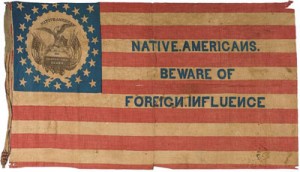 This has been a tough few weeks for Republicans. Donald Trump is emerging as a far more complex threat to the party’s viability than most people had initially recognized, your humble blogger included. There remains almost no possibility that the man can secure the nomination and he probably lacks the attention span to launch or sustain an independent bid. This offers no comfort as viability is not what makes him dangerous.


 GOPLifer