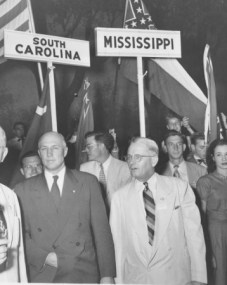
Strom Thurmond and his running mate Fielding Wright, nominees of the Dixiecrat Party in 1948
On Tuesday, the Party of Lincoln nominated for President a reality TV star with no government experience or policy platform who has been enthusiastically endorsed by the KKK and other white nationalist groups. Though an extreme outcome, this is not a departure. Republicans have been on this road for a long time. As this “Lifer” exits the party it’s worth taking a moment to reflect on the journey that led us to this miserable place.
Perhaps the best starting point is Truman’s 1948 executive order desegregating the military. That move sparked a third-party challenge from Democratic Senator Strom Thurmond, which would blossom over time into a shift among Southerners toward the GOP. A glance at Thurmond’s speech accepting the Dixiecrats’ nomination in Houston reveals a style and themes that persist today among the Tea Party.
The First Tea Party Speech
In 1964, Republican Presidential nominee Barry Goldwater pushed the GOP away from its traditional role as a proponent of Civil Rights legislation. Breaking from the rest of the party, Goldwater took a “principled” stand in opposition to the passage of the Civil Rights Acts on libertarian grounds. This was the beginning of a strange relationship between so-called libertarians and the counter-civil rights movement. Nixon in 1960 won a third of black votes. Goldwater earned 6%.
How Libertarianism Failed African Americans
The Tension Between Civil Rights and Limited Government
After Jim Crow was dismantled it took time for the counter-civil rights movement to find its feet. When they did, they would be standing under a new banner, cloaking their concerns behind new ‘culture war’ rhetoric.
Years later as the movement gained momentum analysts would point to the Supreme Court’s decision in Roe v Wade as the spark that launched the religious right. That simply isn’t the case. Protestant religious conservatives who would form the backbone of the religious right were largely disinterested in abortion in the years after Roe v Wade.
How Protestant Evangelicals Shifted Their Abortion Stance
Southern conservatives defeated by the Civil Rights movement found a way back to power not through abortion activism, but thanks to a very different issue. In 1978 the Carter Administration signaled their intention to use federal power to desegregate the religious schools set up to evade busing. It was private school desegregation that would inspire Jerry Falwell and Paul Weyrich to found The Moral Majority in 1979. Abortion, porn, school prayer, and other “culture” issues became the lever behind which the losers in the battle over Jim Crow could push their way back into power.
Southern Baptists and Southern Politics
These Southerners, having lost their influence in the Democratic Party, found an empty Republican infrastructure in the South ripe for takeover. Nixon often gets undeserved credit for a “southern strategy” that swung the South toward the GOP, but he accomplished almost nothing on the ground. It was the organized, passionate work of the Moral Majority and similar culture warriors that later succeeded in building a Republican infrastructure in the South.
Myths and Realities of the Southern Strategy
New Republican converts were markedly more conservative than the Republicans who occupied positions of authority in the party. As early as the first years of the Reagan Administration this sparked tensions, as Jerry Falwell expressed frustration over the way Reagan officials treated religious activists.
Throughout the Reagan and Bush I years, the culture warriors would remain an eccentric fringe of the GOP. Reagan tolerated them, but kept his distance. He pointedly refused to make in-person appearances at anti-abortion events. Religious Right activists and the Dixiecrats who rallied around them were treated as useful idiots. All the while though, they were building influence on the ground in formerly Democratic Southern states.
In 1989, Al Gore’s campaign chairman in Texas would switch to the GOP to run for Agriculture Commissioner. Rick Perry would ride this eccentric fringe to the longest Gubernatorial career in Texas history.
With the 1994 wave election, those political oddballs were swept into positions of real power all up and down the ballot.
The Stockman Effect
Across the 90’s reform Republicans like Jack Kemp found themselves battling the Jesse Helms and Pat Robertson wings of the party and steadily losing ground.
My Favorite Republican
As the party grew more conservative and white, Republicans in urban areas and the North began peeling away. Just five years after Rick Perry switched to the GOP, Republican Elizabeth Warren became a Democrat.
The late 80’s and early 90’s also saw the rise of right-wing media. Led initially by characters like Morton Downey, other figures like Ann Coulter and Rush Limbaugh pioneered a new form of political entertainment.
Ann Coulter is the Andy Kaufman of Politics
Fact free, obnoxious, and catering to their audiences’ cherished paranoia, they radicalized a slice of the white electorate frightened by their own perceived decline. With the arrival of Fox News, they would manufacture a media bubble that left America’s political right utterly dissociated from fact-based decision-making and insulated from the consequences of their intensifying extremism.
Why the Right Has Such Lousy Information
Blueprint for Republican Reform: Pundits
Running beneath these trends like water flowing underground was the decline of America’s social capital institutions. Their weakness, described in The Politics of Crazy, stripped the country of critical filters that once acted to mediate our political climate and squelch the influence of extremists.
The Politics of Crazy
With the election of George W. Bush, Kemp’s influence was entirely eclipsed. Religious kooks and racial dead-enders were ascendant. Whatever dissenting voices remained inside the GOP were either disciplined into compliance or dispatched to the outskirts. Figures like Bruce Bartlett and David Frum lost their jobs and were hounded out of the party. Political purges and a propaganda-driven media infrastructure meant no reasoned voices could be heard.
Rebuilding the GOP: Think Tanks
Unsurprisingly, the Second Bush Administration was an unmitigated catastrophe, starting with a disastrous war and culminating in a shattering economic collapse. John McCain who had challenged Bush in 2000 as a reformer, made a successful run for the 2008 nomination. Despite the difficulty of following the second George Bush, he might have won had he not been pressed into picking Sarah Palin as his running mate. Palin was a dimwitted amateur who weighed down the campaign with gaffes and erratic behavior.
McCain lost and faded from influence. Palin, erratic, incoherent, and telegenic, became the poster child for a new era of unchecked right-wing stupidity defined and promoted by the Tea Party. Rocked by the disasters of the Bush presidency and robbed of any credible leadership the GOP had no means to fend off an insurgency. An astro-turfing project sponsored originally by one of the Koch Brothers’ organizations, the Tea Party was a monster that immediately turned on its handlers.
Since the Moral Majority, Republicans had been animating voters with coded appeals to racism. The rise of the Tea Party replaced an era of coded racism with a shift toward open racism. As the movement grew more powerful and extreme, it pushed the GOP toward an unprecedented white nationalism.
Can the GOP Survive as a White Nationalist Party?
By the summer of 2012 it was clear that the GOP was consolidating around a shrinking white, Southern base. Former Republican strongholds in California, Illinois, Pennsylvania, and Connecticut had collapsed.
The Republican Dilemma on a Map
With Romney’s defeat came another, less noticed landmark. After the 2012 Elections, Republicans for the first time in our history held none of the mayor’s offices in the nation’s 10 largest cities.
Republicans Should Not Surrender the Cities
A Republican coalition once-centered around commerce, trade, and urban professionals was developing into an unrecognizable party of lower-income rural whites, mostly in the South.
How the GOP is Winning Among the Poor
This emerging party of the New South was borrowing a disturbing portion of its appeal from the Old South. As racist rhetoric became more overt during Obama’s second term, it became impossible to maintain even the most minimal outreach to minority communities.
Republican Minority Outreach Will Not be Easy
No one on either side of the aisle has shown any willingness yet to grapple with the tangible impact of pluralism on lower income white voters. That alienation, combined with a complete lack of a vision for the future, has fed a drift toward political extremism in middle America.
White Supremacy and the Shadow Welfare State
Results from the 2014 Election, touted as a Republican success story, demonstrated the party’s demographic collapse. All capacity to compete outside a hyper-conservative base in the South and rural west had disappeared. Inside the red states Republicans consolidated their hold. Everywhere else our capacity to remain relevant had ended. The White House was now permanently out of reach. The force that holds a party together in our system had vanished from Republican politics.
The Missing Story of the 2014 Election
Into this maelstrom marches a bigoted reality TV star with a lot of money. He swept through the 2016 primaries by rejecting the racist dog-whistle in favor of a racist bullhorn. No one could lay a glove on him, because Republicans are not allowed to talk about or acknowledge racism.
Why Republican Criticism of Trump Fails
This is now Donald Trump’s party. As such it is officially a party of white nationalists. His inevitable defeat in the fall won’t change the party’s orientation in the slightest. There is only one route back to relevance and that involves grappling with the party’s relationship to race. It will not be easy and frankly, it probably will not happen. For the first time more than 150 years one of our two parties may disappear from the national stage.
Whatever entity comes to occupy the space vacated by the modern GOP, it will have to find a successful response to America’s core racial dilemmas:
Middle Class Life in 1957
Race and the ‘Middle Class’
Sympathy for the (blue-eyed) Devil
Why I Live in a White Neighborhood
Reagan was able to assemble an unlikely coalition of commercial interests, Dixiecrats, and Northern blue collar voters on the strength of a single appeal – A radical new approach to fighting the Cold War. That’s the only interest that held these people together. When the Soviet Union collapsed, with it collapsed the logic beneath the Republican coalition. A quarter of a century later we have still not found a reason to exist in this new world. Our time appears to have run out.
Looking to the future, there is hope and there are challenges. The GOP as we know it is probably finished, but there are opportunities to rebuild from the wreckage.
America’s Parliamentary Future
Launching an Urban Republican Rebellion
Along with race, a new political movement will be asked to grapple with the demands of a changing economy and a shrinking world.
Beyond Jobs
With so many amazing improvements to our lives emerging from beyond the reach of government, it can be tempting to imagine that political dysfunction doesn’t matter. We shouldn’t be complacent.
A Warning From Flint
And in case Democrats are tempted to gloat, here’s a warning. The same cultural forces, described in The Politics of Crazy, that fed the demise of the GOP are nipping at your heels. Get ready for the rise of your own crazy politics.
Democratic Denial and the Politics of Crazy
Despite these frustrations, America today is more prosperous and powerful than it has ever been and our future remains bright.
A Golden Age
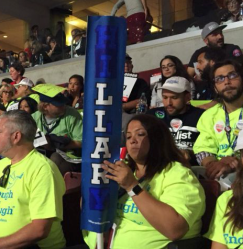
 “We’re fighting — not for one particular candidate or one campaign — but because each of us wants to be able to tell our kids and grandkids…that we did our best for their future, and for our country.”
 Republicans yesterday took our first big step toward Making America a Banana Republic Again by launching a national party convention made for daytime TV. There was only one achievement worth noting – we got through a whole day and no one has been assaulted.


 GOPLifer