Red State Divorce

For decades the higher divorce rates across the Bible Belt have been a puzzling phenomenon. Researchers used to assume that the problem related to poverty, but as the region has begun to close the income gap with the rest of the country that explanation has become less persuasive. Research at the University of Texas suggests conservative religion may be a direct factor.

From a summary in the Washington Post:

“Conservative Protestant community norms and the institutions they create seem to increase divorce risk,” researchers say in the study. For example, those who are struggling in their marriage may feel discouraged to find help in communities where marriage is idealized or marital failure is viewed as shameful, the researchers suggest.

“Generally, religion, religious belief and religious activities are thought to strengthen marriages,” said co-author Jennifer Glass a sociology professor at the University of Texas at Austin. “It appears that the cessation of education, early marriage and early parenthood, you’re set up for relationship conflict, financial stress and dissolution.”

It’s also worth noting that among religious groups, evangelical Christians generally have higher rates of divorce and Southern Baptists consistently have the highest rates. In “the family that prays together” someone may be quietly praying for a way out.

Here’s a link to the complete paper (as a pdf).

Tagged with: , ,
Posted in Religion

The Best Political Blogs in Houston

The rowdy little community we’ve built here around the GOPLifer blog has been a rewarding experience for me and hopefully you’re enjoying it too. There is a place for thoughtful, analytic writing and that’s what I try to do with this blog.

Other writers however are using blogs, Twitter, Facebook, and other integrated social media to help voters stay informed about the local races that affect their readers’ lives. They move people to action, building a platform for effective political organization. All political differences aside, I deeply admire what they are doing. As the primaries approach, these guys and others like them deserve a close read.

Houstonians David Jennings and Charles Kuffner operate the best political blogs I have seen anywhere. They deliver insightful information on down ballot races, the ones that determine the shape of our political map, while covering other local matters that are generally overlooked by major media.

What I do at the GOPLifer blog requires some thought and occasional research. What they do demands constant in-person engagement. They face the people they write about. They are accountable for their positions and opinions on terms that I and other “opinion” bloggers seldom face.

I envy the work they are doing and I regret not being able (okay, willing) to invest the kind of intense personal capital in public service that they are demonstrating. I go to my monthly party meetings. I walk the neighborhood handing out fliers at election time. But I’m not spending free time attending clubs, going to fundraisers, and sinking into the details of local political life they way they do.

Regardless of your politics, if you live in Houston David & Charles’ posts should be a must-read. With so much of the critical infrastructure of our political system weakening, these guys offer a model for how things might all work out for the better.

Tagged with: , , ,
Posted in Uncategorized

Greta van Sustern attacks Erick Erickson over Wendy Davis remarks

It is rude to say I told you so. Therefore I won’t do that.

The nominees for the Texas Governor’s race have not even been selected yet, but Democratic State Senator Wendy Davis is already creating a rhetorical pileup in the far right lane. Even in the Fox News universe, there are women who are uncomfortable with the way Davis is being manhandled by “conservative” talkers.

Greta Van Sustern lashed out at Red State’s Erick Erickson today, calling him a “jerk” over his Wendy Davis tweets. Her comments are on her Fox News blog here. Erickson is a first class jerk, but that’s basically his profession. What’s awkward is a Fox News commentator pointing out crude, bigoted behavior by a professional far right blowhard.

Like I said, Davis creates some difficult problems for the far right. You can alienate virtually every black person in America and still win a lot of state and local elections. Insulting women is a considerably more tenuous election tactic. Unfortunately, there is no force remaining in the GOP that can stop this nightmare from unfolding.

Davis is irresistible bigot-bait. It will not take long for the nasty rhetoric to overwhelm whatever messaging either side tries to develop. That’s not good news for a Republican frontrunner.

Greg Abbott, the presumed Republican nominee, could try to diffuse the rhetoric but it would cost him the support of his base and run counter to all of his instincts. He is unlikely to ever recognize the problem in the first place. You don’t become the leader in the GOP race for Texas Governor by virtue of your keen sensitivity to women’s concerns.

For twenty years the party has shouted down anyone who tried to encourage basic civility or understanding on culture, gender, or racial issues. Whoever tells Erick Erickson to stop insulting women can expect to earn their RiNO tag and be sent into exile for the sin of pushing “political correctness.”  Without any adults left in the room, this is going to get much uglier.

Tagged with: , ,
Posted in Texas

Does technology cause unemployment?

The Washington Post published a piece over the weekend on the complex connection between technology and unemployment. It lays out the ways that technology improves working conditions and the long, disruptive lags that sometimes occur in employment. The sum of it:

Even with the right policies, these social changes can take time to work out. So while new inventions can come into use relatively quickly, it may take decades of slow learning and occupational changes before the benefits of major new technologies are shared by large numbers of ordinary workers.

Technology does not breed unemployment. It breeds disruption. Those who can adapt generally thrive as technological advances accelerate.

Keynes theorized that technology would bring a different kind of “unemployment.” He speculated that enhanced productivity could produce a 15-hour standard work week. Keynes didn’t bank on the additional opportunities for consumption produced by all the wealth of the industrial age. Those additional consumption options may be driving up to keep work hours high, but for how long?

From Marketplace, Is the 15-hour work week closer than we think?

Posted in Uncategorized

It’s cold, so there is no global warming

For those of us who are particularly proud of the power of representative government and free markets, climate change is a particularly painful issue to discuss. The challenge of human-influenced climate change plays on practically every weakness of our favorite political and economic system.

Climate change is generated disproportionately by the choices of the wealthy and politically influential while it’s impact falls disproportionately on the poor and disenfranchised. It develops on a pace too slow for our feedback mechanisms to detect and respond to. Because of its long, slow impact cycle and its critical importance, it manages to be both horrifying and boring at the same time.

Climate change is a global phenomenon, but human culture has only evolved mechanisms to cope effectively with social behaviors that occur at the nation-state level. Even within a nation-state, we are seldom very effective at coping with problems that occur above the tribal level.

With good reason, we place much value on the power of science to interpret and predict reality, but our scientific capabilities remain very weak in interpreting complex matrix-phenomenon. Climate is a problem, like economics, that challenges our capacity to model, interpret, predict, and remedy effectively because of the massive scope of potential inputs, including human inputs. With good justification we may trust what our best scientific minds tell us about the causes of climate change, but they still cannot tell us with much specificity what we can do about it or whether anything we try might work.

Last year continued our streak of accelerating global warming. However, it’s cold in Chicago. It snowed this week in Texas. So now we get to listen to the clever shaved apes on Fox News tell us that global warming doesn’t exist. Freedom isn’t free.

Excellent cartoon from the guy who produces xkcd:

xkcd

Tip for surviving the cold. Fill balloons with water and food coloring. Set them outside at none-degrees and they freeze solid in about two hours. Peel off the rubber and embed them in the walls of your snow fort. Make absolutely sure the kids understand that these are NOT snowballs. You don’t want to be that dad.

They look really cool when the light hits them. Now I’m the Martha Stewart of political blogging. You’re welcome

Tagged with:
Posted in Climate Change

I agree with Rick Perry!

When this happens you have to jump on it. I agree with Rick Perry – about the need to move away from blanket criminalization of marijuana use.

Perry’s statements were measured and nuanced, another anomaly. He did not endorse legalization or regulation. He merely expressed an openness to explore possibilities in drug cases aside from criminal prosecution. It would have been good to see him go “full-Libertarian” and advocate legalization, (here’s what they could look like), but I’ll take what I can get.

Limited though it is, his statement is a remarkable departure that contributes to a growing momentum away from strict prohibition. Hopefully the momentum will continue to build.

Posted in Uncategorized

Wendy Davis is a Republican Nightmare

sneakersTexas is a solidly Republican State that hasn’t elected a Democrat to statewide office since 1994. With Gov. Rick Perry stepping down to devote some personal time to remembering what that third thing was, the way is clear for his heir apparent, Attorney General Greg Abbott, to waltz into office.

No prominent Democrats chose to mount a campaign against him because there are no prominent Democrats in Texas. So the mantle of “default candidate” is falling on Democratic State Sen. Wendy Davis.

Davis is developing into a problem. She started with little name recognition, a massive fundraising disadvantage, a thin resume and no experience in a state-wide race. The fact that she’s gathering national attention and closing in on Abbott in the money race is not what’s really scary about her campaign.

Why is Wendy Davis such a dangerous challenge? Texas Republicans have learned from hard experience that they should never, under any circumstances, express what they think about blacks and Mexicans. Women, however, are still fair game and Republicans are Akin’ to share what they think about Davis’ personal life.

The Dallas Morning News published a bio piece that stirred some dark waters. Davis was raised in Fort Worth by a divorced mother with virtually no child support. She got pregnant as a teenager and briefly married the father. She left him at 19 and moved back into her mother’s trailer. Her divorce wasn’t final until she was 21, which matters for some reason. A few years later she married a well-heeled lawyer who held a seat on the city council. So far, it’s a pretty standard DFW socialite career-path.

Then it takes a turn. She attended TCU and graduated at the top of her class, earning a place at Harvard Law School. With her children in the care of her husband, she graduated cum laude from Harvard. She returned to Texas where she established a successful law career and became a business owner. She left her husband after they paid off the last of her student loans (in strictly legal terms “they,” not “he” paid those loans). Her second ex-husband kept custody of the kids while she pursued her career and her political ambitions.

Across most of the rest of America and the non-Muslim world, this resume would rate somewhere between mildly inspiring and boring. Single mother goes to college, has a career, blah, blah, blah good for her. Texas, however, is not the rest of America. It’s barely America at all. In Texas, Wendy Davis is a symbol of all that’s evil and terrifying.

The Dallas Morning News’ bio piece sparked a storm of comment from the usual corners. Any woman who would leave her children in their care of their father to pursue her own personal ambitions is a whore, unless she’s Sarah Palin. “Conservatives” lined up to express their moral superiority and some of the nastiest comments came from other women. A fellow Houston Chronicle blogger led the righteous charge with these gems:


divorce

whore

For those who aren’t familiar with the place, it is socially acceptable in Texas to say absolutely anything, no matter how ugly or bigoted as long as you preface it with “sweetheart.” That makes it cute. And women in Texas are supposed to be cute. They are supposed to smile, and do what their husbands tell them, and keep themselves pretty, and take care of the children, and tame their tongues.

Good, wholesome Texas women do not leave a husband behind in Fort Worth to go gallivanting off to Harvard. They do not let fathers raise children while they pursue a career. They most definitely do not stand up to ignorant, sexist bullies in the Texas Legislature, thwarting plans to shove righteousness into the dark unwilling places that resist it.

And if they do, you can be sure that “good” Texas women will be on the front line of the effort to hold their uppity sisters down while society enforces proper social order. Wendy Davis is not a good girl. Righteous Texas women do not approve.

Sounds like a feel-good story so far, right? What could possibly go wrong?

Many Americans, especially those far from the South and insulated from social media, still look to the Republican Party as the bastion of traditional commercial values – the strongest political force defending free enterprise, trade, and prosperity. Whoever it is out there who has missed the party’s ugly takeover by our own homegrown Taliban may see their foggy delusions burned away in the light of this otherwise inconsequential state-level contest.

Leaving behind for a moment all questions of morality or decency, this side of the GOP’s madness is unquestionably the most politically disastrous. The party may have alienated African-Americans and sold off much of its moral credibility in the process, but there are only so many black voters out there.

By contrast, there are lots of women. Many, many women. Many of them, more than you probably want to imagine, wish they had the chutzpah to do what Wendy Davis did.They do not always vote in the manner that their husbands and fathers request.

Wendy Davis is unlikely to win this election. She was always unlikely to win this election. So far her chief qualification for office is a filibuster she conducted once. By that criteria, Ted Cruz is ready for the White House.

Meanwhile Greg Abbott has served in an executive office for nearly a decade. Sure, he is utterly beholden to a cadre of religious kooks, but he has also demonstrated fundamental competence in a high-level state-wide political office over a long period of time. That’s really all the campaign story this race ever needed. The ugly references to Davis’ biography are not going to help.

Thanks to this race, young women all across Texas and the country who will one day be successful business owners, entrepreneurs, and perhaps also mothers and wives are going to hear what the GOP thinks of them. The way things are headed they may remember this race for the rest of their lives and vote accordingly.

Sen. Wendy Davis is a walking invitation to Texas Republicans to put their worst instincts on display. Anyone with any investment in the Republican Party’s broader goals, the ones that have nothing to do with putting people of certain races or genders in their divinely assigned place, please shut the hell up about Wendy’s Davis’ private life.

Pardon my manners. Please shut the hell up, sweetheart.  🙂

Tagged with: , , , ,
Posted in Religious Right, Republican Party, Texas

The Cruel Myth of the ‘Gateway Job’

burgerFor conservatives, one of the central arguments against a minimum income or even a minimum wage is the notion that employment is a value in and of itself. Taking a low-paying job, no matter how menial or “dead-end” is supposed to be an exercise in character that builds self-worth and places a person on the ladder toward upward mobility. Therefore, anything that prevents someone from working is contributing to sloth and moral decay.

Perhaps it was true once. There really was a time in America when an unskilled, menial job could be a gateway to a rewarding career. One of the reasons CEO’s now earn 100’s of times more than their entry-level employees is that menial jobs have become a gateway to nowhere. In a knowledge economy, the on-ramp to post-middle class affluence is located in a place fewer and fewer people can reach.

Research is starting to demonstrate the nature of the problem. People who take low-wage, menial labor in service industries or fast food at any point in their careers tend to have depressed incomes throughout their lifetimes. If you ever work at Wendy’s, you have roughly a 5% chance of ever earning $70,000 a year. Working at Ford, by contrast, suggests a 50% chance of eventually earning a median income. Lousy jobs are a gateway to lousy jobs.

This matters because the myth of the gateway job is blocking policy choices that might open up greater access to opportunity and enable America to more productively develop our vast pool of human potential. Labor is not what it used to be. In a knowledge economy, labor is not strongly distinguished from capital. It can be developed, shaped, enhanced and turned into more than a zero-sum resource. Labor, paired with a great deal of personal investment, can actually be used to accumulate enough capital to one day live on. This requires time, determination and opportunity.

The logic behind this research outcome is relentless. Dropping into menial labor operates much like dropping out of school, limiting the potential to develop labor as capital. Accessing and remaining on the ladder toward higher earning careers requires the ability to support a long cycle of education and the economic freedom to make choices about what kinds of work to engage in.

Because we believe that work is a value in and of itself, we push people into the labor force too early, depriving them of the opportunity to learn how to do something that might reward them and enrich the economy as they proceed through life. We close off opportunities to convert labor to capital.

We end up with too many people trying (and failing) to go to college because it is the only path for which we offer any subsidies. Non-technical college graduates who developed critical skills like effective communication and a spectacular capacity to learn, end up tracked too soon into work that offers little chance to put their skills to work.

Most of them eventually find their way because the skills and networks developed in the college environment give them most of what they need to succeed in a knowledge economy. They will tend to pick up additional skills on their own as needed, because ultimately that’s what a degree in Philosophy or Medieval English Poetry delivers. College graduates earn more than high school graduates, even if they spent four years studying Feminist Literary Studies, because they developed the skills that open up a lifetime of ceaseless learning and adaptation.

This dynamic is far more damaging for those who might want to pursue careers in fields that require skilled industrial labor. In fact, it is in blue-collar jobs where the dynamic described in the research by Bright.com is brought to bear most cruelly.

No one walks off the grill at McDonalds to take their new as an underwater welder or aircraft mechanic. Developing the ability to compete for those kinds of jobs is time-consuming and expensive. If you do not have a family that can support you while you learn and some time or exposure to discover that these careers even exist, these options are out of reach.

Employers cannot afford to pay a living wage while training a vast pool of potential recruits in key skills. Potential recruits with an interest in higher-skilled jobs cannot afford to prepare for those jobs if it requires them to forgo earning a living while taking out student loans for two or three years.

Someone who takes that job at Home Depot or Wendy’s in order to support themselves is limiting their range of options for developing a more productive career. Front-line menial labor is supposed to create opportunities to climb the economic ladder, but they generally do not. More often than not, these jobs are a gateway to a lifetime of economic underachievement.

Some might look back on their own experiences to suggest the “lessons” learned from an early job became the key to later success. There may be a few elements of those experiences missing from the analysis.

Almost all of us beyond a certain age spent years doing menial work part-time, as an adjunct to something more important we were doing. Very few us, if we ever achieved much higher salaries in very successful careers, ever had to perform that work in order to survive or feed a family. If we did, whatever lessons we gained came at the cost of lost opportunities for higher paying careers that we may not even be aware of.

There’s a lot to learn from doing a menial job. Many of us can look back on poorly paid work that taught us crucial values. Or we could look back on years training for an academic or athletic competition that did exactly the same thing without sucking time and energy out of a career path. We may press our kids to experience menial labor to help develop grit and a greater awareness of the world, but we will work hard to keep those experiences from becoming necessary for their survival.

Affluent white kids on the construction site or behind the store counter are usually tourists. They are doing a blue-collar internship.

A shift away from the traditional safety net toward a form of minimum income offers a lot of benefits. One of the strongest criticisms of such a move, the fact that it would undermine the need to take menial work to survive, is actually one of its strengths. Pushing people too soon into menial work is as economically valuable as pushing twelve year olds into a coal mine. A shift toward a minimum income would not only streamline our government, it would improve economic opportunity in almost exactly the same way that a universal public education once did.

Our attachment to the supposedly ennobling value of menial labor is dysfunctional and frankly condescending. Many of the same voices who crow about the value of work go to great lengths to prevent their kids from falling into that trap. We should not let a myth about gateway jobs prevent us from opening up broader economic opportunity and better developing American talent in a brutally competitive global market.

Tagged with: , , ,
Posted in Economics, Ownership Society

A conservative approach to universal health insurance

Voices are starting to emerge on the right promoting a response to the Democrat’s plan that consists of something more material than repeal and replace. From the Washington Examiner:

The good news is that we don’t have to theorize about unproven solutions to our health care problems. Two wealthy countries have health care systems that, if we could substitute them for our own, would exceed the wildest dreams of American conservative reformers. Switzerland and Singapore achieve universal coverage while spending a fraction of what we spend, and they ensure broad access to high-quality doctors and the latest technology.

The plan is worth a look. There are issues with the approach he is adopting, starting with the fact that Singapore’s health care system is much closer single-payer than conservatives seem ready to recognize. But this represents progress. If conservatives ever emerge from the mire of conspiracy and delusion and start debating actual alternatives to Obamacare, we might see good things happen.

Posted in Uncategorized

The Tension between Civil Rights and Limited Government

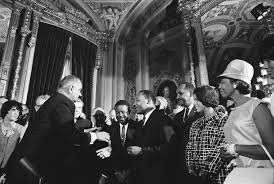
kingWhen Congress passed the Johnson-Era Civil Rights Acts, America began an unprecedented expansion of personal liberty that reached far beyond the black community. For the first time ever, the meritocratic ideals that have always rested at the foundation of the American political experiment were backed by forceful Federal intervention.

The effects were rapid and dramatic. In a single generation, Southern states nearly caught up with the rest of the country in terms of literacy, average incomes, even life expectancy. A solid African-American middle class emerged along with vast new political power. Frustrating gaps still exist, but the expansion of basic personal liberty for African-Americans and other formerly marginalized communities has been impressive.

This presents a conundrum for libertarians. The Civil Rights Acts expanded personal freedom by expanding the role of government in our private lives. There may be no major Federal legislation in history that stretched the fingers of the central government more deeply into realm of personal decision-making, or even personal opinion, than the Civil Rights Acts. The use of intrusive Federal power to successfully expand personal liberty puts the whole foundation of modern libertarianism in doubt.

The Acts regulated how personal opinions could be expressed in almost any economic terms. Freedom of association, as it had been previously interpreted was deeply curtailed. State and local government rights were severely limited. Civil Rights legislation was even interpreted to define, in some circumstances, how religious opinions could be expressed.

For libertarians, freedom is almost always defined by the extent to which individuals are unencumbered by the coercive power of government. By that absurdly narrow definition the Civil Rights Acts were a dramatic reduction in freedom. The libertarian obsession with government leaves them blind to other, more powerful forces that destroy personal liberty.

By libertarian standards, Southern states in the pre-Civil Rights Era were a paradise of personal liberty. There was virtually no government to speak of. Personal choices were almost entirely unburdened by intervention from an organized central authority.

Want to dig a coal mine? Go for it. Want to dump industrial waste in the river? What you do with your property is your own business. Want to lynch a black teenager for whistling at a white girl? No one is going to stop you.

In the libertarian paradise of the Old South, no central authority interfered with a man’s basic freedoms. As a result, the strong, the popular, the well-organized, and the wealthy were able to run roughshod over those with less power.

Enforcement and maintenance of white supremacy did not come from the state. Governments in the South were too weak to enforce anything. Jim Crow was conceived, implemented, and held in place by informal, voluntary, popular arrangements as one would expect in a libertarian community.

A dense, organic network of paramilitary and terrorist groups performed the day to day work of maintaining white supremacy. The KKK is by far the best known of these organizations, but much of the dirty work of maintaining segregation was carried out by local, less formal groups.

Sitting above the paramilitaries were more dignified, “moderate” local assemblies, like the White Citizens’ Councils of the late Jim Crow period. The secrecy of the paramilitaries meant that a man could sit on a more respected assembly by day, urging the peaceful resolution of differences while coordinating or even participating in more violent groups.

Very little of the structure of Jim Crow was ever reduced to law. The laws were only necessary to limit the ability of high-minded law enforcement from attempting to restrain “public will.” Jim Crow was almost entirely informal, cultural, and driven by extra-legal enforcement. Jim Crow is what happens when libertarians get what they want.

When Dr. Martin Luther King, Jr. rallied African-Americans to resist Jim Crow, they faced some resistance from local law enforcement, but it wasn’t a sheriff who murdered Emmett Till or Medgar Evers. No civil authority bombed churches or lynched Civil Rights workers. When local law enforcement feebly tried to enforce the law, attempting to prosecute those who harassed or even murdered civil rights workers, they were thwarted by a liberty-loving community bent on preserving their own freedom to discriminate.

For Republicans in our era looking to restrain growing Federal power, it is critical that we demonstrate an understanding of the risks. Smaller government could potentially make our society wealthier, freer, and better able to compete in the world, but only if we know what to cut and what to preserve.

Successful streamlining of our Federal government must preserve its core functions or it risks nightmares. No one will trust our efforts unless we have the sense to acknowledge this fact. The experience of the Jim Crow South, or the Caribbean, or Mexico, or much of the Third World shows that weak government is not a value unto itself.

Smaller government is not about indiscriminate cuts. Smaller government means developing smarter ways to operate. We seek to streamline government for the same reason that companies seek to streamline their operations. Being able to perform core tasks while consuming fewer resources improves liberty and wealth. Cutting government blindly merely releases demons to do their work.

We will never successfully restrain the relentless expansion of Federal power unless we understand the valid reasons it exists. On Martin Luther King’s birthday, it would be wise to acknowledge the permanent tension between small government and personal liberty. We must learn to intelligently protect the latter if we will ever achieve the former.

Tagged with: , , , ,
Posted in Civil Rights, Ownership Society
Goodreads

Enter your email address to subscribe to this blog and receive notifications of new posts by email.

Join 448 other subscribers