The World is Getting Better…Much Better

shanghai

What Mao’s China looks like now

Our attention is nearly always focused on what’s wrong with the world for good reason. Our problems, not our achievements, demand our most immediate attention.

It pays sometimes to step back and look at what’s working. Things do get better. Taking time to appreciate the progress we experience helps us maintain focus and hope. For human beings, the past twenty five years have marked some stunning victories.

Globally, the number of people living in extreme poverty has dropped by half in only a generation.

Out of the collapse of Communism has emerged a massive global middle class. By 2030, almost two thirds of the world’s population will have moved into the middle class.

For all the conflict and instability we see there is not a single active war between nation-states on the planet. The age of American global military dominance has marked a historic low in military violence. The world is more peaceful than it has ever been.

In the US, most aspects of life have been improving at rates no one could have anticipated in 1990. Teen pregnancy, abortion, cocaine use, murder, crime, homelessness, and divorce are all in steep, long-term declines that have gone largely unnoticed.

The cost of almost everything is in steep, long term decline with one very important and very positive exception. Human expertise is more valuable than it has ever been.

The number of Americans getting a college education is not only climbing, but that climb is accelerating. Why does college cost so much? One reason might be the good news listed immediately previous. Another might be the next bit of good news.

High school graduation rates are the highest they have ever been in the US, and heading toward 90%. For all the hand-wringing about US schools, we are educating more of our people than ever by a very wide margin.

When technology, health care improvements, crime, and the declining cost of nearly everything is taken into account, even America’s least fortunate are radically richer, freer, and safer than they were just a generation ago.

Population growth has stabilized everywhere in the developed world, including China. Population growth rates are in steep decline globally. We are on track to see global population begin to decline in absolute numbers starting in less than 40 years.

Thanks to a gradually stabilizing population and technological advances, America has probably already reached the historic peak of our demand for farmland.

The Chicago River, which no so long ago was a long sewer, now hosts kayak tours through downtown. Since the passage of the Nixon-era environmental protection acts, our nation’s air and water have become remarkably clean, even in the middle of big cities.

One of the hottest neighborhoods in New York City is Harlem. Brooklyn is trendy.

Twenty years ago Dr. Dre was producing a particularly angry brand of rap music. Now he is a billionaire tech entrepreneur. Michael Jordan, Magic Johnson, 50 Cent and a very long, mostly obscure list of other former “stars” have made more money in business than they did in their entertainment careers. African-Americans from all kinds of backgrounds are making the transition from “rich” to “wealthy.”

Green energy is no longer a dream. Dark, rainy Germany is on track to generate a third of power from solar energy alone by 2020. The price of solar energy has dropped by half in just five years. In sunny parts of Asia solar power is already cheaper than gas. It is expected to be cheaper than fossil fuels globally within five years.

The most exciting new sports car in America is powered by electricity. It isn’t built in Detroit or Mexico or Brazil, but in suburban San Francisco.

Thanks to a boom in energy production in the US, Mexico and Canada, America is now effectively energy independent. We may be capable of meeting all of our energy demand within our own borders within twenty years. Our natural gas imports alone have fallen by almost 70% in less than a decade.

The US is the only global military power on the planet. Russia still maintains one aircraft carrier. It has to be accompanied on missions by a fleet of tugboats. No other military force, apart from our European allies, is even close to being able to operate beyond their borders. We possess the only offensively-capable “defense” force on Earth.

The United States is the wealthiest nation on the planet and the margin isn’t close. Our economy produced just short of $16tr last year. The second-ranked country, China, came in at less than $10tr, but that number appears to be radically distorted. China’s population is more than four times as large as the US. Its GDP per capita ranks 83rd, roughly the same as Peru.

But aren’t we bankrupt? Hardly. Our debt is growing, but that was not always the case and need not be. Just over a decade ago we were debating what to do with a massive projected surplus. George W. Bush took office with a budget plan inherited from his predecessor which was projected to pay off the national debt entirely by 2009. Eight years later, Obama inherited a budget that created the largest single-year deficit in American history.

We could get back in black with a modest tax increase, a few changes in defense and safety-net spending, and a fraction of a point increase in economic growth. We’ve had a formal, bi-partisan plan on the table to do this since 2010. We haven’t done it because the people who claim to care the most about our debt don’t actually care about balancing a budget.

Our debt is having zero economic impact in the present and no impact on the economy in the foreseeable future. It is purely a political problem.

We live in an extraordinary time of peace, freedom, and wealth and we are almost entirely blind to it. Conditions for Americans and the rest of the world could be, and probably will be, even better in the future. How much better things will get and for how many people, will depend to a very large extent on decisions that Americans make in coming years.

Progress means graduating up to better and better problems. We will cope with those new problems more capably if we properly appreciate our accomplishments.

Tagged with: , , ,
Posted in Economics

Who really controls our politics?

Who is really running America? The Koch Brothers? George Soros? The Illuminati? The Lizard People?

Researchers studying the question have found the answer – American politics is dominated by “the 1%.” Trouble is, this is not the 1% you are expecting.

The National Journal wrote up the polling they conducted with Allstate and the results are pretty stark. A very tiny minority of people with too much time on their hands compose the overwhelming bulk of political initiative in the US.

Forty-one percent of Americans do not participate very often in any of 10 bedrock activities of American civic and political life, according to the latest Allstate/National Journal Heartland Monitor survey.

At the other end of the spectrum, just 1 percent of Americans engage very often in eight or more of the activities—from attending town hall meetings to volunteering in the community to giving money to a cause or political candidate.

The decline of our social capital institutions has radically weakened the complex network of relationships and organizations that used to filter much of the crazy out of our politics. Now a narrow, odd, and consistently unrepresentative sample of Americans has a radically disproportionate influence on politics. You may have heard this before:

Time, especially the time of capable individuals has become the most valuable commodity in our economy and some are blessed with more of it than others.  We recognize the growing influence of money because it is easy to understand how money affects politics.  We have attempted to construct an entire legal and political infrastructure to document the political activities of the wealthy and keep them in check.  We are ignoring the influence of the other elite – those who have precious time to spare and the will to pour it into grassroots politics.

We remain defenseless against the surging power of the other one percent.


Tagged with:
Posted in Political Theory

The National Climate Assessment

climateThe Federal government released its latest multi-agency report on climate change this week. The report is more bleak than past versions. Less and less of the climate change debate is focused on future projections as we start to experience the changing climate in ways that are increasingly apparent in the present. A few highlights:

Arctic Sea Ice

“Sea ice in the Arctic has decreased dramatically since the satellite record began in 1978. Minimum Arctic sea ice extent (which occurs in early to mid-September) has decreased by more than 40%. This decline is unprecedented in the historical record, and the reduction of ice volume and thickness is even greater. Ice thickness decreased by more than 50% from 1958-1976 to 2003-2008. The percentage of the March ice cover made up of thicker ice (ice that has survived a summer melt season) decreased from 75% in the mid-1980s to 45% in 2011.”

Awesome graphic: http://nca2014.globalchange.gov/highlights/report-findings/our-changing-climate#graphic-20966

Changing frost zones

“The lengthening of the frost-free season has been somewhat greater in the western U.S. than the eastern U.S., increasing by 2 to 3 weeks in the Northwest and Southwest, 1 to 2 weeks in the Midwest, Great Plains, and Northeast, and slightly less than 1 week in the Southeast. These differences mirror the overall trend of more warming in the north and west and less warming in the Southeast.”

Carbon Emissions are the driver for warming climate

“The conclusion that human influences are the primary driver of recent climate change is based on multiple lines of independent evidence. The first line of evidence is our fundamental understanding of how certain gases trap heat, how the climate system responds to increases in these gases, and how other human and natural factors influence climate. The second line of evidence is from reconstructions of past climates using evidence such as tree rings, ice cores, and corals. These show that global surface temperatures over the last several decades are clearly unusual, with the last decade (2000-2009) warmer than any time in at least the last 1,300 years and perhaps much longer.

“The third line of evidence comes from using climate models to simulate the climate of the past century, separating the human and natural factors that influence climate. When the human factors are removed, these models show that solar and volcanic activity would have tended to slightly cool the earth, and other natural variations are too small to explain the amount of warming. Only when the human influences are included do the models reproduce the warming observed over the past 50 years.”

Yes, it still snows sometimes…

“Winter storms have increased in frequency and intensity since the 1950s, and their tracks have shifted northward over the United States., Other trends in severe storms, including the intensity and frequency of tornadoes, hail, and damaging thunderstorm winds, are uncertain and are being studied intensively. There has been a sizable upward trend in the number of storms causing large financial and other losses.”

Sea level rise

“Global sea level has risen about 8 inches since reliable record keeping began in 1880. It is projected to rise another 1 to 4 feet by 2100. The oceans are absorbing over 90% of the increased atmospheric heat associated with emissions from human activity. Like mercury in a thermometer, water expands as it warms up (this is referred to as “thermal expansion”) causing sea levels to rise. Melting of glaciers and ice sheets is also contributing to sea level rise at increasing rates.”


As the evidence of climate change becomes more immediate and undeniable and the denial more blindly obstinate, it’s worth remembering an entertaining irony. The most palatable, just, and affordable strategy for coping with the problem of climate change comes, as is so often the case, from a Libertarian economist. Ronald Coase was part of the now-legendary core of University of Chicago economists who helped bring Libertarian theory into mainstream public policy. Coase, along with his “Chicago School” colleague Milton Friedman, helped design pollution markets as an alternative to regulation.

Of course, what passed for Libertarianism a generation ago is a bit too thinky for a movement that’s been taken over by Neo-Confederates. Nevertheless, Libertarians deserve credit for cap and trade. It remains the best solution we have.

Tagged with: , , ,
Posted in Climate Change

Obamacare and Waterloo revisited

As I’ve written before, our method of financing health care creates serious, unnecessary obstacles to entrepreneurship and innovation. In the name of avoiding “Socialism” we have created enormous obstacles to Capitalism with serious consequences for those trapped in our dying middle class.

The way we finance medical care is probably the worst obstacle we face to developing a real ownership culture. If Republicans are serious about making capital ownership and entrepreneurship available to middle-income Americans then we have to find ways to decouple insurance from employment and make it affordable on an individual basis.

For all the problems with the ACA, and they are legion, the Act is proving to be our first solid step in that direction. For people who live in states that embraced the law and established exchanges, the ranks of the uninsured are declining significantly and we are starting to see the first signs of what that means for commerce. From NPR:

Last year, Murray says, her husband — a freelance worker in the information technology field — was diagnosed with chronic spinal arthritis. He needed good health insurance, which he received through Murray’s job as a social worker in Chicago for a dialysis company. But Murray didn’t like her job.

Murray and her husband are both 31, with a 20-month-old daughter and a second child on the way. Before the Affordable Care Act, they couldn’t get insurance on the individual market because of his .

But under the federal health law, they now qualify for a subsidized policy that will cost $535 a month for the whole family. It’s not cheap, she says, but the coverage allowed her to quit her job and launch an online business to help other young women take care of sick loved ones.

This is not an isolated case. The problem is often called “entrepreneur lock.” Talented, ambitious people with the will, initiative, and even the capital to start businesses find themselves trapped. Launching a business is supposed to be risky, but it’s not supposed to cost you your life. The structure of our health care system, pre-ACA meant that health care might be the single largest cost of starting a business. Worse, the lack of basic legal protections meant that family members who were already ill might be left with no practical access to care whatsoever.

Republicans are supposed to be the party of commerce, but the fight over health care displays how far we have traveled from that tradition. If the US adopted some form of universal health insurance, just like every other settled nation on Earth, the biggest beneficiary in pure dollar terms would be the business community.

U.S. businesses spend a whopping $500bn a year on medical care. In America, every business must become an expert at health finance in addition to whatever it is they do for a living. That is a particular burden on the most fragile and critical segment of our business ecosystem – small business.

Republicans are also supposed to the party of individual choices. What choices are we making available with policy decisions that rob people of their savings, stymie their initiative, and threaten them with a fate far worse than bankruptcy when they pursue the American Dream? There may be no single issue that better displays the extent to which the Republican Party has lost its moral core than health care.

While failing to muster any credible alternative, because that’s hard, the party has fought the law with lie after lie after lie after lie. From death panels to RFID chips to the incredibly cynical distortion that people are losing access to health insurance, there seems to be no conscience to stem flow of deception. For a party that claims to care so much about morality, the “debate” over health care is a horrifying hypocrisy.

The ACA is a bureaucratic nightmare. It works, but the cost in terms of the size, influence, and reach of the Federal government is enormous and utterly unsustainable over time. That said, “repeal” is a childish cop-out. It is never going to happen because the public will never tolerate it. Repeal and replace sounds nice, but how are Republicans going to assemble a replacement that works better?

Health care is a dazzlingly complex subject with enormous impacts to each and every voter. The kind of people who are still chasing the ghosts of Benghazi can never muster the hard-nosed pragmatism required to tackle complex, difficult problems that do not yield to ideology. Jesus is not going to fix our health care system and Republicans have little interest anymore in matters that can’t be resolved with a prayer meeting or a dishonest Facebook post.

Health care is an issue that desperately needs the attention of the Republican Party, the old one that used to feature grown-ups. There are alternatives available that would shrink the Federal government, increase the ability of states to act as innovators, and cover everyone, but no option fits the childish demands of a party that insists that every problem can be solved by doing less about it. While the GOP indulges its fantasies, we drift toward an increasingly inevitable alternative solution to the ACA, single-payer, that will take us in the opposite direction.

Sen. Jim DeMint once predicted that the ACA would be Obama’s “Waterloo.” Now he’s out of Congress, Obama has been re-elected, and the ACA continues to roll along unimpeded. When the story is finally written, whose Waterloo will this be?

Tagged with: , , , , ,
Posted in Health Care

Could Tony Bourdain Rescue CNN?

There was good reason to be skeptical when Tony Bourdain made the decision to leave the comfy niche of the Travel Channel to do a new show for CNN titled Parts Unknown. Could punk travel survive in the stuffy atmosphere of a dying 24-hour news station, or would Bourdain lose his old audience while pissing off a new one?

As the third season gets rolling this is looking like a match made in heaven. Instead of wondering whether CNN will ruin Tony Bourdain, we may discover whether Bourdain can rescue a dinosaur.

Tony Bourdain is a relentlessly honest voice in a travel-show genre drenched with gee-whiz bullshit. At the Travel Channel he produced some of the best television anyone has delivered since the early episodes of the Simpsons. However, the attitude that made No Reservations an Emmy-winning hit on a three-digit cable channel is not exactly a hallmark of CNN. There’s not a lot of candor in cable news.

The network has so far managed to tolerate Bourdain’s style, letting him continue to do what he does best without trying to dumb him down or file away the rough edges. With access to CNN’s superior infrastructure for operating in difficult environments, Bourdain has bloomed.

The new backing gave him access to tough-to-navigate places like Gaza, Myanmar, Libya and Congo. Viewers who watched Bourdain survive an awkward run through Northern Iraq a few years ago must have been pleasantly surprised by the quality and depth of these new shows under CNN’s banner.

In the first season Bourdain stepped up from a mere Emmy to win a Peabody Award. His coverage of life in Libya was not only the best, but also perhaps the only really insightful look at the results of the revolution available to American audiences. He navigated the treacherous minefield of Jerusalem with a striking combination of care and candor, showing Americans images of Israeli and Palestinian life that are never portrayed on TV.

As expected, in the higher profile of a CNN role his unique style has also earned Bourdain some ire. New Mexicans got upset with his candid assessment of their Frito Pie, calling it a “colostomy pie.” He also had the gall to claim, accurately it should be pointed out, that Frito Pie was born in Texas.

His unflinching portrayal of life in Detroit, guided by local author Charlie LeDuff, stands out for the heat and volume of angry comments. Not everybody loves the Bourdain treatment. Overall though, the show has been a remarkable success.

Sitting in a Sunday night slot that’s a murderer’s row of knockout television, it could hardly be tougher to stand out. It is not only CNN’s best rated program, it is consistently winning its time slot in the cable news category. More to the point, Bourdain is drawing in a younger audience, a feat that has been nearly impossible for anyone in cable news.

Much has been made of the average age of the Fox News’ viewer pool, the oldest in the in the business. But CNN and MSNBC are only a couple of years behind Fox. Bourdain brings younger people to cable news at a time when the audience is literally dying and that’s where Parts Unknown may play a role in saving CNN.

What’s the point of producing more engaging, challenging programming if there is no audience to watch it? Bourdain is becoming the viewer bait that is making other hosts like Morgan Spurlock and the network’s amazing series, Chicagoland, viable.

Parts Unknown is giving CNN a chance to split their viewer base, offering car-crash and tornado coverage all day to its traditional Geezer-vision audience, while building the core of a new audience base in prime time.

Not so long ago, you could watch a music video on MTV. The network eventually realized it needed more content, to use the term loosely, if it was going to hold an audience. If CNN is going to survive the mass die-off of people who don’t understand how to get their news elsewhere, it will probably need to move toward less ambulance chasing and more theme-driven shows.

24-hour cable news was probably never a very good idea. Round-the-clock TV journalism means broadcasting twenty minutes worth of news on a repeating loop all day long. The only reason it still exists is that a lot of older people never learned to use the Internet and struggle to master the most basic functions of a remote control. Those people won’t be around much longer and Fox already has most of them locked up.

Parts Unknown could not be better named, not just for where it takes the audience, but for where it is leading CNN. By taking a surprisingly bold chance on Tony Bourdain, the network may have found a way out of the demographic trap that threatens the entire cable news field. If his popularity can draw audiences to a new range of content, the oldest cable news network may once again lead the pack.

Tagged with: , , ,
Posted in Uncategorized

War and Conservatism

Stanford Professor Ian Morris got a lot of attention this week for an op-ed he published in the Washington Post provocatively titled, “In the long run, wars make us safer and richer.” The article is connected to the release of his book on the subject, arguing that war has social benefits overlooked in the face of its more obvious and painful consequences.

Morris is making the traditional conservative argument in defense of military conflict, as an option in the right circumstances. War is necessary because violence is an evitable accompaniment to the human condition. It’s not that war is good, so to speak, but that war is in some cases preferable to the alternative.

In that conservative understanding of the world, war and peace are not opposites in tension, but companions. War is organized violence, conducted by a state actor toward a purpose. Its opposite is disorganized violence.

Throughout human history, the greatest fear was disorganized violence. Even with the horrible toll of 20th century war, it is disorganized violence that has claimed the most life and material damage across our history. It is disorganized violence that still looms around the edges of civilization, whether in Iraq, Mexico, or Chicago. Peace is what happens when a civilization acquires the power to wage war decisively enough to deter rivals and contain disorganized violence.

The old Hobbesian conservative argument is that war only becomes impossible when governments are too fragile to wage it. When that happens, private violence fills the void with consequences that destroy commerce, thwart knowledge development, and destroy quality of life. War is not good, just like surgery is not good. We choose it because at times is it better than the alternative.

Morris’ argument is interesting in part because of the way it defiantly cuts against general public opinion. More interesting though is the way it highlights the growing gap between conservatism in its older intellectual tradition and “conservatism” as it is understood on the ground in current American political discourse. This passage from Morris’ op-ed stands out as a stark reminder of what conservatism once meant:

People almost never give up their freedoms — including, at times, the right to kill and impoverish one another — unless forced to do so; and virtually the only force strong enough to bring this about has been defeat in war or fear that such a defeat is imminent.

Conservatism was a view of the world that assumed that absolute freedom meant absolute anarchy, accompanied by violence and perpetual destruction. A good civilization was a measured effort to replace some freedoms with duties, and make that process accountable to the people who were yielding a portion of their rights. A good civilization was in a perpetual, organic cycle of change as rights and duties naturally evolved. Good civilizations avoided the disruptions of war or revolution by permanent but incremental transformation, emerging mostly from private contracts.

Conservatives had no trouble recognizing that government was not the only force capable of destroying a man’s freedom. Those threats descended from every angle and could only be warded off with a carefully measured collaboration. War, in that worldview, is sometimes necessary to preserve civilization. Compromise, contract, law and duty are always necessary to preserve civilization. As Morris points out:

“The 10 most dangerous words in the English language,” Reagan said on another occasion, “are ‘Hi, I’m from the government, and I’m here to help.’ ” As Hobbes could have told him, in reality the 10 scariest words are, “There is no government and I’m here to kill you.”

Old world conservatives had a fine appreciation of balance. Among those who call themselves conservatives today the sense of prudence and measure that has always defined the movement is not only absent, but completely forgotten. As a gang of well-armed idiots gathers to “defend” Bundy Ranch in Nevada, or supposedly “conservative” politicians make increasingly incendiary remarks about our own elected government, Morris may be doing us a favor. We would do well to remember what conservatism actually is and why we need it.

Tagged with: , , , ,
Posted in Libertarian, Political Theory

Good news on teen pregnancy is bad news for fundamentalists

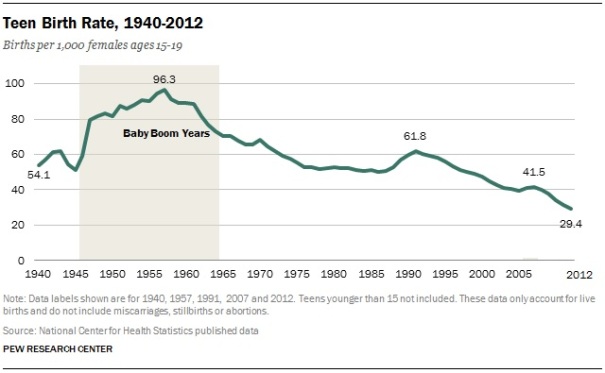
Teen PregnancyEach new year brings a new low in the rate of teen pregnancy in the US. One might think that religious conservatives would be cheering this healthy trend, but they never mention it.

The numbers look like a victory for the religious right until you consider the longer trend and the reasons behind the decline. Teen pregnancy didn’t peak during the dirty years of the sexual revolution. The great age of the teen mom was the 1950’s.

It turns out that teen pregnancy has been in fairly steady decline since its towering peak in 1957. The half-century long declines seem tied to the growth in women’s power over their own lives, not exactly the central focus of the religious right. You won’t hear fundamentalists trumpeting this victory because it isn’t a victory. It is a defeat.

Teenagers are delaying sexual activity more than in the recent past, but most of the decline comes from increased education about sexuality and more consistent use of contraceptives. That’s not exactly a win for fundamentalists. By the same token, the long term decline in abortion rates and teen births, which should cheer religious conservatives, comes with an accompanying rise in women’s choices over their own bodies. This is not the kind of “victory” that Jerry Falwell had in mind.

And that’s one of the central ironies of the culture wars. Our culture is vastly more socially conservative by honest measures than it was in the seventies, but not in the ways that really mattered to the fundamentalists. They wanted to get there through authoritarian means that would limit choices and shore up religious values. Instead, we got there through libertarian means; education, choices and freedom.

People, especially young people, are making smarter choices about sex, drugs, education, and other personal matters than ever before. That’s not a victory for fundamentalists because their goals were never related to outcomes. Their objective was to limit choices. That’s why the “pro-life” movement is just as enthusiastic about blocking sex education and contraception access as they are about picketing abortion clinics. There is nothing pro-life about their movement or their motives.

The steep long-term declines in teen pregnancy, teen birth, and abortion are not going to be celebrated by religious fundamentalists because those were never their core objectives. The expansion of choices, especially for women, is a defeat for the religious right even as it improves quality of life for everyone.

Tagged with: , , , ,
Posted in Religious Right, Reproductive Rights

A Hip Hop Republican breaks one off

Let me clear my throat…

Being black and conservative is not easy. The left has a presumptive hold on “authentic blackness,” leaving black conservatives political isolated from their communities. As the Republican Party falls more and more deeply in love with Dixie, it is getting harder for African-Americans with any backbone to retain a place in the GOP. Their presence is tolerated, even celebrated, so long as they read from a prepared script. If they dare to try to influence the party’s direction they will be promptly escorted to the RINO pen to while away the hours with Colin Powell.

The Cliven Bundy flap may be a bridge too far for many self-respecting black conservatives. For a colleague at Hip Hop Republican, the support for Bundy from “conservative” media and political figures inspired an eloquent outburst. From Chidike Okeem at hiphoprepublican.com:

I am proud African man and a proud conservative. I refuse to accept that being a conservative means apologizing for racists and white supremacists who do not acknowledge my humanity. If it means I have to stand alone and forcefully articulate an idiosyncratic conservative worldview that does not involve my dehumanization, then so be it.

You cannot be a proud black person and make a career out of defending right-wing racists. If only people would listen to the totality of Dr. Martin Luther King’s sociopolitical message, as opposed to twisting his 1963 speech on the steps of the Lincoln Memorial in service of their invidious colorblind agenda. Artificial black conservatives are as, or even more, dangerous than white supremacists. At least white supremacists tell you what they truly believe. Artificial black conservatives just repeat white supremacist beliefs for financial security and emotional blandishments—and I find it repulsive.

Guys like Tim Scott and T.W. Shannon are making their own peace with the racist forces that drive the Tea Party and the rest of the far right. So be it. It will be interesting to see the where their paths lead. But for many others the cognitive dissonance is becoming too much to tolerate.

Tagged with: , ,
Posted in Civil Rights, Tea Party

Your automated dinner

The list of jobs which cannot be automated continues to shrink, largely to the benefit of consumers. Milking machines have been reducing dairy costs for almost a century, but robotic technology is now being deployed to replace the dairy farmer. From the New York Times:

Robots allow the cows to set their own hours, lining up for automated milking five or six times a day — turning the predawn and late-afternoon sessions around which dairy farmers long built their lives into a thing of the past.

With transponders around their necks, the cows get individualized service. Lasers scan and map their underbellies, and a computer charts each animal’s “milking speed,” a critical factor in a 24-hour-a-day operation.

The robots also monitor the amount and quality of milk produced, the frequency of visits to the machine, how much each cow has eaten, and even the number of steps each cow has taken per day, which can indicate when she is in heat.

As usual, this new advance has implications for others in the business. Automation may reduce costs, but it requires capital investment. It makes the most sense at larger scales.

Many of those running small farms said the choice of a computerized milker came down to a bigger question: whether to upgrade or just give up.

“Either we were going to get out, we were going to get bigger, or we were going to try something different,” said the elder Mr. Borden, 59, whose family has been working a patch of ground about 30 miles northeast of Albany since 1837. “And this was something a little different.”

The Bordens and other farmers say a major force is cutting labor costs — health insurance, room and board, overtime, and workers’ compensation insurance — particularly when immigration reform is stalled in Washington and dependable help is hard to procure.

The machines also never complain about getting up early, working late or being kicked.

“It’s tough to find people to do it well and show up on time,” said Tim Kurtz, who installed four robotic milkers last year at his farm in Berks County, Pa. “And you don’t have to worry about that with a robot.”

For all the promise of automation, author Michael Pollan offers his usual warnings. Food is not purely a product. It is impossible to truly commoditize. Products which are consumed in mass but incapable of commoditization are an awkward fit for capitalism. Food, as a market, also has limited growth prospects. There is only so much you can eat.

This is something, Pollan says, that you see again and again when you look at which food innovations get attention  —  and funding. A close look often shows that the problem being solved wasn’t a problem in how we grow food, but in how companies grow profits.

Wall Street wants these companies to grow by at least 5 percent each year. But America’s population only grows by about 1 percent each year

There’s a “key fact” you need to know to understand the food industry, Pollan says: Wall Street wants these companies to grow by at least 5 percent each year. But America’s population only grows by about 1 percent each year. That is  —  or at least was  —  a problem.

“For a long time people in the industry thought it was impossible to get people to eat more,” Pollan says. “They called it ‘the fixed stomach’ and they lamented that, unlike in the shoe business where you could get people to keep buying more kinds of shoes, you couldn’t get people to eat more. Well, they’re to be congratulated. They solved that problem. Capitalism is very powerful. It solves problems. But it solves its own problems, not always our problems.”

More of Michael Pollan’s interview with Vox here.

Tagged with: , , , ,
Posted in Uncategorized

Why poverty matters for Republicans

Twenty trillion dollars is a lot of money. Absent a major course-correction or a sudden increase in economic growth, the US Federal debt will reach that level by 2017. Americans would consistently prefer to have Republicans, rather than Democrats address our fiscal issues, but there is a catch. The country will not trust the party to do what we do best so long as they fear what Republicans will do to the social safety net.

Republicans will not get the mandate we need to change this country’s fortunes until we can develop a convincing approach to dealing with plight of the less fortunate. A sound, convincing approach to poverty relief is the gateway to a Republican future and an American Renaissance.

Dealing with our mounting financial problems should not be difficult. America is fantastically wealthy, fully capable of generating surpluses or managing a much higher debt load. In fact, a modest, sustained increase in economic growth would allow us to bring the debt in line within a decade or so.

Our debt is not a problem in and of itself, but a symbol of something more dangerous. People and organizations successfully borrow money as a means to achieve a goal, but that is not what America has been doing since 2000 – the last year we experienced a surplus. The debt we are accumulating today isn’t buying us anything. It is the accumulated cost of political gridlock and a lack of vision.

The key to debt reduction is growth and our biggest single obstacle to growth is a sclerotic government structure which has failed to keep pace with changes in the economy and culture. Government remains slow, labor-intensive, and relatively unresponsive. Government is not only increasingly expensive, it is accomplishing less and less.

Tearing down government is not a solution. We need government to work.

The debt is just a symbol of our real political problems. Dodd-Frank, for example, was meant to curb the thinly veiled casino gambling of federally-insured financial institutions. Instead it has become a regulatory Potemkin village. Saddled with massive new bureaucratic burdens legitimate businesses struggle while the same derivative speculation that fueled the last crisis continues virtually unabated.

No Child Left Behind was so massively broad and clumsily crafted that it has devolved into little more than a bureaucratic dance. Almost every state in the union has either had the requirements waived or has a waiver pending. The goals of the law were admirable and might have actually worked in the mid-20th century. Today, such an ambitious effort at central planning is a ridiculous and painful joke.

Then there is the Affordable Care Act. Do we even need to address the ACA?

Government in the US does less for ordinary people than the dense bureaucracies of Western Europe, but it does it with the same levels of inefficiency, complexity and unaccountability. And that’s just the Federal picture. The problem is arguably much worse at the state and local level, where many government entities continue to exist for little practical purpose other than to collect taxes to pay under-funded pensions.

New technologies like Tesla and Uber offer enormous promise, but their growth is being thwarted by state and local governments shackled by their political ties to incumbent businesses and unions. The same combination of cronyism over-enthusiastic regulation is strangling the growth of solar power. As heavy as our Federal government may be, it is less of a burden on our economy than our thousands of city councils, state legislatures, and county boards.

Democrats, with their deeply entrenched ties to organized labor are institutionally incapable of leading the country toward the leaner, smarter government institutions we need in order to operate in a more dynamic world. Americans look to Republicans to make tough decisions on government reform, but they legitimately fear what we might do.

Welfare, Medicare, Social Security and the rest of our social insurance network has been the buffer that makes our financial dynamism possible. A deteriorating long-term debt picture and a bureaucratic quagmire may be concerns, but they are far less worrying than the possibility of seeing the entire structure of the safety net destroyed.

If Republicans could develop a reality-based, sensible approach to the social safety net it would alleviate most of the concerns that prevent the party from being trusted. An intelligent approach to poverty relief might be the key that unlocks a Republican future.

Developing a realistic agenda around poverty issues is going to be very difficult. Safety net policies expose the blind spots in most Republicans’ understanding of the world. They touch on questions of race, justice, and institutional inequality which most Republicans patently refuse to acknowledge. Dealing with the social safety net requires us to confront realities about the shape of the world that undermine deeply cherished myths.

The good news is that there are options available, developed by economists and thinkers on the right, which would allow us to replace our old approach to the social safety net while reducing the size and role of government. The bad news is that the party is so mired in paranoia and delusion that it is virtually impossible for anyone to propose realistic reforms of almost any kind without being forced to the political margins. A political party that can be deluded by Cliven Bundy or Ted Cruz is in no fit shape to be trusted with important matters.

Republicans, as the challengers to the established bureaucratic order, have an unusual burden to demonstrate that our goals can be accomplished without tearing down the other pillars of the Republic. We should be able to do that, but Fox News and AM radio aren’t going to help. People used to trust Republicans in part because they were boring. The GOP today is relentlessly exciting in the worst possible ways.

Restoring some sense of sanity and realism is going to be a painful challenge. Before we can once again with a Reagan-style mandate, we will have to win the country’s trust on the issue that has been our Achilles heel.

If it were easy we would have done it already.

Tagged with: , , , , ,
Posted in Ownership Society, Republican Party, Welfare State
Goodreads

Enter your email address to subscribe to this blog and receive notifications of new posts by email.

Join 448 other subscribers