Both parties are unusually unpopular

Lots of ink has been spilled outlining the increasingly dire condition of the Republican Party. Levels of public affiliation with the party have set new record lows over the past couple of years in a predictable response to the party’s growing extremism. However, much of the commentary about this situation has overlooked a critical factor.

While Republican affiliation is setting new lows, Democratic affiliation, while still much higher than the Republicans, is beginning to approach their own historic lows. Neither of our major political parties are generally trusted or respected. Democrats are gaining ground politically, but only as a default.

This has not always been the case. The Democratic Party was able to generate a wave of optimistic enthusiasm from the late fifties until about 1968. Republicans enjoyed tremendous respect from the late seventies until the train wreck of the second Bush Administration. In our time, Democrats are steadily gaining momentum almost everywhere outside the Deep South and the sparsely populated regions of the Mountain West, but this political shift is very different from similar epochal shifts in the past.

Growing Democratic power is not coming from a more popular governing agenda, a vision for the future that sparks enthusiasm, or even a set of charismatic leadership figures. The only force driving the Democratic Party’s expansion is growing hatred of the GOP.

Failure to appreciate this dynamic is the story of the Obama years for both Democrats and Republicans. Emerging from the unprecedented catastrophe of the Bush Era, Americans gave a pair of massive electoral victories to the Democrats in ’06 and ’08 out of pure, desperate exhaustion. If the Democrats had recognized the meaning of those victories, people today might be sizing Obama up for a new spot on Mount Rushmore.

Instead, Democrats interpreted the results to mean that Americans loved them and supported their outdated plan to extend 20th Century hyper-bureaucratic government into our time. With a nation reeling from a long series of bleeding disasters, they diverted all of the energy the country had given them into fulfilling Ted Kennedy’s dream of national health care.

They failed to do this. They then re-packaged their failure to deliver national health care as some awkward form of success, and lost big in 2010.

When the Republicans swept into office in 2010 turned out to be batshit crazy, the electorate recoiled again in 2012. Now we’re all stuck. Government has effectively closed down. Any public function that cannot be carried out by the executive branch or the courts is indefinitely deferred.

On the one side we have a Democratic Party which is moderately reasonable, but trapped in the past and incapable of forming a governing vision that can address the needs of a Post-Cold War world. On the other side we have a Republican Party gripped by a terrifying paranoia that threatens to ruin the country and the planet.

Put Democrats in power and they’ll assume we like their ridiculous ideas and work hard to implement them against our actual wishes. They’ll cost us money for projects we don’t want or need while creating headaches that have to be dealt with in the future.

Put Republicans in power and they’ll obey the voices in their heads. The party is more or less controlled by the kind of idiots who would threaten to bring the global political and financial order to its knees in order to solve problems that only exist in their delusions.

American voters are trapped between crazy and inept. Almost every election is a cost-benefit analysis between the marginal cost of putting a Democrat in office and the terror of unleashing a Republican lunatic. Increasingly we are voting for the relative safety of Democratic ineptitude and Democrats are misinterpreting it as love.

Opportunity hides in this grim scenario for an organization with the insight and dexterity to exploit it. The country is aching for an Eisenhower; dull, relentlessly competent leadership. America does not need an Apollo Project. We need to fix our highways, update our tax structure, and tame our fiscal mess. We’ve had three charismatic young Presidents in a row and they have all sucked.

The party or leader who can offer us eight years of bare, gray competence and uneventful leadership may win lasting admiration. Recognizing that neither party is poised to inspire us, or being asked to inspire us, might lead to a major political victory for whoever is ready to seize it.

Tagged with:
Posted in Republican Party

The Most Important Issue I Don’t Understand

Wise people avoid expounding on issues they do not grasp. In that spirit, you’ll find very little content here on foreign policy, military life, Canadian politics, bow hunting or hockey, as a small sample. Occasionally though, an issue is so important that it can’t be ignored merely due to ignorance. Sometimes it’s helpful just to describe the outline of a baffling problem in the interest of generating conversation that might lead to clarity.

Privacy issues emerging from our ever expanding digital lives are so complex and unprecedented that it’s difficult to establish any useful reference points. Clearly we are making policy decisions in our time, mostly by default or inaction, which will determine the shape of our personal and property rights in the digital realm for generations to come. We are making these decisions (and in-decisions) while largely blind to the outcomes and implications. That’s not just frightening, it’s maddening, and there doesn’t seem to be much that we can do about it.

Part of the problem is that privacy as a legally protected “right” is rather new. The Bill of Rights mentions some of the building blocks of privacy, including the obscure 3rd Amendment, but there is no expressed privacy right in our Constitutional law. The first time the Supreme Court struck down a law for interfering with privacy was in 1923.

In Meyer v. Nebraska the Court invalidated a state law criminalizing foreign language instruction in primary schools. This reading of the liberty clause in the 14th Amendment was novel. The decision did not use the word “privacy” but described the concept at some length. By interpreting 14th Amendment protections to extend beyond mere physical constraints, the Court was beginning to stake out a realm of personal space protected from public interference.

It was a reasonable response to the nation’s transition from an agrarian to an industrial culture. The concept of privacy is fairly esoteric when your nearest neighbor lives too far away to see. Liberty has different demands in a city.

Even then, another four decades would pass before the term “privacy” would take on much meaning in legal terms. Griswold in 1965 and Roe in 1973 established privacy as a personal, Constitutional right in rulings dealing with contraception and abortion. Even then those decisions were controversial and privacy rights are still contentious. As late as 1989 the Bush Administration nominated a Supreme Court justice who denied a Constitutional privacy right. The matter was not generally settled until the Lawrence decision in 2003. You can still find prominent Republicans who insist that the Constitution does not protect personal privacy.

Privacy as we generally understand has come more from legislation and culture than from Constitutional law, reflecting the fact that commerce, not politics, is where our privacy is mostly in play. The Fair Credit Reporting Act was passed in 1970, representing probably the most powerful protection of personal financial information. Your rights to your health data were not uniformly protected at the Federal level until 1996. Privacy legislation has been late in arriving and relatively thin compared to other western countries. New technological developments are already rendering our meagre protections useless.

A new generation of credit reporting companies is emerging to evaluate your value in the digital realm. Everything from your home equity to your social media influence is available for assessments that impact your ability to get a job, borrow money, or engage in other commerce. Refusing to participate in social media or other methods of surveillance does not prevent the creation of a profile, it merely influences your score (downward, generally).

Almost none of this category of surveillance is covered by existing consumer protections or credit regulations. The monitoring of your email and phone metadata by the NSA is positively trivial in size, sophistication, scope, and relevance compared to the dossiers being compiled on you by Internet service providers and other technology companies, free of almost any accountability or regulation.

Traditionally, transparency and consent have been treated as the antidote to privacy intrusion. Law assumes that the real tension in privacy disputes comes not from surveillance, but from clandestine surveillance. To the extent we are properly warned of what is being done, an activity is largely accepted. That understanding may not be enough as our technology becomes increasingly complex.

There are things you would say on a train that you would not say in an elevator. There are things you would say on a softball field that you would not say at school. There are things you would say in a break room that you would not say in a conference room. We expect to be able to judge fairly sophisticated grades of our setting in order to judge what levels of candor or expression will be not only appropriate, but properly understood by a potential hearer. That is one reason that so-called “hearsay,” an over-heard third-party report of a statement, is generally inadmissible as evidence in a legal proceeding. There is no similar protection from the impact of hearsay online.

At stake is not merely our control of our image, but our ability to communicate effectively. Use language or phrasing appropriate for the bleachers at Wrigley Field at a 3rd grade softball game and witness one of the challenges presented by the decline of privacy. The ability through omnipresent surveillance to transpose communications from one setting to another without context can have implications for one’s ability to hold a job, protect a credit rating, influence politics, or retain ownership of the Los Angeles Clippers. Watch how many phones are recording the speeches at the next political meeting you attend. Why is that happening?

We are less and less competent to judge the sensitivity of our communications as surveillance technology transforms the landscape. What makes this phenomenon so difficult to manage is the fact that its implications are entirely mixed. Yes, a central authority can now monitor your every move. However, you may also monitor theirs. The technology that lets the police identify a suspect on the street can (and occasionally is) also used to observe and punish police brutality. Technology that lets someone surreptitiously record your conversation also lets you photograph the person who stole your phone.

Adding to the complexity is the fact that surveillance is not merely, or even primarily, a matter of state power. Say what you will about the Snowden leaks, but perhaps the most startling revelation from the whole affair is the discovery of how far the Federal security infrastructure still lags behind the monitoring capabilities of private companies.

The potential for government to misuse personal information is a valid concern, but it is far from a pressing concern. What looms over us now is the digital land grab that is gobbling up property rights in information that could potentially belong to individuals. When those rights are gone they will never be restored.

Your digital profile is valuable property. Like a homestead on the prairie that you haven’t seen yet, it may belong to you, but it is very difficult to evaluate. Our current model allows individuals to sell away chunks of their privacy rights in exchange for free email, navigation services, games and hundreds or even thousands of other valuable services.

The freedom to transfer those rights is every bit as constitutionally valid as a right to privacy. The problem is that technology companies are operating at a significant information advantage as relates to individual consumers. Like oil companies at the turn of the 20th Century negotiating leases with farmers, both sides are engaged in an uncertain speculation. However, without any legal framework to set the balance the companies control the terms of the trade. Ask a landholder what it takes to recover their mineral rights and you’ll get a sense of what the next generation faces online.

So what can we do about this? In the digital realm, what is “privacy” and how valuable is it? How much of your data should be protected? On what terms should you be able to bargain it away? I don’t have answers and I’m not seeing a lot of other good ideas. There is no partisan divide on the issue of digital privacy as there aren’t really any coherent positions being taken by anyone on a broad scale. It might be the most important issue rights issue of our time and we have little or no idea what to do with it.

At the very minimum, it is probably necessary to remove the ability for children to sign away their digital rights while still a minor. A generation is emerging that values privacy in much the same way they regard virginity, as something to be shed definitively in the transition to adulthood. That is a completely unnecessary mistake and we owe it to our children to prevent it. Blocking the compromise of privacy individually is like trying to build seawall around your beach house. To be practical and effective, this will have to come from legislation.

The terms of the compromise struck at age 13 may look very different at 30, but perhaps not. Privacy, like mineral rights, may be meaningless if you never knew you had it in the first place. If all we do about the erosion of our ownership in our personal profile is to build a wall around an emerging digital generation that might be enough. Perhaps an emerging wave of digital natives with a keener understanding of technology might strike a different collective bargain for their digital rights.

For us, there seems to be very little we can do to establish any personal control of our online data. We’ve made our bargain for free real time maps and music. The value is not trivial, but it will likely prove to be a fraction of what those assets were worth. No matter, we will get where we are going on time and be entertained along the way even if the destination is unknown.
Tagged with: , , ,
Posted in Civil Rights, Technology, The Second Machine Age

Why the GOP needs a big win in 2014

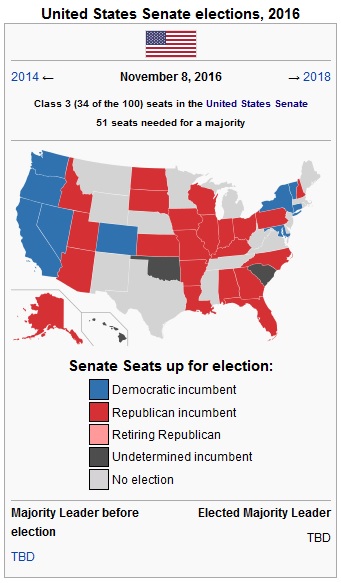
From WikipediaThe 2014 election is critical for Republicans in ways that few pundits are addressing. As the party steadily retreats into a regional strategy, focusing more intensely on aging, rural whites who make up a steadily declining percentage of the electorate, the party becomes increasingly vulnerable to wave elections – major disruptive events that can shift power for decades. One of those may be looming in 2016.

This year’s election is the GOP’s last hope to build a bulwark against its declining national presence. The vagaries of the election cycle mean that a large percentage of Democratic Senate seats are up for grabs in 2014, many of them on terrain that still favors Republicans. The flipside of this happy coincidence is that a tsunami looms in 2016 that could put the GOP in danger of dropping a dozen or more Senate seats and put the House back in play.

Control of the Senate for a couple of years is the least of the GOP’s priorities in this election. Republicans need more than a mere majority in the Senate. Unless the party can get at least 52 or 53 seats, which would represent a remarkable showing, they face a catastrophe in the election that follows.

To get a sense of the growing national gap between the parties, compare the prospects for the 2014 and 2016 elections. Based on current numbers and the assumption that Republicans generally fare better in off-year elections, a massive GOP sweep might give them as many as 53 Senate seats. Facing their best electoral landscape in decades they still have no shot at absolute control of the Senate.

Now look at 2016.

Of the 33 seats facing election in 2016, Democrats hold only ten. None of those ten are in states won by McCain or Romney. Colorado and Nevada could potentially be competitive depending on who runs, but there is little likelihood of a contest elsewhere. Barring a major flub or retirement, the Democrats will not be playing defense anywhere on the map in 2016.

Worse, Democrats traditionally perform at their peak in Presidential election years. Even worse, there is no Republican frontrunner for the 2016 Presidential race. Since the fifties, Republicans always nominate the runner-up from the last election cycle (’64 and ’00 are the exceptions, in which the previous runner-up did not run). The runner-up from the bizarre 2012 campaign, Rick Santorum, is not a major figure.

Republican Senate candidates in 2016 will be getting no help from the top of the ticket. There is no sane Presidential candidate waiting in the wings.

Neither Jeb Bush nor Chris Christie shows any sign of winning over the frothing base. If it seemed like the 2012 nominating race was freak show, get ready for some truly nauseating action in 2016. Unless the Democrats can find another Black Communist Fascist Muslim born in Africa to nominate for President, Republicans will be struggling to manufacture even the marginal enthusiasm that left them short in the last two elections.

Many of the 23 seats Republicans will be defending sit in territory where the party is steadily losing ground. Seven of them are in states the party lost in both of the last two Presidential campaigns. Barring an extraordinarily poor Democratic nominee, Republicans can expect to start each of those campaigns at either a toss-up or trailing. Those Senators:

Florida – Rubio
Illinois – Kirk
Iowa – Grassley
Wisconsin – Johnson
Ohio – Portman
Pennsylvania – Toomey
New Hampshire – Ayotte

The rest of the Republican field will be defending seats in states Obama lost, but that provides limited comfort. Another eight of those Republicans will be running in states that have already elected a Democrat to their other Senate seat.

Alaska – Murkowski
North Carolina – Burr
Indiana – Coats
Louisiana – Vitter
Arkansas – Boozman
Missouri – Blunt
North Dakota – Hoeven
South Dakota – Thune

That’s 15 seats Republicans will be defending in states that either voted for Obama or have recently sent a Democrat to the Senate. Some of them should be pretty solid, like Murkowski and Thune, but the map gives them no guarantees. And with the party in such a deep defensive stance, resources will be scarce.

The news gets worse when you look into the narrow pool of what should be “sure-thing” states. The Arizona Senate race in 2012 was surprisingly close. Whether Arizona comes into play may depend on whether McCain decides to run again and if not, how daffy the Arizona GOP’s replacement candidate is.

Likewise, Georgia and Kentucky ought to be safe, but this year Democratic challengers are running unexpectedly close races. Altogether, Republicans will be defending 23 seats. At least seven of them will face strong headwinds from the start. Another eight have to be expected to be competitive. And three more warrant watching.

With seven Republicans defending Blue-state seats, another eight in competitive states, and three others teetering toward purple, just a modest overall Democratic showing in 2016 would be enough for an epic-making sweep. And that’s before you look at the ways that demographics are eroding the already tenuous gerrymandering that protects Republican control of the House. A subject for another time.

If Republicans somehow manage to sweep all eight of the tossup Senate races in 2014 they will hold a narrow majority of 53 Senate seats. Almost anything less than that gives Democrats a solid shot at a super-majority in 2016. Failing to take the Senate would give Democrats an opening to rack up the kind of overwhelming Senate majority in 2016 that they haven’t seen since the sixties.

This is the kind of math Republicans can expect to face on a consistent basis as the consequences of a decade of mounting extremism become increasingly difficult to escape. Chickens are coming home…

Review the list of Senate races in 2016 at Wikipedia.

Tagged with: , ,
Posted in Election 2016, Republican Party

Losing the culture war – by the numbers

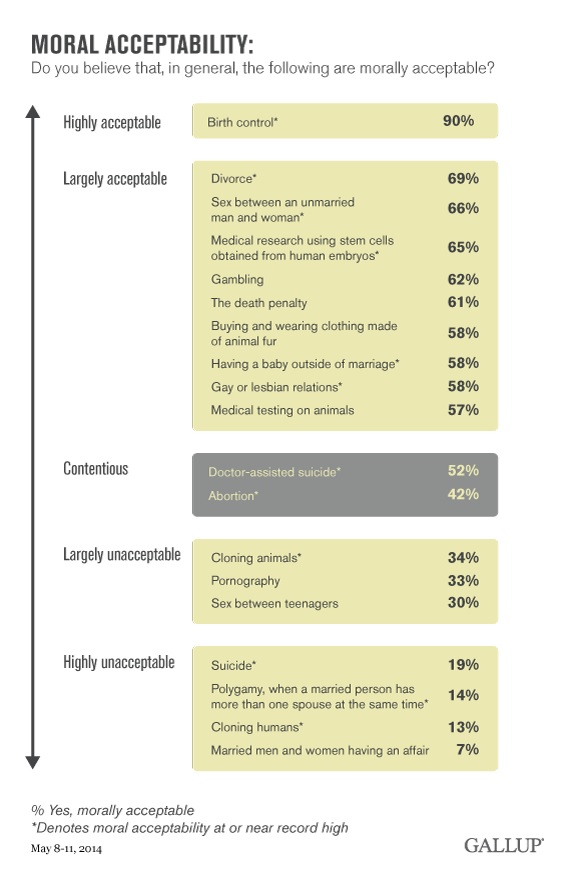
Gallup released some interesting survey results this week on people’s views of the “moral acceptability” of a wide range of issues. Here’s the graphic from Gallup:

Survey Results

Record high comfort levels with divorce and abortion are interesting, but the more interesting data is in the comparisons based on party affiliation. Not surprisingly, Republicans are out of line with general public opinion on just about every “moral” issue. Interestingly, though they are stricter on sexual matters, Republicans show far higher tolerance levels on issues related to animal cruelty or animal rights. The drift over time is interesting too, as Republicans have basically missed the broader public shift on all of these issues which has opened up a new partisan rift that was not so prominent in the past.


Tagged with: ,
Posted in Religious Right

New EPA rules on carbon emissions

On June 2 the EPA will release its proposals designed to regulate carbon emissions from existing power plants. To put this in historical perspective, these new regulations come less than fifteen years after George W. Bush promised to deliver them on the campaign trail in 2000.

The public will have a year to comment before the rules take effect. We don’t know yet what the rules will be, but because this new regulatory scheme comes from the EPA’s existing authority rather than from new legislation, we already know some important things about what won’t be in these new rules.

Without new legislation we cannot get the kind of comprehensive, globally significant, Pigovian marketplaces that would be most effective. What we’ll have instead is some combination of new rules power plants must follow and a fresh patchwork of additional rule-making and taxing authority granted to state governments. In short, this is the worst case scenario for carbon regulation.

This approach will likely be the Obamacare of carbon regulation. It means we will add a fresh new layer of regulatory burdens to our energy markets while failing to deliver any nationally or globally effective regimen. We will add new costs to energy, but only in certain markets and for certain users. It will lay on additional cost and complexity without solving the core problem – the central theme of the Obama Era.

Democrats can only bear some of the blame for this outcome. The best approach to carbon reduction was developed by Libertarian economists decades ago and incorporated by Republicans, briefly, into legislative proposals. If Republicans weren’t in full retreat from reality on all fronts we would have been operating under this scheme for more than a decade already.

Instead of writing millions of lines of new rules dictating in ever finer detail the operating procedures of energy producers, simply apply a tax on carbon, paid at the point of generation or import. That’s it. From there, you could potentially allow producers to “trade” credits created through offsets, like carbon capture. You could use the revenue to provide a tax credit to lower income families hit harder by higher costs, use the funds for remediation. You could also use the money to “buy back” carbon, essentially setting up a market for carbon sequestration.

Countries that did not match our carbon taxes, or failed to consistently impose them, would face steep import duties which would be directed into the carbon fund. The impact to countries like India and China would be steep and immediate, helping to curb the urge to skirt the carbon regime.

The carbon tax would change the market balance among other products like cars, solar panels, and other technologies. Alternative technologies would get the boost they need without government intervening to pick winners and losers. Funds would be available to fuel a market for remediation which does not exist today. A market approach has vast advantages over the clumsy hand of regulation.

This is just one more example of the national and global cost of a Republican Party that has opted out of reality. As in the debate over health care, sound, market-focused Republican voices are completely absent, replaced by shrill denial. Simply voting for Democrats is not a solution. We desperately need the Republican Party to sober up.

Tagged with: , , , , ,
Posted in Climate Change

The Reparations Article

The Atlantic’s article by Ta-Nehisi Coates on reparations is an absolute must-read for anyone who claims to have an informed opinion about racial matters. For that matter, it’s a must read for anyone with an interest in quality writing or American history.

Several portions of the piece jumped out at me for their potential to serve as an excerpt, but I’ve resisted the temptation. To summarize it in chunks is an injustice. And doing injustice to an article about injustice is, well, that would be too much irony for a weekend.

Coates’ article is a unique game-changer. No one has ever assembled the complex history of American race relations in such a sound, succinct, accessible package. Whatever you may think about reparations, this article is a master work. This article is going to resonate for a long time.

There is one essential accompaniment to any discussion of Coates’ article. This explainer from NPR on “how to tell who hasn’t read the new Atlantic cover story” is indispensable. In summary, the three clues are:

1. They talk a lot about slavery

2. They talk about the logistics of reparations

3. They talk about affirmative action or welfare

By the way, the pitiful effort at a reply published by the National Review is notable for including two those tells while completely dodging the bulk of Coates’ case.

Tagged with: , , ,
Posted in Civil Rights, Race

A conservative looks at food trucks

The American Conservative Magazine may among the last places in America where anyone still remembers what the term “conservative” means. Yesterday they tackled the issue of food trucks in Alexandria, VA and as usual their approach is more thoughtful, nuanced, an interesting than you might have expected.

It may seem that a “conservative” approach to this situation would be to hold on to the norm—to ban the food trucks, in favor of more anchored, traditional restaurants. Another supposed conservative approach might be to favor a complete “free market” approach: allowing the food trucks to run riot through Old Town, setting up shop on any old cobblestone street they favor.

But a truly conservative approach must be both balanced and thoughtful—protecting the old, while embracing new measures that will complement civic life. We must consider the impact, for good and ill, that food trucks might have on Old Town Alexandria, and consider ways we could  bring the most benefits, while avoiding harm to the character of the district. I think the New Urbanist approach gives us some excellent insights into the way Old Town could maximize this new market for the benefit and enjoyment of its local community.

New Urbanism is not a reference you’ll commonly hear on the political right in the US without some connection to conspiracy theories or Agenda 21. Likewise, you’ll seldom hear anyone on the political right pressing government to protect community, as everyone knows that’s the root word for Communism.

It is refreshing to hear the sober voice of a conservative weighing in on a relatively mundane, but important local issue. I miss conservatives.

Tagged with: ,
Posted in Political Theory

The outcome of the GOP “Civil War”

After last night’s round of primaries, David Frum issued the definitive statement on the GOP’s short and largely meaningless civil war. His tweet:

Post-primary GOP deal: donors choose the candidates; Tea Party writes their message.

Texas and a few other pockets of the South may be exceptions, but across most of the country that’s the deal. “Established” political figures like Mitch McConnell get to keep their spots as long as they let the party’s craziest extremes hold a veto on policy decisions. The lessons of 2012 have been trumped by the lessons of 2010. Why should I care about the party’s future chances of holding the White House if doing something about it might cost me a carefully gerrymandered seat?

Good to have that cleared up.

Tagged with: ,
Posted in Republican Party

The changing economics of home ownership

homeThough home prices across much of the nation have recovered their pre-crash levels, the volume of transactions is still less than half what it was at the peak of the boom, and still well below historical norms. The number of new home transaction is still hovering near historic lows. Analysts are starting to ask whether home ownership retains its traditional place as an element of the American Dream.

Should young people who have shied away from home investments be considering a purchase? It depends.

Measured in straightforward math, home ownership is a money-losing proposition. With the exception of the period from 2004-2007, all the fabulous stories you’ve heard about the money made from an “investment” in a home are pure garbage. People are as good at evaluating the merits of their homes as they are at judging their kids’ talent.

When people evaluate the performance of their home in investment terms, they subtract the sales price from the purchase price and pat themselves on the back. Occasionally they will incorporate the cost of the kitchen renovation, or a selected portion of that cost, but they will almost never account for all the cost of ownership. The ledger will magically fail to include the new water heater, lawn maintenance, the endless minor repairs, or the time devoted to upkeep. They will not incorporate the additional travel costs or time incurred because they had to live fifteen minutes farther from everything in order to find a place they could afford.

More importantly, they will fail to evaluate the opportunity cost of the investment or the cost of the lost alternatives. Across hundreds of years, real estate gains a fairly steady .5-2% above inflation. If prices move much higher or lower over a short term period you need to brace for a correction. By contrast, that same money placed in an equity investment can reliably earn two to three times as much. That lost opportunity will not make it into the ledger.

For those looking for “new buyers” entering the market to take prices back to boom levels, it’s time for a little sobriety. The only reason prices spiked in the last decade was because clever monkeys on Wall Street found a way to engineer a brief boom, using the mass securitization of the mortgage market to convert housing into high-octane Ponzi scheme. There is no mass of new buyers out there waiting to enter the market. The basic demographics of the country are heading in the opposite direction.

Population growth has largely stalled with the exception of new immigrants. Changes in the way the economy works means people who will earn enough to support home ownership start their careers and their families much later in life than before, meaning that their span of homeownership comes later and is often shorter than in the past. And growing inequality means that fewer and fewer young people today will ever be homeowners at any price.

The real estate boom is not coming back. Home price appreciation can be expected to stabilize back down around the low end of its historical norm

And the tax benefits of home ownership? That may be the cruelest hoax, especially for middle-earners. Even at the highest tax brackets, the savings are far less than you would expect. Very few Americans realize how little they spend in Federal income taxes or how much they spend comparatively in property taxes. In exchange for taking on a new property tax obligation, a middle earning taxpayer will get perhaps as much as a 6-10% discount on the interest they pay on their mortgage. With interest rates on new mortgages running in the 4% range, that’s not very helpful.

Home ownership is far more expensive than almost anyone realizes. As an investment it under-performs almost any available option, including treasury bonds. In a radically dynamic economy, it makes movement to pursue new job opportunities sometimes prohibitively expensive, tightening career options. Worst of all, it creates a fixed burden on young families that does not flex with changing financial conditions.

And for a lot of people buying a home is a pretty good idea. Here’s why.

The benefits are not entirely financial. A home should not be treated like an investment in the purest sense, though over time it will tend to have some stabilizing effects on a family’s finances. The main value obtained from home ownership has to do with the relative shape of the markets for single family homes as compared to rental properties and the social impact of ownership on families and communities.

First, there is some minor financial advantage to home ownership that helps offset some of the costs. The impact is not enough to convert ownership into an investment, but it does make it attractive overall when all the factors are calculated.

Home ownership based on a fixed-mortgage, the most common method in US markets, converts a home into a form of inflation hedge. If a homeowner follows the model pattern, purchasing a “starter” home around the time of marriage, then stepping up to “stretch” home at early career, they set in motion a process that could see their housing costs drop steeply below the cost of a lease or rental over time.

As inflation proceeds and their income (presumably) rises across the arc of a career, their mortgage cost remains flat while leasing costs rise with inflation. By about the ten year mark, their housing costs are perhaps a third of what they would be if they were still leasing. From about that point forward, they also begin to accumulate equity in the home which can be converted very cheaply into capital.

That rosy investment scenario requires a lot of uncertain variables to fall in a family’s favor. Divorce, for example, takes that promise of a long term benefit and converts it into a costly loss that often follows the family for many years. A job loss or transfer complicates the picture. And if income does not rise the effect is dimmed. That said, this is a plausible scenario that has brought meaningful financial advantages to a lot of families.

Perhaps the most persuasive reason for home ownership, the one that provides the decisive factor that trumps all else, is the way the housing market is bent toward ownership. The rental market in the US offers virtually no options to rent single family homes with the kind of predictable quality you would expect from a corporate product.

The rental market is volatile. The quality of landlords is highly variable and almost entirely unpredictable. That makes the prospect of a long-term lease very unsettling, but families at mid-career with young children face tremendous costs when forced to move. Decent rentals are hard to find and you often can’t identify whether you have a good or a lousy rental until you’ve moved in and experienced your first maintenance problem.

In short, the rental market for families is unstable, unpredictable, and far too dynamic for families to absorb. A rental may, in principle, provide some savings over ownership, but it is just as much of a gamble.

This could change. A very substantial portion of single family home purchases since the collapse have involved hedge funds. Many of those funds expected to “flip” the homes when market conditions improved, but the improvements they were expecting have not materialized. If a new market for corporate-quality, branded rentals emerges from the crash then this dynamic might change. If that happens, then the economics around home ownership might shift decisively in favor of renting.

Absent such a shift, home ownership is likely to remain an expensive, but necessary investment for young families.

Tagged with: , , , ,
Posted in Economics

How climate change is already affecting us

If you have tried to purchase a vacation home on Galveston Island in recent years, you may have discovered the crazy new insurance rules that are changing the real estate game. If the property you are purchasing did not survive Ike undamaged, you may find that your insurance bill rivals the cost of your mortgage.

That’s because most of the island is uninsurable on the private market. It turns out that insurance companies are too stupid to understand what every Tea Partier instinctively knows – that global warming is a hoax. Thanks to a century of rising sea levels behind us and accelerating sea level rise ahead of us, insurance rates even with substantial intervention by the State of Texas are skyrocketing.

Portions of Galveston unprotected by the seawall were already projected to be underwater in coming decades based on estimates issued a few years ago. News this week about the Antarctic ice sheet is going to further darken the picture. You may not believe in climate change, but if you believe in homeowners insurance and you want to own coastal property, a warming planet is already affecting your bank account and those impacts are going to grow more severe very soon.

The State of Texas effectively nationalized homeowners insurance for coastal residents several years ago under the umbrella of the old Texas Windstorm Insurance Association. Socialism appears to be bad for everyone except those who want to own vacation homes. That agency is functionally insolvent. Instead of funding claims through premiums and investments, it must fund claims through bond issues. The state-run “insurance” that coastal residents depend on is funded collectively and backed by the state. Private insurers will not deliver coverage at anything approaching an affordable level.

How much longer will the state’s taxpayers and insurance holders continue to subsidize coastal development that ignores climate change and rising sea levels? The science on the question is unsettled.

Tagged with: , , , , , ,
Posted in Climate Change
Goodreads

Enter your email address to subscribe to this blog and receive notifications of new posts by email.

Join 448 other subscribers