Link Roundup, 2/25/16

From The Week: Obama’s genius tactical move on the SCOTUS appointment

From The New York Review of Books: How long can Putin hold on?

From Slate: Is your boss reading your email?

From PRI: What really happens to former GITMO detainees?

From Aeon: Would we know whether our machines had achieved consciousness?

From Bloomberg: The increasingly difficult abortion business

Posted in Uncategorized

A warning from Flint

Screen Shot 2016-02-21 at 9.43.42 PM

Statue of former Flint Mayor, Don Williamson, from Flintexpats.com

Awkwardly posed and absurdly oversized, it’s a monument you’d expect to find on a journey through some decaying, post-Soviet kleptocracy. Flint’s former mayor finally posted this bronze statue of himself at the entrance to his grand estate after the city expressed no interest. Down the road, Flint residents who voted him into office wonder how much poison their children absorbed and when their tap water will once again be safe to drink.

Journalists pin blame for Flint’s water tragedy on the officials who inherited the city’s mess, creating a danger that we will miss the warnings in this story. Meanwhile, just outside town, that silent statue offers a lesson on how this sad tale unfolded and what it might signal for the rest of us.

Political collapse has practical consequences. Like her neighbor, Detroit, Flint is an early victim of the Politics of Crazy. Mayor Williamson’s monument points to a dangerous future as we struggle with the decline of our social institutions. Like the gaudy decorations on one of Trump’s buildings, it reminds us that in politics, personal failures are often cushioned by collective consequences. That statue is a lighthouse standing over the rocks of the Politics of Crazy.

Flint is not unique. Smaller cities all over the country are dipping below a critical threshold of viability as populations dwindle and their civic fabric frays. It is difficult to shrink a city. An economic revolution has shifted prosperity back toward the once-struggling downtowns of America’s largest cities. Rural areas and smaller cities are losing their reason to exist. As residents leave smaller towns to pursue opportunities elsewhere, populations left behind grow politically weaker, their governments more and more dysfunctional.

Flint is earning a lot of attention, but similar examples abound. Almost all of the elected government of Crystal City, Texas was arrested en masse recently by the FBI. Weeks later, residents discovered their drinking water had turned black. Explanations from city officials have thus far been less than reassuring.

Residents of Sebring, Ohio are being warned that their water supply may be tainted by lead. A city official is accused of falsifying reports to the state EPA. A manager of the city’s water system was accused by the Ohio EPA in 2009 of filing false reports but remained in his job.

Water and infrastructure issues are getting a lot of attention because of events in Flint, but the pressure on schools may be a more pressing threat. A school district is perhaps the most expensive, technically challenging, and economically critical element of a local government’s infrastructure. Their failures in recent years have been far more numerous and much more difficult to solve.

Districts in rural communities in Texas, Colorado, and South Carolina have faced the extreme sanction of losing their accreditation. Kansas City schools lost their accreditation in 2011. A district in suburban Atlanta lost their accreditation in 2008. Rural schools are running out of money as populations decline and needs rise.

Money solves none of the problems created by the Politics of Crazy. Sometimes it makes them worse. A declining capacity for self-government doesn’t always shut off the money-tap. In Beaumont, Texas, revenues from refineries have insulated a school district in a long cycle of decline. While the community’s basic capacity for civic management has eroded away, the money has kept flowing, fueling a cyclone of local government dysfunction.

These problems, experienced locally, rise from a broader dynamic. The premise of the Politics of Crazy is that effective democratic government starts with healthy social capital. Our rapid economic transition toward a freer, more prosperous, and vastly more dynamic global economic order has produced the unintended consequence of eroding that social capital.

A once-dense network of voluntary social institutions is in steep, sudden decline. These institutions once acted as a critical mediating influence, weeding out much of the poison that might otherwise float free in our political ecosystem. Robbed of these critical filters, we are seeing a disturbing rise in the power of cranks, crooks, and crazies. Our failure to adapt to the demands of this changing environment gives rise to the Politics of Crazy, undermining our capacity to maintain successful self-government.

Our first round of failures from the Politics of Crazy are, predictably, emerging in communities that already had the weakest social capital. Flint is a poster-child for this phenomenon and, as such, a valuable warning too pressing to ignore.

Flint’s economic difficulties from the transformation of the auto industry are fairly well known. Less well known is the response from voters to the challenge posed by their changing environment. As jobs and people steadily fled the city, its government resisted pressure to adapt.

In the late 90’s Woodrow Stanley, one of the last capable leadership figures the city would see, fought to trim budgets, contain looting by interest groups, and put Flint on a footing to survive. Voters in Flint rewarded Mayor Stanley’s efforts with a successful recall campaign. With the recall complete and a budget deficit of more than $30m, bond holders dried up access to new borrowing. The failed city was placed in state receivership in 2002 for the first time.

A state administrator restored the city’s finances, reorganized its debt and restored basic services placing the city back on track. Removed from receivership in 2004, the city was delivered back into the hands of its newly elected mayor, a car dealer and millionaire ex-con named Don Williamson.

Williamson was a charismatic tyrant, incompetent, arrogant, and not terribly bright. He banned the local newspaper from city offices, describing it as unauthorized reading material. He had a newspaper deliveryman arrested for failing to disclose the names of subscribers. Random firings of city employees, a crackdown on ‘baggy pants,’ gross discrimination against certain police officers and fiscal mismanagement on an epic scale were the hallmarks of his administration.

During his 2007 re-election campaign he gave away $20,000 to voters in a “customer appreciation” stunt at his car dealership. A quote from a ‘man on the street’ at the event echoes loudly in the Age of Trump:

“He’s giving back to the city. Nobody else is doing that,” said James Searcy, 42, of Flint, while waiting for the winning names to be drawn.

One wonders whether Mr. Searcy’s kids are still in Flint, drinking the tap water.

In that election Williamson lied about the city’s alleged budget surplus, revealing after his victory that the city was deeply in debt. Two of his actions alone, a discrimination lawsuit and error-prone handling of a building condemnation, have cost the city more than $10m, almost half its annual budget.

Facing the specter of another recall election Williamson resigned in 2009. Again, the mess left behind was far greater than Flint’s capacity for civic management. After a brief stint under a promising new mayor, the state assumed receivership of Flint for the second time (so far) in 2011. It was under that second, far more serious and complex receivership that Flint’s water tragedy played out.

Commentators on both sides have tried to forge a partisan weapon from the Flint narrative. The right points to Flint’s long tradition of Democratic leadership, conveniently ducking vital details of Mayor Williamson’s story. Though he ran as a Democrat, he was solidly Republican, repeating Republican talking points and making the maximum legal contributions to George W. Bush in both elections.

Democrats are working feverishly to pin the blame for Flint on Republican state leadership. Their story somehow always misses decades of nearly exclusive Democratic local government resulting in total, repeated civic collapse. Flint is a not a partisan catastrophe. The Politics of Crazy is a non-partisan phenomenon.

No state worker would have made any critical decisions about Flint’s water supply if the city’s voters could have produced a remotely competent local government. Receivership was the only option for a city that had lost the capacity to govern itself. As incompetent as Flint’s local government had become, falling into the lap of the state meant losing even more control and nearly all oversight. Residents’ interests were now subject to political winds beyond their control.

Additional state or federal infrastructure spending would not have stopped the Flint water crisis. That crisis occurred because there was no competent local authority capable of making administrative decisions on behalf of residents. Why? Because for decades those residents had been electing crooks, charlatans, and occasionally outright idiots into positions of civic authority. A social fabric that once kept the city’s politics minimally healthy had collapsed.

The second time around, the state bailout attracted little interest. State officials had grown tired of administering Michigan’s failed cities. No one wanted to own Flint’s mess, not even its residents. Errors in judgment, critical miscalculations, and calloused disregard led to poisoning. Natural consequences.

Flint is not alone. We miss this warning at our collective peril.

Freedoms we enjoy under an elected, representative government are accompanied by an ironic curse – We will always have the government that we deserve. Sometimes we invite disasters with our choices. Flint’s voters ran the city into the ground, and now their children are living with the poisonous consequences. Unless we learn to adapt to the demands of this new economic environment, more disasters will follow on a grander and grander scale. Flint is a warning shot.

The root of the Flint water crisis, and so many less-publicized incidents around the country, is an utter failure of representative government. Flint was wrecked by its own voters. Those voters are returning to control as Flint emerges once again from receivership. Prospects this time are no more promising than before. A city clerk last year botched the publication of filing deadlines for candidates, threatening to block candidates from appearing on the ballot. As the newly elected local government begins work, familiar fault lines are already appearing. One councilman faces a misdemeanor charge for his conduct in council meetings.

Lest anyone be tempted to take comfort in their distance from Flint’s disaster, similar forces are at work at the highest levels of our government. Since 2010, America’s legislative branch has been effectively closed, leaving the courts and bureaucracy to limp along as best they can under emergency budgets and without Congressional leadership.

Making matters worse, Republican voters are lining up behind a national version of Mayor Don Williamson, a wealthy, ranting blowhard campaigning on racism, empty slogans, and vulgarity. Democrats are not immune. A leftist Ron Paul, an ideological gadfly making bizarre promises backed by fiscal voodoo, has harried their nominating campaign. Sen. Sanders is threatening to deliver the left’s answer to Donald Trump, a campaign of folk songs and emotion leading toward a public policy train wreck.

There is no refuge from the Politics of Crazy. We will, collectively, evolve the means to adapt, or we will experience the story of Flint on a national and even international scale.

A bronze statue just outside Flint commemorates a political failure that has poisoned thousands of families and further tattered an already thin civic fabric. Doughy and brooding, with hands inexplicably crammed into pockets, the Sphinx of Flint has a story to tell for those who are listening.
Tagged with: , , , , , , ,
Posted in Politics of Crazy, Uncategorized

Gaffes that would ruin Trump

Donald Trump’s campaign for the Republican nomination has been one long ‘drunk uncle’ rant. No matter how insulting, stupid, or offensive his antics, his supporters remain delighted.

Given his resilience so far, the willingness of commentators to assume that he’s rhetorically bullet-proof can be forgiven. Nevertheless, he remains vulnerable. Here’s a list of statements that could destroy Trump’s support and cost him the nomination:

“The Confederate Flag is a symbol of racist oppression.”

“Police violence against young black men is a national disgrace.”

“I’m worried that America no longer attracts immigrants from Mexico.”

“Those jobs aren’t coming back.”

“I’ll have a Venti half-caff soy-milk latte with caramel drizzle, three shots.”

“NASCAR isn’t a real sport.”

“Kanye West is a real mensch.”

“I love my Prius.”

“The number of veterans joining white supremacist militias is a legitimate concern.”

“This isn’t a purse, it’s a man-bag.”

“You know who was a great President? Jimmy Carter.”

“The most dangerous threat facing America is climate change.”

“This calf injury gives me trouble in down-dog.”

“I promise that my running-mate will be Jewish.”

“Nashville is for sell-outs.”

“What’s with all these gun nuts?”

“Everybody knows that Obama is a Christian born in Hawaii.”

“Guys who drive pickup trucks are losers, really sad.”

“It’s ‘their,’ not ‘they’re,’ you illiterate troll.”

“You can’t call it a taco if it’s not in a corn tortilla.”

“Never trust people who Tweet in ALLCAPS.”

“I apologize.”


Posted in Uncategorized

Republicans are missing their ride

Wouldn’t it be great for Republicans to line up behind a massively popular force that pits entrepreneurship and innovation against corrupt political interests? Even better, what if that same force was helping ordinary people improve their lives and opening up opportunities for Republicans to compete in urban and minority communities?

New labor and capital models emerging from the tech sector are a gift from the political gods that Republicans have, as yet, entirely failed to recognize. These innovations are vastly popular with the public, especially younger voters who are otherwise drifting left. Meanwhile, new technology is setting up a conflict with corrupt, unpopular established business models tied to Democrats by deep institutional bonds.

Mired in delusional pessimism and hopelessly burdened by bigotry, Republicans are missing a golden opportunity. Innovations in mobile payment, asset sharing, 3-D printing and digital marketplaces are not just changing the way we live; they are upending economic assumptions that once defined our partisan divide. Pioneers in this new economy are desperate for political allies. Innovations in the labor market are opening a window of opportunity to build a new identity for the GOP. There is no sign that we are ready to seize it.

Understanding how technology is blurring the once bright line between labor and capital starts with a close look at how ride-sharing has disrupted the taxi business. Democrats are lining up to defend an archaic taxi business model against competition by adopting flimsy rhetoric about worker protections. In reality, Democrats are defending existing models for two reasons, 1) they don’t understand emerging technology any better than Republicans, and more importantly, 2) they cannot wriggle free of their deep political dependence on a patronage model.

Taxi industry rentiers were one of the largest contributors to the campaign of New York’s “progressive” mayor, Bill de Blasio. The mayor has locked himself into a fight against the ride-sharing service. Bernie Sanders has, unsurprisingly, expressed that he has “serious problems” with the company’s business model.

The taxi business owes its continuing existence to regulatory capture and its corrupt ties to urban political machines. Democrats find themselves defending rentiers, occasionally even organized crime figures, against the interests of individual workers they celebrate in their rhetoric. Democrats are trapped in a 19th century model of urban political patronage. Republicans could make them pay.

Local governments have several legitimate interests to protect in the taxi industry. They need the drivers and vehicles to meet safety standards. They want the market structured in way that insures cabs are available on consistent basis and that drivers are not exploited.

To manage taxi markets, New York City in 1937 passed the Haas Act, mandating a limit on the number of taxi “medallions” the city would award. To legally operate a cab in the city, the vehicle must display a medallion purchased from the city, and licensed annually, a practice that continues today.

It was a solid idea that spread rapidly, giving cities some leverage to impose minimum standards in the industry without granting a monopoly to a single vendor. Medallions were a form of market-based regulation that kept cities out of the taxi business while preventing a market-driven race-to-the-bottom in terms of quality.

Every great idea has a lifecycle. As an environment changes, an adaptation that bred success in the past can become a dangerous liability. A close look at the way the industry has evolved reveals those weaknesses now.

Medallions developed into a form of capital, one whose only value rose from the regulators themselves. From the beginning, medallions were accumulated by politically-connected insiders who capitalized them. The medallion attached to the vehicle, not the driver. By leasing the right to operate to other drivers, the vehicle itself could be almost constantly in service. As the value of the medallions rose they become a legitimate investment.

Over time the relationship between medallion holders and urban regulators evolved in a predictable direction. Medallion ownership has consolidated into relatively few hands. Their influence over urban politics (reads: Democratic politics) has grown and deepened. Owners’ cozy relationship with their very local regulators has helped them block competition, exploit workers, skirt safety standards, and disregard the needs of riders. The taxi business is a cesspool of corruption, controlled by a relatively small collection of capital owners who have imposed an effective monopoly on the business.

With very few exceptions, taxi drivers are independent contractors who operate under lousy conditions. For each shift they work they pay a set fee, in the form of a lease, to the medallion owner. A dispatcher controls much of their activity, and receives an additional cut. So the driver starts their shift with a sizable fixed cost.

Unionization in the cab industry is challenging for a combination of practical and political reasons. Since the drivers are almost never employees and very few people perform the work consistently, the driver pool is difficult to coherently identify, much less to organize. Complicating the problem is the fact that unions and medallion holders are both deeply embedded inside the same political party. Unionization would require a poorly organized, politically marginalized minority to persuade existing union interests to upend powerful forces with entrenched interests from inside the Democratic political machine. It hasn’t happened and it won’t. Thanks to innovation, it is no longer the most promising option for workers.

For consumers the taxi market is similarly lousy. Vehicles are consistently old and in minimal repair. Technology available to drivers to process payments is miserable, often improvised on the driver’s phone. Supposedly set fares always seem to inexplicably vary. Rides often end with a driver strongly suggesting that cash would be the best payment method, then making the electronic transaction take as long as possible. On short fares, the payment process can take as long as the ride.

This is a business ripe for disruptive innovation. How do ride-sharing services like Uber and Lyft work? Press a button on your phone to request a ride. Costs will vary based on the number of available drivers and traffic conditions. Despite all the worry about variable pricing, you can get a highly reliable fare estimate by pressing a button.

While you wait for your car you can watch its progress on a map. When the ride is over you get out and walk away. Rate your driver. That’s it. The transaction is handled electronically by Uber or Lyft. Need a car, get a car. Costs are low, service is excellent, uncertainty and delay are reduced to near zero.

And the drivers themselves? That’s the best part. They are almost all part-timers working to capitalize an existing investment in a vehicle. A driver with a paid-off vehicle in good condition can make vastly more money than a traditional taxi driver working far fewer hours. More importantly, the flexibility of the work opens up options for people who need a little extra money but don’t have the time or desire to commit to the years of twelve hour shifts necessary to break into the taxi industry.

Press a button on your phone, clear a background check and vehicle inspection, then make far more money than a cab driver working on your own schedule when you feel like it. Drivers owe nothing to Uber or Lyft. They owe nothing to a corrupt union bureaucracy. They owe nothing to local politicians. In many ways, Uber epitomizes the new economic freedom of social capitalism. The Uber driver is a political nightmare for Democrats, a true free agent unconstrained by any political machine.

Lyft and Uber are disrupting more than the taxi business. In the course of demolishing a corrupt business model they are also threatening a corrupt political model that hinges on blocking workers from gaining their own independent voice. At the heart of America’s big cities, the last remaining stronghold of Democratic politics, ride-sharing could redraw the political map if Republican would just pick up that stylus.

Rhetoric in play against ride-sharing is bizarre, suggesting that many Democratic politicians have no idea how the taxi business (or any other business) works. Uber is bad because it doesn’t offer health insurance. Uber is bad because drivers are not employees. Uber is bad because few drivers work full-time hours. Conditions of the sharing economy that liberals criticize are in many cases the traits workers most love. And the absence of employment benefits is not unique to Uber, but an embedded characteristic of a taxi industry Democrats foster and politically protect.

Suddenly Democrats have discovered the plight of taxi drivers, after having created their plight in the first place.

Here’s where ride-sharing, like many other similar disruptions, presents a radical new opportunity for Republicans. These innovations blur the line between capital and labor in ways that destroy older political alignments. Instead of investing in a medallion or paying leases to an owner, a Lyft or Uber driver uses their own car, which normally would be an ordinary cost of living – an expense. How does ride sharing change the cost of becoming a capitalist? Observe:

Cost of a taxi medallion in a major city: Somewhere between $400,000 and $1,300,000.

Cost of a car used for UberX: $18,000-30,000.

Like a business owner, Uber or Lyft drivers work when they want to, quit when they want to, and hold out for higher pay by only working when the fares are most lucrative. They earn a chance to convert their labor into capital leveraging assets they already own.

What about health insurance, protection from termination, and fair pay? Taxi drivers under existing arrangements enjoy none of these benefits. Taxi drivers’ lack of health insurance is not an Uber problem, it’s a national political problem. The solution is not to force Uber to enter the same antiquated, suffocating labor arrangement we’ve imposed on the rest of the market. The solution is to recognize the ways the world is changing and finally decouple health insurance coverage from full-time employment.

Developments in the late stages of the knowledge economy are giving birth to millions of new capitalists. In a move that would make Marx’s head explode and Jack Kemp’s face glow in the dark with excitement, workers are becoming capital owners. Their future partisan alignment is largely in our hands. Democrats are unable to adapt, trapped by their existing relationships with corrupt urban political interests. Republicans are free to pursue these new constituents, urban, young, and often black or Hispanic. We just need to recognize them and make an effort.

A healthy Republican Party could seize this opportunity to champion the liberating forces of market economics against political corruption. Clearly defined, delivered with discipline, this becomes the core of an optimistic, broad appeal that could break open the Democratic stranglehold on big cities and smash the Blue Wall. Instead, for some reason, we’re promising to roll back gay marriage and shut out immigrants.

Our willingness to find comfort in a world of manufactured facts comes with a price tag. By blinding ourselves to the massive social changes developing around us we are also missing vital opportunities. Republicans have a crucial role to play in fostering hopeful 21st century business models. Will we miss our ride?

Tagged with: , , , , ,
Posted in Economics, Republican Party, Technology, Uncategorized

Link Roundup, 2/16/2016

From Politico: Our first taste of a potential Trump/Sanders campaign

From The American Conservative: The Right discovers budget math

From Inside Higher Ed: Why tuition is so high

From Aeon: Frustrated by your country? See what it’s like to not have one.

From The Daily Dot: A glimpse at the next anti-science freak-out from the left – Monsanto caused Zika

Posted in Uncategorized

Why Republicans should brace for a contested convention

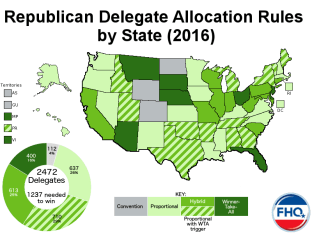
2016_GOP_del.all

Delegate allocation map from FrontloadingHQ

Republican commentators have dismissed concerns over a contested convention with a hand-waving reference to “winner-take-all” primaries later in the calendar. Like so much of the rest of Republican reasoning, that confidence is built on a set of factual assumptions not born out in the world around us.

These are the reasons we can anticipate a contest at the convention to select the nominee.

1) Few delegates will be assigned in a true, statewide, winner-take-all contest.

Only eight states, delivering less than 400 of the necessary 1247 delegates needed for a majority, will be awarded in a winner-take-all fashion. One of them, Ohio, is a likely win for Kasich who is otherwise a delegate laggard. He is unlikely to drop out before that March 15th primary.

2) The system is only designed to select a winner if one candidate can consistently top 50%.

Most of the states that commentators describe as “winner-take-all” are in fact proportional unless one candidate tops 50%. That list of about 12 states includes some big ones, like Texas (155) and New York (95). Something remarkable and unpredictable would have to happen in the five weeks or so for someone to reach 50% just about anywhere.

3) Trump has a hard ceiling somewhere in the mid-thirties. So does every other GOP candidate.

Pollsters have made clear that Trump’s support dries up beyond about a third of GOP voters in almost every state. What they haven’t mentioned is that practically every other candidate experiences a similar, fairly low ceiling.

Cruz may actually top out a bit lower than Trump. Pollsters point to voters’ generally favorable image of Rubio. However, that only extends to their view of him as a person, not as a candidate.

Once negative campaigning focuses in on Rubio, his embrace of immigration reform will translate into a hard cap. That cap is made worse by Rubio’s general weakness as a candidate. He may be less annoying than Cruz and less revolting than Trump, but he’s not very good at this. We have a deeply divided Republican primary electorate, creating strong incentives to stay in the race for candidates in the top four or five.

4) A vast majority of delegates are ‘soft-pledged,’ meaning they shed their attachment to their assigned candidate after a failed first ballot.

Here’s where the Republican ‘Red Wedding Scenario’ gets its energy. Most GOP delegates are only locked into their selection if there is a clear winner. Soft-committed delegates are basically only committed if the convention doesn’t matter. After a first failed ballot, serious, involved, committed members of the Republican Party – the kind of people who become convention delegates – are set free from the yahoos who voted in the primaries. They get to pick the winner.

In 100 out of 100 potential runs of that scenario, Donald Trump fails to win the nomination. In fact, there is reason to expect that the nominee would be someone who wasn’t even a candidate in the primaries.

5) There are no brokers.

Note the vital difference between a ‘contested’ and a ‘brokered’ convention. Decades ago, before primaries played such a prominent role, powerful interests in the parties negotiated the convention outcome. This was a vital service, as 2500 people who don’t know each other will often have difficulty organizing themselves toward a sensible outcome without the help of some leadership. In a scenario like we face this year, a dozen or so leading figures should be able to help mediate an outcome prior to the convention, at least limiting the convention delegates to two or three reasonably options.

There are no authoritative figures inside the party with the credibility and influence it takes to bring potential rivals together. It will be an unpredictable, bare-knuckles fight. There is a chance that a contest on the convention floor could extend beyond the convention, with more than one claimant insisting that he was the winner in a disputed outcome that lands in the courts.

6) And a note about Rule 40.

Some have pointed out that Rule 40 would bar consideration of any potential nominee who failed to win a majority of the delegates in at least 8 states. Rule 40 doesn’t matter because the party gets to make the rules more or less on the fly, within the constraints of what is politically possible. If primary results dictate that Rule 40 becomes a problem, then the party will simply change it at the start of the convention.

The real difficulty here is that we have no political structure in place to allow the Republican Party to select its nominee in a convention. Over the past seventy years or so our conventions have evolved from a real political process to a pep rally focused on marketing a nominee who, for all intents and purposes, was selected before anyone cast a primary ballot.

Forcing the convention to perform the complex task of selecting the party’s nominee for the White House is like taking sailboat down a Class 5 rapid. In some ways, this kind of catastrophic institutional challenge might be just the medicine we need. Maybe we will recognize the cost of building an entire political platform on fantasies. Perhaps out of the wreckage of Cleveland we can build something more credible. Evolutionary forces have a way of imposing discipline when we fail to do it ourselves.

More resources:

From FrontloadingHQ: Map of Republican delegate allocation

From Green Papers: Detailed Republican allocation rules by state

From RealClearPolitics: A delegate allocation simulator. This tool misses the Congressional District breakdowns in some states and glosses over some other subtleties, but it is generally helpful.

Tagged with: , , , , ,
Posted in Election 2016, Uncategorized

Link Roundup, 2/11/2016

If the political turmoil in the US isn’t enough to leave you queasy, signs of trouble in the banking sector are starting to emerge.

Analysts have speculated for months when (whether) the collapse in commodities prices would trigger ripple effects in the investment world. This week, for the first time since the financial collapse, the public was introduced to a new, innovative financial instrument: the CoCo bond. Differences of opinion on how to value Deutsche Bank’s hard-to-value Contingent Convertible bonds in light of recent losses led to wild stock fluctuations. Expect more of the same.

So, let’s chance the subject. How about some lighter material for a change.

From Mental Floss: What ever happened to the waterbed?

From the Guardian: How Siri may be killing off accents

From Fader: An evaluation of the cultural impact of Beyonce’s Formation

From Gizmodo: How to harness the placebo effect as a treatment method

From LiveScience: Laser scans are uncovering ‘lost’ Roman Roads in Britain

Posted in Uncategorized

Bernie Sanders and the Blue Wall

poc

The Politics of Crazy, available at Amazon

A pattern was evident in the results from the 2014 Election. Though the prevailing narrative focused on the number of Republican victories, a close look at the map revealed the culmination of a long, dangerous trend for the party. Those GOP victories were highly localized to a geographic bloc containing relatively few electoral votes. A Blue Wall was emerging that Republicans could not breach. Behind that wall lay enough Electoral College votes to lock Republicans out of the White House for the foreseeable future.

Democrats enthusiastically embraced the idea, delivered by a Republican blogger, that they couldn’t lose the 2016 Election. Lawrence O’Donnell read from the Blue Wall post on his MSNBC show. References to the Blue Wall show up daily in comments sections and message boards all over the Internet. Nate Silver considered the idea, expressing concerns that the concept was unsupported by polling.

Our world is complex and full of surprises, making predictions perilous. Democrats seem to have taken the news of their good fortune less as an opportunity than a challenge. Here’s the campaign slogan that most honestly expresses how Bernie Sanders would alter the logic of the Blue Wall: “Sanders 2016: Your Only Way to Lose.”

Bernie Sanders would break the Blue Wall in a way that no Republican could – from the inside.

Just as Republicans a generation ago threw away their chance at decades of political dominance, Democrats may be poised to follow the same path. To understand why, it might be helpful to examine the dynamics that shaped the Blue Wall and how Bernie Sanders is a kind of ‘perfect storm’ for Democrats.

Here’s the most critical thing to understand about the Blue Wall – it was not built by Democrats, but by Republicans. The Blue Wall rises from an incidental coalition of voters unimpressed with liberal politics, but disgusted by the increasingly racist and theocratic rhetoric from Republicans. Three critical voting blocs give the wall its character – African-Americans, Hispanics, and affluent urban/suburban voters (Blue State ticket-splitters).

Democrats have been successful in minority communities because they’ve been far more willing than Republicans to create a climate of acceptance and tolerance. It is important to remember that acceptance and tolerance are not the same as power.

The three groups that give the Democratic Party its resilience are united not by liberal political leanings, but by their disgust at Republican race-baiting and religious fundamentalism. Though Democrats are friendlier to minorities, at an institutional level they have only marginally more comprehension of or sympathy for black and Hispanic communities than Republicans. Issues of the highest priority to minority communities always take a back seat to the interests of union leaders and white progressives.

This means that minority communities find themselves voting Democratic out of a lack of options, a particularly acute dilemma among black voters. As urban communities struggle against resistance from public employee unions to get the vital public services they so desperately need, these tensions are rising to the surface. Black Lives Matter in particular finds itself facing its most immovable resistance inside the Democratic coalition.

This beats the treatment African-American voters receive from Republicans, but still leaves them frustrated. Much of the support that Democrats enjoy is a gift from Republicans who drove minority constituents away. Few Democrats recognize that dynamic, leading them to assume that the loopy ideas of leftist college students must automatically be shared by the rest of the Democratic coalition.

To win upwards of 70% of Hispanic voters and almost 95% of African-Americans you have to bring into your coalition millions of voters who are effectively holding their noses. Half of black and Hispanic Democrats identify ideologically as conservative or “mixed.”

Take a glance at comments by Sanders supporters online about their…ahem…’less enlightened’ black and Hispanic brethren and the outline of this problem becomes apparent. These voting blocs dislike each other a great deal more than either Democratic or Republican insiders recognize. White progressives are particularly oblivious to this fault line, imagining that their adoption of politically correct language and their support of a generous welfare state is more than enough to earn the warm gratitude of minority voters. Sanders is a kind of perfect storm, exposing in a sometimes ugly way the limits of minority influence in the political party they’ve committed to support.

Black voters in the US have a very unique relationship to the political system. The average black voter is far more politically active, motivated and informed than a peer of similar income and education in other groups. Why? Because politics has consistently been a matter of life and death for them. They aren’t screwing around. This is not entertainment.

While affluent white college students get all starry-eyed over folk-singer rhetoric, black voters care intensely about outcomes. They demand effectiveness. Despite their deep commitment to the Democratic Party (or perhaps because of it?) black interests always lose to the pet projects of affluent, privileged, white progressives. Black voters, especially in the country’s big cities, are growing bitter.

For Bernie Sanders to take the nomination on the strength of white progressives, especially college students, would rub salt in an already very raw wound. Black and Hispanic voters, weary of being taken for granted, are already feeling the Bern. It’s leaving them chafing.

Trapped between a Republican candidate hostile to their interests and a Democratic candidate oblivious to them, the Democratic nominee can still count on strong support. However, maintaining the Blue Wall requires more than “strong support” from minority voters. Obama carried barely 40% of white voters in 2012. Nothing short of dominant support and turnout in minority communities will hold the Blue Wall in place.

Democratic success among the last component of the Blue Wall, urban and suburban whites, is even more brittle. These consistent ‘split-ticket’ voters are the reason that Blue States like Michigan, Pennsylvania, Wisconsin, Minnesota, Illinois, Maryland, and Massachusetts frequently elect Republican Governors or Senators while almost always supporting Democrats for President. These voters are relentlessly moderate and in Blue Wall border-states they can account for a 10-15% swing, defeating liberal Democrats in favor or moderate Republicans on a consistent basis.

If Republicans ever stopped pandering to racists and religious extremists, these voters would switch sides quickly. If Democrats nominate a ‘Democratic Socialist’ from Vermont, these voters will be in play regardless of who the Republicans nominate.

Just like black and Hispanic voters, Blue State ticket-splitters are frustrated by the power of urban Democratic political machines and deeply hostile to the Democratic Party’s delusional left flank. They have increasingly supported Democrats in recent years as the DLC-style Democratic politics of the Clintons has become the norm. They prefer pragmatism over ideology in almost every case. Faced with a choice between a wacky, delusional Republican promising to slash their taxes and a wacky, delusional Democrat promising to take more of their money for pie-in-the-sky projects, their political direction becomes impossible to predict.

Some of the dynamics that created the Blue Wall will also serve to limit the odds of a Sanders nomination. However, not all of the groups that comprise the Blue Wall are active in Democratic primary politics. Many of those white split-ticket voters in Blue States vote in Republican primaries. Others are relatively disengaged from primary politics. Black and Hispanic voters active in the primaries generally lean farther left than their peers who turn out for the general election.

Worse for Democrats, Sanders brings the ‘Politics of Crazy’ into the Democratic Party to a degree we haven’t previously seen. As social capital institutions weaken all over our culture, remaining institutions like our established political parties struggle to hold back a tide of extremism and general nuttery. That drift toward the extremes could overwhelm the Democratic institutions that would otherwise block Sanders’ rise.

Would Bernie Sanders lose the General Election? Not necessarily, but Sanders is the only Democrat in the race who could lose the General Election. It would be difficult to conjure from imagination a Democratic candidate less suited to sustain the Blue Wall. Combine that problem with the significant possibility that Republicans will have a Hispanic at the top of their ticket and you see the weakness emerging.

Even with Clinton as the nominee it was going to be difficult for Democrats to maintain the near-unanimous black support Obama generated and deepen their gains among Hispanics. Lose Clinton, with her deep institutional ties to those communities and her massive embedded support, and the Blue Wall no longer holds.

Would minority voters shift their support to a Republican in large numbers if Sanders were the nominee? Probably not. But these are the communities whose commitment and turnout built the Blue Wall. A 10% fall-off in support and turnout among these voters would be a catastrophe, especially when you consider the impact of an untested, unvetted, socialist from Brooklyn on split-ticket voters in Blue States.

Sanders might be competitive in a general election, but only if Republicans remain determined to nominate the most obnoxiously unelectable candidate they can find. That might change if the party perceives an opening. If it looks like Sanders could take the Democratic nomination, delegates assembled in Cleveland would have all the incentive they need to carry out a Republican ‘Red Wedding’ at the convention. With Sanders as the potential Democratic nominee, Republicans aren’t going to be so generous as to nominate Donald Trump.

The Blue Wall analysis has a weakness – The Democratic Party. Bernie Sanders, as the nominee, would break the wall from within, making the outcome of the November election an open question.

Tagged with: , , ,
Posted in blue wall, Election 2016, Uncategorized

Link Roundup, 2/7/2016 – Energy Edition

Strange things are happening in the world’s energy markets. To almost everyone’s surprise, a massive campaign by the Saudis to undermine the growth of alternative energy producers is proving to be a near-complete failure.

Thanks to government incentives, concern over climate change, and some impressive technological advances, the growth of alternative energy seems to have finally decoupled from price shifts in the oil market.

Low oil prices are creating some odd economic distortions. With the exception of a brief window during the financial collapse, we have been operating for 15 years under a general expectation of relatively expensive energy. Business models adapted around those expectations, with companies sensitive to high oil prices adopting leaner practices and a majority of our manufacturing activity centered on energy development.

This sudden drop is curtailing investment among oil, gas and coal producers, but energy-reliant businesses continue to be wary of expansion, fearing lower prices won’t last. They are mostly just stashing the premium from cheaper energy rather than investing in growth. Until the impact of cheaper energy on consumer spending starts to build, creating new growth pressures, we may actually see lower oil prices produce a counter-intuitive slowdown in the economy.

From The Big Picture: How the oil price decline is impacting business investment.

From Governing: Impact of declining oil prices on state revenues.

From The New York Times: Low prices are finally starting to impact the bottom line at major producers.

From the Solar Foundation (.pdf): The number of jobs in the solar industry is increasing at more than 20% a year, now double the employment level in the coal business.

From Green Tech Media: China is determined to own the solar market.

From Science 2.0: The latest in science denial from the left, the fight over nuclear energy as a response to climate change.

From CNN Money: Important statistic to watch, the foreclosure rate in Texas. While foreclosure rates continue to decline nationally, they rose 15% last year in Texas, and more than 300% in North Dakota. Right now those foreclosures in Texas are concentrated in the state’s western oil belt. If the numbers start to rise more significantly in Dallas and Houston expect trouble.

And a quick profile of oil prices over time.

Posted in Uncategorized

Link Roundup, 2/4/2016

Let’s take a break from the slow-motion triumph of The Politics of Crazy to survey an area in which mankind is still achieving great things. While our governments stagnate, technology is solving problems at an unprecedented pace. One interesting theme, in each of these situations (except the last one) technologists must find ways to circumvent obstacles from politics.

From the Washington Post: A simple approach to removing junk from the ocean will begin testing in June.

From the Max Planck Institute: German researchers are tantalizingly close to building a sustainable fusion reactor in the lab.

From Wired: The first start-up built around the gene-edited technology, Crispr, has filed a public offering.

From Pacific Standard: One down-note, a description of what it’s like when science has to defend itself to the moderately advanced primates on the House Science Committee.

From Gizmodo: Google is finally taking its self-driving cars for testing in more demanding real-world conditions.

From i09: Most important of all, some clever person has finally developed a Simpsons-meme search engine.

Posted in Uncategorized
Goodreads

Enter your email address to subscribe to this blog and receive notifications of new posts by email.

Join 448 other subscribers