All lives will matter

dallas

From Ting Shen, Dallas Morning News

Anyone who has experienced childbirth can attest to this fact: no great change comes into the world without pain. From our earliest origins as a nation we have been torn by a fundamental contradiction between our ideals and our reality. With great pain, we are closing that gap, squaring that contradiction.

We hold these truths to be self-evident. Generations before us have borrowed pride from that lofty vision while falling short of its demands. After so many false starts, aspirations, partial payments, and bloodshed, we may be approaching a climax. Over the noise of shouting and gunfire and paid TV commentators, in quieter conversations happening all over the country in person and even in our much-reviled social media, we may be starting to understand one another.

Police represent us in a truer sense than any Congressman or Governor. While our political leaders describe our values in speeches and legislation, police officers express the reality of our values on the ground. When they murder innocent people, they do it in our name, on our moral ledger. When they are killed protecting us, we bear the moral cost of their sacrifice.

The highest of our collective failures, a cost that can never be repaid, is carried by the families and friends of the dead, blue or black. Our black citizens live every day with the worry that they might be next, that they might be asked to foot the bill for our unrealized vision. Our police and their families volunteer to carry the same burden on our behalf.

As we struggle to close that persistent gap between our self-evident truths and our persistent racial lies, police are absorbing friction from both sides. Police are the crucible for this climactic wave of change. That may be good news, because they have developed into one of our least-appreciated strengths as a culture.

Bigotry, racism, guns, fear, and hopelessness are boiling together into an ever more toxic brew. Police have been wrestling with these demons for decades. While high-profile incidents of violence have made them a symbol of our cultural failures, more quietly they have grown into one of our great cultural success stories. Just look at Dallas.

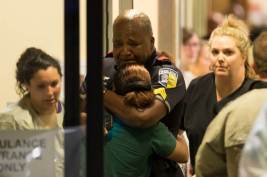
Progressive, intelligent, humane, a model of non-violence, the Dallas Police Department is among the most successful big city police in the country. In Dallas, a rally to protest police shootings that occurred elsewhere in the country was attended and aided by police. Then those protestors were defended by police as one of our other cultural symbols – the psycho mass shooter armed with an assault rifle – murdered officers. In Dallas, protestors and police have wept together. Dallas, of all places.

Our past few years have been defined by a series of pointless deaths and a political environment soaked in gonzo lunacy. We are an electorate struggling to find a common vision for our future. In public we are riven by paid cheerleaders for rage, yet quietly, on our neighborhood streets, hope is stronger than it has ever been.

Humane values are winning. Forget about the politicians and commentators. Look at what is happening on the ground. Look at Dallas, at both the bloodshed and the response.

A wider view shows the truer picture: this outpouring of hatred, fear, and outright lunacy is not our direction, it is a reaction to our direction. A world our ancestors dreamed of creating is being born around us in blood and pain.

This dramatic change is stirring latent poisons from our system, but we are growing stronger. Beneath the voices of outrage, new ties of understanding are being formed. Our best hope for the future is represented by the protestors and the police who were attacked in Dallas. They present a promising picture of a bright new era just coming into view.

We mourn officers killed while protecting others. We mourn civilians killed by police officers for their race. We learn to recognize that neither is an exception. Neither is an outlier. Both represent who we are as a people right now, in 2016. And we develop the determination to become better.

By finally wrestling with the dissonance between our vision and our present-day lives, we are becoming the Americans we always believed we could be. A nation in which “all lives matter” might soon cease to be an evasion and instead become an assumption. That America is within our reach.

We hold these truths to be self evident.

Tagged with: , ,
Posted in Civil Rights, Uncategorized

Link Roundup, 7/8/2016

From The New York Times: June hiring surge continues long streak of growth.

From The Verge: While Google steals the headlines, Microsoft is quietly betting on AI.

From the NSIDC: New record low for June Arctic Sea Ice.

From Vanity Fair: Is it real or is it just the latest clickbait fad? The “sugar daddy” thing is getting a lot of attention lately.

From Gradient: Dr. O. Alan Noble penned a moving reflection on sports, celebrity, and community, inspired by Kevin Durant’s departure from Oklahoma City.

From the archives: As we mourn more senseless death, a reminder of why ‘Black Lives Matter’ even while we grieve lost officers.

Posted in Uncategorized

Do not stab the Nazis

Screen Shot 2016-07-05 at 2.47.20 PM

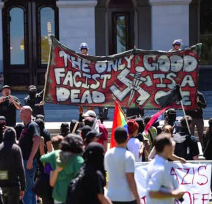
Ant-fascist counter-protest in Sacramento last week

When is it OK to attack a Nazi? This should be a dumb question, but the Trump campaign has awkwardly placed this moral conundrum at the center of our political system. After months spent encouraging his supporters (including many Neo-Nazis) to assault protesters at campaign events, the inevitable has happened. Opposition is becoming  organized and violent. People are showing up to stab the Nazis.

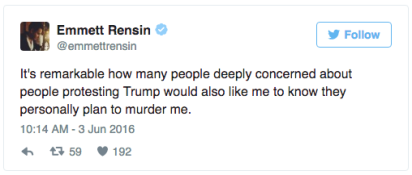
Rioting in Chicago in March was our first warning. At the end of April, Vox suspended its online editor, Emmett Rensin for encouraging protestors to riot at Trump rallies. Last week a group of Neo-Nazis in Sacramento staged a protest complaining of their treatment at Trump rallies. They were met by organized counter-protestors, resulting in a small riot and several stabbings. The genie is out of the bottle.

Until recently, the “is it okay to kill a Nazi” question would have been little more than an intellectual parlor game, a moral puzzle with only distant real world relevance. Ironically, the question “Would you kill baby Hitler” briefly became a campaign issue in our gonzo Republican primaries. It sounds dumb, but sitting beneath this goofy hypothetical is a revealing, and surprisingly complex ethical question. By what standard should we judge the morality of an act of violence?
Screen Shot 2016-07-05 at 3.48.14 PM

Former Vox editor Rensin was fired for advocating riots at Trump rallies.

In other words, should I stab a Nazi?

Donald Trump is challenging our simplistic public narrative on political violence, building an entire campaign inside its contradictions. Forces he has unleashed now require us to develop a more sophisticated understanding of the meaning and morality of political violence – quickly.

Dr. Martin Luther King, Jr. became an American civic saint for his categorical rejection of violence. Every year on his birthday we honor him by teaching schoolchildren that violence is morally wrong. He was, of course, murdered.

A few months later in June, we commemorate the D-Day landings. The carnage we unleashed in France was one of our finest moments as a civilization, an epic demonstration of courage, perseverance, and sacrifice for which we remain grateful and justifiably proud.

Violence is a moral outrage. Violence is the signal expression of our highest cultural values. Both statements are true, but neither is complete. They leave us with this conundrum: If it is OK for the US military to incinerate Hiroshima or Hamburg, then why isn’t it OK to stab a Nazi?

Civilization, one of our most vital evolutionary adaptations, is built on a logical fault line. At its simplest level, civilization is a social structure by which human beings harness formal, accountable, public violence toward the elimination of private violence. Civilization is designed to solve a human social problem – how do we live together in large groups without slaughtering each other? Adapting around that challenge in our social evolution creates an opportunity to more rapidly evolve technologically toward massive common benefit.

How do we leverage the enormous creative capabilities of a large community without allowing one or two people to simply steal it all or destroy our work? How do we capitalize on the power of a farm and an irrigation system without that work being ruined by marauders? How do we board a plane without yielding to our primal urge to club our way into first class?

The answer, paradoxically, is a combination of violence and non-violence. We use the powerful concept of legitimacy to create authority. We invest that authority with our collective powers of violence. Through those engines of legitimacy, whether based on heredity, ideology, religion, or a simple vote, we sacrifice a large portion of our agency.

In return for that theoretical transaction, we get to build a civilization. Instead of roaming the countryside eighteen hours a day searching for sustenance (and violently stealing it where we can), we get to live in permanent dwellings. We get to use technology to have better lives.

Boarding a plane looks like a triumph of non-violent human collaboration. It isn’t. Test the matter by violating one of the social norms governing that process. Take a place at the front of the 1st class line with your boarding pass marked “Boarding Group 4.” Set your watch. See how long it takes to experience legitimate violence meted out by the friendly security professionals who patrol the airport.

Everything we achieve through peaceful cooperation depends on our collective confidence that organized, legitimate violence will be available when we need it to enforce social and moral norms. Elevated by that understanding, we have developed cultural habits that make violence unnecessary in as many cases as possible. You can judge the sophistication and success of a civilization by how much public resource it takes to suppress private violence.

There was a genius to Dr. King’s campaign of non-violence which is seldom if ever noted. Without access to violence, King would have been killed far earlier, before his work had achieved any progress. By carefully restraining their resort to private violence, King’s movement created enormous pressure on our civilization to use public violence in defense of basic public norms and established laws. A disciplined restraint from unaccountable violence formed a successful moral appeal for intervention from disciplined, accountable forces.

King didn’t defeat segregation with non-violence. Jim Crow died at the sharp end of a bayonet. King’s genius was that he, and his followers, had the discipline, determination, and intelligence to refrain from wielding those bayonets themselves. That’s how he took his place as a latter-day Founding Father.

nonviolence

A victory for non-violence in Mississippi

Non-violence did not place James Meredith in a classroom at Ole Miss. Truckloads of US soldiers did that, deploying in overwhelming force to defeat resistance. Losing track of the violence that propelled the Civil Rights Movement to victory obscures its lessons.

As in King’s time, there is an accountable political structure currently in place charged with protecting us all from violence by Trump supporters, Trump opponents, or anyone else. Like in King’s time, that structure is struggling to adapt to the challenge posed by Trump’s unprecedented appeal to private violence. Just like the scenario King faced, a resort to private counter-violence will degrade the capacity of that central authority to do its job. Restraint will make the lines of demarcation clearer, allowing that central authority over time, to leverage violence as needed, if needed, to bring a just outcome.

Above the fray, the political process is slowly working to strangle the Trump phenomenon, pressing it to the margins toward political defeat. In short, the system is working. So-called “protestors” stabbing Nazis at rallies are not doing us any favors. They are just one more problem to be ultimately solved by law enforcement. Private violence will eventually yield to public violence if necessary in defense of order.

We hanged John Brown. Jefferson Davis was allowed to live. The reason is simple. Brown was leveraging violence outside of any negotiable structure. Brown was the rough modern equivalent of a terrorist. Think what you will about his purported cause, Brown was first and foremost a killer convinced he was taking orders from God. Like modern terrorists, John Brown’s politics were incidental to his violence. He could not inhabit a civilization.

Like the rebels who founded our democracy, Davis was operating inside of a reasonably accountable authority structure. His cause was abhorrent, but he and his compatriots pursued that cause through a channel that civilization could ultimately cope with, defeat, and tolerate. That structure granted one critical benefit to his enemies that Brown did not offer – negotiability.

Davis could be (and was) persuaded to terminate his violence through a combination of counter-violence and politics. His cause notwithstanding, Davis’ resort to political violence was less of a fundamental threat to civilization than John Brown’s. That accountability to a defined political structure meant that Davis’ violence could be contained and ended without necessarily killing him.

Davis didn’t commit any acts of violence after the war. No one was ever going to stop John Brown from killing, no matter what happened in the political realm.

Violence unleashed by amateurs in the streets, accountable to no one, cannot be contained through politics. The kind of people who will be rioting at Trump rallies over the next few months are not working toward a political goal. They are doing what they like to do. People who leverage this kind of violence, like Trump or Rensin, are a cancer on civilization.

Someday, under some circumstances, perhaps it might be necessary to kill a Nazi. If it is ever again done legitimately, that violence will be constrained by defined goals and a negotiable authority structure.

What happened in Sacramento is not politics, it’s just violence. That kind of violence always looms at the margins of civilization. Releasing it into our political bloodstream takes us in unpredictable, unwelcome directions.

Please refrain from stabbing the Nazis. Other people will do it better and more thoroughly than you should the need arise.
Tagged with: , , , , ,
Posted in Election 2016, Uncategorized

Democracy’s Boaty McBoatface problem

boatyIn individuals, insanity is rare; but in groups, parties, nations and epochs, it is the rule.
Friedrich Nietzsche, Beyond Good and Evil

Like many disasters, it began with a great promotional idea. Britain’s leading environmental science institute was about to commission a new polar research vessel. To highlight their achievement and increase public engagement they decided to let the public name the ship in an online contest.

Public response was both predictable and disappointing. A BBC radio presenter heard of the promotion and weighed in publicly with a fun suggestion: Boaty McBoatface. His idea took off and won by a huge margin. Coming in a distant second was the name of a cancer-striken toddler who had become the momentary darling of British tabloids. Other notable entries included: It’s Bloody Cold Here and Boatimus Prime. Near the bottom finished a few more relevant nominations, heroic British scientists and explorers relatively unknown to the TV-watching public.

The soul-sucking killjoys who run the Natural Environment Research Council made the controversial decision to disregard the overwhelming will of The People. Britain’s most advanced polar research platform will be christened the RRS David Attenborough. That name earned a tiny fraction of the contest votes.

There isn’t always an adult in the room. In groups, we often do stupid things, things we later regret. While giving a research vessel a stupid name would have been demeaning to the men and women who served onboard, no one would have gotten hurt. The FTSE 100 would have remained untouched. No bond downgrades would be announced.

Sometimes we’re not so lucky.

As democratic ideals take hold globally, becoming the de facto standard for political legitimacy, democratic processes are beginning to show troubling weaknesses. Disasters loom in the dark alleys of majority rule. From Trump to Brexit to the convulsions of the Arab Spring, democracy is experiencing some growing pains.

We’re being reminded that effective, representative government requires more than just letting people vote on stuff. Nothing mystical happens inside a voting machine to transform half-informed opinions into policy gold. Solid, effective democracy does not magically emerge from elections. Institutions and process that support democracy must adapt to fresh demands. Voting will not solve all of our problems.

Since human beings began living in social groups larger than clans or tribes we have faced a consistent challenge. How do we build decision-making structures for these large groups which are smart enough to make competent decisions, but also retain their members’ agency?

For the first time in human development, we seem to have arrived at a global consensus on the best solution to this problem – representative democracy. We may have found the best way for human societies to organize themselves, but we’re still struggling to work out the details. Like Churchill said, democracy is the worst form of government, except for all the others.

Democracy can be summarized as government by majority-rule. Structures may vary, from direct to representative, but a democracy is organized on the principle that public policy disagreements are resolved by an appeal to the will of a majority. Legitimate governments are built on the expressed will of their citizens.

Democracies suffer from two frustrating weaknesses. The first is justice. Majorities might thwart the greed or violence of a few, but who will stand in the way of an angry electoral mob? Majorities can as easily be assembled toward lynching as problem-solving.

The other problem is expertise. We make fairly good decisions for ourselves when we understand the subject matter and we have a personal stake in the outcome. We make consistently terrible decisions when we have little understanding of their implications and the decision involves consequences which are distant in time and dispersed in impact. Without direct personal concern for an outcome or an appreciation of consequences, novelty, entertainment, bigotry, and outright graft heavily influence electoral outcomes. Described another way, we make our best decisions in our personal lives and our worst decisions in politics.

Democracy places equal weight on the opinions of a seasoned climate science expert and that Hibyyjobby lady from the Trump rally. It is impossible to assemble a majority of geniuses. Democracies struggle to arrive at smart solutions to complex, expert problems.

Our Founders recognized democracy’s Boaty McBoatface problem and worked hard to limit it. They were suspicious of democracy, instead choosing to construct a republic, which has evolved into a form of “representative democracy.” Public will in our system is expressed through the election of representatives. Actions of those representatives are checked by laws and shared power among other layers of representatives. Those laws (most of them) are subject to amendment, but altering the most critical and precious of those laws requires nearly impossible levels of public unanimity.

In order to make expert decisions possible in a fundamentally representative system, we sometimes insulate public decision makers from direct public scrutiny. We delegate power to bureaucrats. Some of our most effective public institutions, like the Federal Reserve and the NSA, are also our most politically independent. Holding a public vote on every change in the Fed’s discount rate, or on every drone strike, would be a nightmare bordering on farce. For our government to be capable of performing certain expert tasks, it must enjoy a some discretion.

If the Fed chairman was appointed by the likes of Louis Gohmert, hilarity would ensure, followed shortly thereafter by its twin – tragedy. On the other hand, remove these institutions from all accountability and even the best ones would sour. If the Fed chairman could not be summoned to face his mental inferiors in Congress, we would all eventually suffer. Balance is key. Achieving that balance depends on our willingness to create and sustain intelligent, accountable processes.

Public will is now our de facto standard for legitimate authority on a global basis. That is an enormous human achievement that deserves to be considered The End of History. Yet, we do not have smooth sailing ahead. Each great challenge we overcome opens the door to its evolutionary successor. Winning just means graduating up to better and better problems.

Our challenge now is to stabilize this representative system, to build systems of administration that can continue to channel public opinion into sound public policy while public participation expands. In the course of that effort, sometimes we get David Attenborough. Sometimes we get Boaty McBoatface. Sometimes we get a Kennedy. Sometimes we get a Trump. How do we ensure more of the first and less of the latter?

Developing a more nuanced understanding of the meaning and extent of so-called “democracy” might help. More democracy does not necessarily produce better government, just like more people in a room shouting does not mean more people have been heard. Each step in the direction of greater representation must be accompanied by adjustments in our expectations.

If we’re going to insist on wider democracy, perhaps we should temper our ambitions for government. A simple equation might be helpful. As a system grows more delicately sensitive to public will, its capacity to perform complex, expert tasks declines. At the other end, if a system comes uncoupled from public opinion, it becomes similarly incapable of meeting public needs. Again, balance is key.

The ballot box is not a miraculous decision-making machine, a political Magic Eight Ball. More democracy is not the solution to every public policy problem. Boaty McBoatface is not a story about silly voters. The failure in this story happened in a boardroom among a group of experts. No one with a rudimentary understanding of social media should have imagined that a public process conducted in that manner, on that subject matter, would yield a credible outcome. Process matters.

This was not a failure of the masses, but a failure of elites. Planners placed too much weight on a poorly constructed process. Voting works better as a decision-making mechanism if someone is paying careful attention to what we’re voting on and how.

Making democracy work as we broaden representation requires awareness of the strengths and weaknesses of the voting process. Donald Trump and Brexit are elite failures, outcomes of processes constructed by delusional “experts” out of touch with conditions on the ground.

Voting works well when we use it to express big picture values, or to select representatives who will work within an established process. It breaks when when ask it to perform feats of public policy magic. A brief, vomit-stained ride on the RRS Boaty McBoatface may be just what we need. Once our stomachs settle we may be a bit less lazy in our approach to voting and democracy.

Tagged with: , , ,
Posted in Political Theory, Politics of Crazy, Uncategorized

Link Roundup, 6/30/2016

From Quartz: The science of why people insist on making idiotic choices.

From Fusion: Welcome to the arrest capital of the United States.

From Wired: Humanity is Killing Off Thousands of Species, But It’s Creating Them Too.

From The New York Times: How Canada is welcoming refugees.

From FlowingData: A graphical depiction of income changes in major careers since 1960. Pay special attention to what’s happened in certain specific tiers, like food preparation, construction, and social services. Also note that the main change in the character of income distribution (the upper end blowing out) happened from 1960-80. The rest was just an intensification of that dynamic.

Posted in Uncategorized

Link Roundup, 6/27/2016

From the Washington Post: The world’s losers are revolting, and Brexit is only the beginning.

From The Week: UK Treasury Secretary tries to stabilize the pound.

From The Intercept: Confessions of a payday lender.

From Fusion: It’s gonna be a long, hot summer. Several people were stabbed in Sacramento during classes at a Neo-Nazi demonstration.

From Texas Tribune: Courts are inching closer to holding oil companies liable for promoting climate change lies. The State of Texas is using public resources to oppose the effort.

From Smithsonian Magazine: A review of Paul Theroux’s Deep South. Tut suggested this book and I really enjoyed it. Keep this in mind if you decide to read it. Theroux comes off as strangely old and cranky, especially in the first fifteen pages or so. Plowing past that outburst is worthwhile. The rest of the book was spectacular.

Posted in Uncategorized

The Atlantic discovers the Politics of Crazy

poc

Something important happened this week. No, not that other thing. Jonathan Rauch at The Atlantic published an extraordinary essay on the disintegration of our political system. This may be the first instance in which a first-tier commentator has addressed the concepts described in the Politics of Crazy. The results were promising in the sense that our commentariat may finally be waking to this trend. It was frustrating in the narrowness of its scope. It was downright disturbing in the reforms it suggested.

The community around the Lifer blog will immediately recognize this warning from Rauch about the potential lunacy of the 2020 election:

As the presidential primaries unfold, Kanye West is leading a fractured field of Democrats. The Republican front-runner is Phil Robertson, of Duck Dynasty fame. Elected governor of Louisiana only a few months ago, he is promising to defy the Washington establishment by never trimming his beard. Party elders have given up all pretense of being more than spectators, and most of the candidates have given up all pretense of party loyalty. On the debate stages, and everywhere else, anything goes.

Rauch’s greatest contribution in this fantastic article is his observation that Democrats face the same forces of insanity as Republicans. To my knowledge, no prominent writers in mainstream media have acknowledged this deeply distressing reality and no one in mainstream politics has begun preparing for its implications. This sentence from Rausch is probably already ringing in the ears of the community around this blog:

Trump, Sanders, and Ted Cruz have in common that they are political sociopaths—meaning not that they are crazy, but that they don’t care what other politicians think about their behavior and they don’t need to care.

Needless to say, your author saw this as a vindication. Rausch is recognizing a phenomenon bigger than “anti-establishment anger” or a supposed reaction from an overlooked, disenfranchised class. He acknowledges that we are experiencing a form of systemic political dysfunction that demands a thoughtful response.

Rauch’s diagnosis of this problem represents a break from the Politics of Crazy:

Our intricate, informal system of political intermediation, which took many decades to build, did not commit suicide or die of old age; we reformed it to death.

Rauch attributes our previous democratic stability to a class of “intermediaries,” political insiders who greased the wheels of the system. Their competitive interaction, undemocratic as it generally was, balanced the extremes of individual ambition and steered the system toward relatively practical outcomes. Rauch organizes his essay around as series of poorly conceived reforms. Paragraphs are laid out as “we reformed pork” and “we reformed closed-door negotiations,” on the way to attributing our present mess to those steps.

We disagree on the essential character of this phenomenon. He sees the collapse of the middlemen as a policy mistake to be remedied at a policy level. By zooming out a bit further, the Politics of Crazy sees the death of the middleman as a necessary evolutionary step, one consistent with an emerging environment in which people are freer, more prosperous, and generally more competent than ever before to handle a wider range of self-government. Instead of trying to cram ourselves back into a historical model, we need to evolve new institutions to serve changing needs. Bury the middlemen with dignity and move on toward a brighter future.

In describing the impact of what Rauch calls “chaos syndrome” he accomplishes something that seems to have eluded my previous posts on the Politics of Crazy. He has explained very convincingly why “this time is different.” It isn’t just the accelerating speed of technology or the end of the Cold War, factors described in the Politics of Crazy, which make this situation unique. What makes this disruption more potentially lethal is the way it has crushed the channels through which our political system reforms itself.

Where Rauch’s “chaos syndrome” better describes our situation than the Politics of Crazy is its illumination of the impact of these transformations on our political machinery. Rauch’s piece is a masterly description of the processes that derail competent policy making in the present climate. It only fails in its limited scope. What we see unfolding in our political system is a consequence, not a root, of our challenge. No response can be effective without an awareness of these wider evolutionary forces.

With its limited focus on Washington politics, Rauch’s near-term prescription for chaos syndrome is firmly at odds with the recommendations in the Politics of Crazy. Rausch summarizes his diagnosis as follows:

Our most pressing political problem today is that the country abandoned the establishment, not the other way around.

Rauch suggests measures to strengthen the existing buffers against democracy in the current system. Insulate his class of middlemen from external meddling, give political parties a freer hand to operate, give party insiders more say over the nominating process, and so on.

Viewed through the lens of the Politics of Crazy, the danger of these measures becomes apparent. If we got to this point via a series of ill-conceived or poorly implemented reforms, then it makes sense to simply step back from those policy decisions. If we got here via an evolutionary shift in our economy, culture, and politics, then trying to cram a lid on that massive transformation is beyond futile. A prescription that seeks to preserve an antiquated model of government by insulating it from feedback could lead to an explosion.

In contrast to Rauch’s diagnosis, the Politics of Crazy sees our situation as global, evolutionary, and on the whole a positive human development. Reforms should not seek to halt this devolution of power, but adapt around its demands.

Governing people who are better informed, wealthier, more educated, and freer than any generation in human history does not call for a thicker layer of middlemen, but a more nimble style of government. On the policy side, this means crafting legislation that relies less on centralized, expert oversight for its effectiveness. Instead of issuing thousands of pages of new gun regulations, impose licensing and insurance requirements. Rather than more heavily regulating energy, implement a carbon tax with trading options. A byzantine tangle of social services could be replaced with a universal basic income. Using libertarian-influenced, market-driven policy tools we can continue to accomplish the goals of central government without needing the level of professionalism or oversight of 20th century, Weberian bureaucracy.

At the social level we can constrain the Politics of Crazy by leveraging the same technical developments that are demolishing our existing social capital institutions. New social institutions already evolving from communications innovation offer to fill some of the gaps left by the death of social capital. These new institutions will never be a one-for-one replacement of older institutions and will not support the same style of politics we experienced in the past. They can, however, allow us to retain feedback mechanisms critical for representative government. Social capital derived from new media will not save our old institutions, but they could allow us to build new ones, better suited for an emerging environment.

Contrasting Rauch’s chaos syndrome with the Politics of Crazy points to one concern above all others – the brightest minds of our commentariat have grown disturbingly disconnected from larger social trends. Rauch’s piece is outstanding; far better conceived, written, and assembled than the Politics of Crazy. Yet it fails to recognize a wider social picture which should be immediately apparent beyond the coastal northeast.

Nevermind trying to grasp events in such incomprehensible backwaters as Kansas or Alabama, a political figure with a passing exposure to commerce in the Bay Area should be able to recognize the enormous scope of devolution unfolding around us. One ride with Uber should allow a Washington or New York-based political commentator to recognize that his death of middlemen is a global social phenomenon rather than a consequence of specific political reforms. Reforms did not destroy the middlemen. Wider evolutionary forces rendered them less relevant and valuable, making those reforms possible in the first place.

Events are overtaking our existing institutions, threatening tremors far more disruptive than Donald Trump or Brexit. Like Rauch’s middlemen, our finest writers and thinkers have a critical role to play in our adaptation to these trends. They are trailing these trends badly, and even the earthquakes shaking their own journalistic institutions have not yet been enough to wake them up.

Rauch’s piece is exciting because it might point to a much-needed awakening of interest in these wider forces, but it is only a start. Hopefully others will look beyond the symptoms Rauch identified in pursuit of their wider social causes. Perceiving that larger picture, we may recognize a far more hopeful reality and begin reckoning with the impressive demands it places on our system.

Tagged with: , , ,
Posted in Politics of Crazy, Uncategorized

Link Roundup, June 23, 2016

From the NY Times: Supreme Court validates University of Texas’ affirmative action program.

From the Guardian: Silicon Valley is pushing a universal basic income.

From The Atlantic: The GOP’s white strategy.

From The LA Times: Brent Scowcroft endorses Hilary Clinton.

From the Daily Dot: Tesla is buying Solar City.

From the Institute for American Values: When Moderates reach the boiling point.

An excerpt:

“I am angry because our policy challenges are complex and the answers will require focused thought, time and some significant level of compromise and sacrifice. I am fed up by too many people proposing simple answers to complex questions. That is not being elitist; it is being serious and realistic. I’m also angry at myself for not raising more of a ruckus long ago when I saw the trends so evident today.

“Our nation’s knots are tied so tightly now. We are angry with each other and deeply troubled about our future. Some find solace in concepts of isolation and moral certainty.”

Posted in Uncategorized

Is it terrorism?

Screen Shot 2016-06-20 at 12.14.00 PM“Although I’m certain that no politician or terror expert would agree, I suspect that this kind of chronic low-level terrorism may be a permanent feature of metropolitan life.”
Author, Michael Mewshaw

An explosion rips through a bus on a highway. Several off-duty soldiers are onboard, but the dead include civilians, many of them women and children. A badly wounded driver successfully brings the careening vehicle to a stop, saving the lives of dozens of other wounded survivors.

That’s the only available information. Is it terrorism?

Our answer carries enormous weight. Terrorism can transcend the boundary between crime and war. When an organization launches otherwise criminal acts toward a political end, dealing with them effectively may require resources and tactics that extend beyond the capabilities of law enforcement. In fact, a well-organized campaign of terror would generally include attacks on police targets sufficient to weaken their capacity to respond.

Once the public is persuaded that a perpetrator is engaged in terrorism, political leaders enjoy a remarkably free hand to respond. That usually includes a burst of public support for whatever group or cause was allegedly targeted, and the de-legitimation of the assumed perpetrators. A classic terrorist campaign intentionally elicits this response.

In a campaign of terrorism, acts of shocking violence are intended to create a cleaving effect in society. An overreaction by the targeted group against innocents who share some ethnic or class tie with the terrorists pulls otherwise comfortable or indifferent civilians off the sidelines and into the fray. Terrorism is designed to provoke an enemy into foolish choices, undermining itself at little cost to the attacker.

Complicating our response is a strange problem, an emerging feature of our globalized world. Terrorism has evolved in an odd direction. Much of what passes for terrorism, or even claims to be terrorism, is nothing more than window dressing for murder. Those crimes sometimes coalesce around a semi-definable goal, but they are missing any coherent political dimension. Responding to this climate in a manner befitting a targeted terror campaign will lead to mistakes, sometimes deadly and enormously costly. And it won’t work.

According to federal law, terrorism:

Involves acts dangerous to human life that violate federal or state law; Appear intended

(i) to intimidate or coerce a civilian population;

(ii) to influence the policy of a government by intimidation or coercion; or

(iii) to affect the conduct of a government by mass destruction, assassination. or kidnapping

Should this definition apply to a lone perpetrator? What if the terrorist was insane and his “cause” was imagined? Our official definition of terrorism was expanded under the Patriot Act in response to the 9/11 attacks, specifically to extend their coverage to domestic activities. However, the reasoning behind this definition goes back to a much older model of terrorism, one that is virtually extinct.

Let’s return to the incident described in the first paragraph. That bus bombing was carried out in 1974 by Irish Catholics, killing 11 people and wounding another 50. It was the IRA’s first major terror attack in England. The M62 attack launched a new, far more deadly phase in the IRA’s campaign for a unified, Catholic Ireland. For the next three decades the organization would move away from guerilla attacks on British military targets in Ireland, concentrating more and more on a campaign of indiscriminate civilian slaughter inside England.

It is important to remember that throughout this period Northern Irish Republicans were an organized political force, maintaining an official political party, Sein Fein. While the IRA waged a violent campaign of terrorism, Sein Fein consistently elected a member to the House of Commons. There was always a clear, coherent political objective behind the terrorist campaign. IRA murders carried a weight beyond criminal jurisprudence.

An international reconciliation effort launched by the Clinton Administration in the 1990’s eventually led Sein Fein and the IRA to renounce terrorism. Today Sein Fein is a legitimate political party partnering to sustain a tentative, but deepening calm in Northern Ireland.

Our understanding of the role and meaning of terrorism evolved under the nearly forgotten influence of the Irish Republican Army, the PLO, Baader-Meinhof, Black September, and the Red Brigades. Much of what we learned in dealing with that mode of terrorism has become an obstacle to sound policy today. Today, treating terrorism as an extension of politics is a mistake. By militarizing what is increasingly a criminal matter we are unleashing dangerous forces inside our political process and undermining our own interests abroad.

In that historic mode, terrorism was explicitly political. Though international, it enjoyed internal sponsorship and support, usually organized to abet the goals of an active, otherwise legitimate political party. People committing these acts might be sociopaths of some sort, but they were sociopaths with organization, leadership, and definable goals. Acts of extreme violence in pursuit of an authentic political purpose created a serious challenge to the rule of law too large for police alone to confront.

Contrast this older model of terrorism with what we see unfolding from the Middle East and the problem becomes clear. ISIS, like Al Qaida before it, is the opposite of a political movement. ISIS is what happens when a political system collapses.

All over the world, the nation-state system is facing pressure from a massive devolution of power away from traditional centers of authority. Where that system is otherwise healthy and vibrant the result has been a surge of personal liberty and new emphasis on human value. Where that system has been brittle and autocratic, central authority is fading away, often replaced by smaller mafia-style entities that control the remaining artifacts of government while chaos swallows provincial backwaters.

Violence in those places coopts whatever local cultural symbols are most familiar and fashionable. In Syria, that means Islam. One book describes the logic behind this violence, and it isn’t the Quran. Lord of Flies outlines in horrifying detail what happens to human beings when we are removed from the constraints of civilization.

So-called Islamic terrorism in the West has no political dimension. It is a spillover effect from chaos abroad, like Zika or Ebola. When a mass shooter in Orlando or San Bernardino claims to be killing for ISIS, does it make sense to treat this as an act of terror? In political terms, what’s the difference between a lone psycho killer shooting people for ISIS and a lone psycho killer shooting the President to impress Jodi Foster? Neither of these incidents call for the same response as the kidnapping and murder of the Italian Prime Minister by the Red Brigade. These are not related activities. They will not respond to the same tactics. The act reflects our own internal struggle with crime and chaos, not any political challenge or foreign influence.

Even when credible members of ISIS strike abroad, it is tough to determine any political implications. There is no ISIS political party in the West, nor will there ever be. There isn’t any such entity anywhere under the control of an organized government. Nothing similar to ISIS can be found among previous terrorist groups. To find a comparison we have to leave politics behind.

We hear very little about the violence engulfing Honduras, El Salvador, and Guatemala. However, the comparisons between ISIS and MS13 are impossible to ignore, from the shape of their violence to their absence of any coherent political objectives. As with MS13, violence not politics, is the center of their appeal. They are fueled by anarchy rather than ideology.

Both ISIS and MS13 have become international magnets for ambitious sociopaths. Both organizations revel in violence for the sake of violence. Both organizations survive on revenue from criminal enterprises. Both organizations recruit on their violence, particularly the opportunity for sexual violence. Either would happily replace a political authority if they could, but neither hold any capacity to govern, either ideologically or materially.

Neither of these organizations have negotiable political goals. Neither could be defeated, or even meaningfully challenged on a battlefield. There is no capital to capture, no head to sever, no strategy to disrupt. Kill every member, destroy every symbol, eliminate any semblance of structure. Fail to create some civilized order in the geography from which they emerged, and another version would emerge within weeks. They live in chaos and thrive when our ill-considered reactions spawn more chaos.

There is no more ideological consistency to Al Shabaab in Somalia than there is to the street gangs in abandoned corners of Chicago. Their relative scope is determined by their distance from organized authority. Despite garbled mission statements by ISIS and other groups none has any credible ambition to replace, reform, or even challenge our political order. We are props in their drama. We are not fighting an ideology. We are fighting chaos. Our response must evolve in response to this reality.

Is it terrorism? Without a definition relevant to modern circumstances, an answer is elusive. And the answer matters. Treating criminals as terrorists elevates them while undermining our counter-measures. Paranoia may be a more potent enemy than the terrorists we love to fear.

Tagged with: , , , , , ,
Posted in Foreign Policy, Uncategorized

Link Roundup, 6/18/2016

From NOAA: Antarctic passes new threshold in carbon concentration.

From the Texas Tribune: New Federal rules may finally curb payday loan abuses in Texas.

From CityLab: How immigration is changing Western Europe.

From Digg: A reminder that nature is trying to kill you.

From Barry Ritholtz: What is really destroying the coal industry.

Posted in Uncategorized
Goodreads

Enter your email address to subscribe to this blog and receive notifications of new posts by email.

Join 448 other subscribers