 America extended its towering global leadership in mass murder over the weekend. A man gunned down his wife and four daughters in Roswell, New Mexico, raising this year’s toll of mass-shooting incidents to 133.
You may not have heard about that one. It was just a single family murdered in their home. Their father didn’t take time to pledge allegiance to a terrorist group, pose in front of a Confederate flag, or raid a Planned Parenthood prior to killing them. At the pace we’re running, we can’t be bothered to care about a mass gun killing unless the perpetrator goes to some effort to build a unique narrative. The death of that family in Roswell was ordinary. It was routine.
Mass killings in the US have spiked in recent years despite a decades-long decline in overall violence. What has remained constant across decades is America’s striking level of gun carnage in comparison to the rest of the world. Homicides may be declining, but we are no closer to the kind of public safety every other respectable country’s citizens take for granted.
No other functioning nation on the planet allows unregulated, unlicensed, untracked ownership of firearms. By magical coincidence, no other civilized nation experiences near-weekly mass shootings. As a “we’re #1” special bonus, no other country racks up dozens of annual deaths at the hands of gun-toting toddlers. We have a gun problem.
So, why don’t Americans care enough about each other, about their kids, or about themselves to pass even the most modest restraints on gun ownership? To understand why we retain this toxic relationship to guns it makes sense to walk through the apparent logic of our gun culture. When that logical thread trails off into futility, as it always does, the real answers start to emerge from the shadows, beyond the reach of reasoned debate. We will not get a handle on our unique relationship to violence without confronting one of our darkest national pathologies.
We could start our exploration with this proposition – America has a globally unique cultural relationship to gun ownership. Though no other civilized nation allows mass ownership of such a wide range of killing tools as the US, any sensible gun regulation scheme should still respect that heritage and continue to allow mass gun ownership.
How do you retain widespread ownership of guns while curtailing the senseless mayhem that accompanies it? We have accomplished this with any number of other potentially lethal products in mass circulation. Establish a sensible regulatory scheme that tracked the sale and ownership of the product, require owners to maintain financial responsibility for safe use, establish a licensing regime to ensure safety, and hold irresponsible owners liable for their negligence. Do these things and, in time, gun deaths would decline steeply, just like automobile, cigarette and tobacco deaths.
Take that premise, or practically any idea for gun regulation, and present it to a seemingly sensible American gun enthusiast. Watch how quickly a reasoned exchange of ideas can descend into madness.
Such a discussion might start with your gun enthusiast downplaying the US death toll from firearms. It’s an odd rhetorical line that’s difficult to restate clearly because it decomposes so quickly into incoherence. There is simply no comparison to be made. No other country not at war or consumed by internal crime experiences gun deaths at anything approaching our rates.
Commonly paired with the “it’s not that bad” response is the baffling canard that mass gun ownership actually makes us safer. Sometimes this argument includes cherry-picked examples of mass shootings in “gun free” zones. It even extends to the idea that we need more weapons to ensure reasonable safety.
Perhaps the world’s largest “gun-free zone” is Japan. Despite the shocking incapacity of Japanese individuals to defend themselves, they remain somehow immune to mass slaughter, suffering a mere handful of gun murders a year. The same general pattern holds for every country in Western Europe. The French, Germans, and British endure a few dozen gun homicides annually.
If mass gun ownership was a credible antidote to gun violence, shouldn’t the organizers of the Republican National Convention press to allow guns on the convention floor? How can they leave their members defenseless while passing laws that let college students carry guns in their dorms? Don’t Republican delegates deserve the warm security of their fully-loaded AR-15s?
Continuing down this line you might next hear that gun regulation doesn’t work. Your ammosexual friend might point out that Chicago and DC have fairly stringent gun laws, yet experience high levels of gun violence. Paired with this seemingly promising argument might be the suggestion that we start by “enforcing the laws we already have.”
This rhetorical feint is interesting for what it exposes about our weak gun regulations. One could start by consulting Google Maps, where we learn that a Chicago resident need only walk across a street to Indiana where they can purchase firearms under a nearly unrestricted scheme.
Indiana does not require firearms to be registered or owners to be licensed. Gun purchases there by private sellers do not require any background check. Unfortunately for Chicago, there are no visa requirements for visiting Indiana and no customs screen on returning. Most guns used in Chicago crimes come from Indiana and Mississippi.
As for “enforcing current laws,” our federal firearms laws were written to be unenforceable. Predictably enough, they are in practical fact unenforceable.
We have no central tracking of gun owners. Law enforcement access to our thin records on gun ownership and registration is riddled with constraints and loopholes created by a thicket of obstructions in state and federal laws. These laws are engineered to cripple gun regulation making it nearly impossible, for example, to track and prosecute “straw sellers,” people who earn money making legal purchases that are then handed over to criminals. The same people claiming we should “enforce current laws” have lobbied very hard to prevent reforms that would make enforcement achievable in the real world. The “enforce existing laws” argument is a cynical evasion.
Some gun fans might insist that gun laws simply cannot work. When something is restricted people want it more. Despite that logic, it turns out that a sensible regulation scheme can be pretty effective. How many people are arrested each year for illegally selling beer? It’s a regulated substance in high demand, yet we seem to be able to stay on top of it.
Maybe, one might argue, there’s something special about weapons that makes them impossible to regulate. By that logic, regulating guns means only criminals will be able to obtain them. How many Americans are killed every year in hand grenade violence? How many are killed at the hands of bazooka-wielding maniacs? It seems that we can succeed in regulating weapons when we try.
Continue through the discussion and you’re likely to hear nearest thing to a logical, legal argument you’ll encounter in the whole exchange: Our Constitution, which is utterly sacred and handed to our Founders by Jesus, guarantees my right to own a gun with no restrictions of any kind. Any suggestion of the most minimal safety regulations around firearms will run into this passionate defense of America’s Constitutional protections. Anyone who wants to regulate gun ownership is, by extension, attempting to demolish our Constitutional freedoms.
Gun enthusiasts are in fact no more attached to the Constitution than anyone else on the left or right. Ask a simple follow up question and watch this passion for Constitutional liberty evaporate into ether:
How do you feel about Texas’ law, passed in 2013, that imposes constraints on a woman’s right to an abortion, constraints so severe that many women have effectively lost that right? How do you feel about similar laws all over the country that sought to regulate that Constitutional right out of existence?
This is where the strange overlap between gun fanatics and right wing politics exposes a logical fault line. Your gun advocate might explain that abortion isn’t mentioned in the Constitution. You might hear that abortion is a brand new right, created out of judicial imagination only forty years ago. That’s an interesting line, because the same thing is true of my personal, Constitutional right to own a gun.
Until the Supreme Court’s Heller decision in 2008, no court had found a personal, Constitutional right to own a firearm. Only the McDonald decision in 2010 extended that right, created in Heller, beyond the District of Columbia. For more than 200 years, courts read the 2nd Amendment to mean what it said, and took Alexander Hamilton at his word as he explained in the 29th Federalist Paper. Even in light of Heller and McDonald, nothing in the Constitution or related jurisprudence suggests that basic regulation would infringe on 2nd Amendment guarantees.
Until Heller, our right to own weapons was collective, subject to regulation, and tied to “a well-regulated militia,” as the Bill of Rights clearly states. A sacred, personal, Constitutional right to own a weapon never existed until a court found it existed, just like a woman’s sacred Constitutional right to an abortion. If God, via the Constitution and the black-robed oracles that interpret it, wants me to own a weapon, then he also wants to make sure I can have an abortion. Chances are the passion for Constitutional liberty expressed by your gun enthusiast will, by some strange alchemy, fail to extend to the rest of our sacred Constitutional rights.
If gun fans were genuinely animated by some esoteric attachment to Constitutional liberty, they would be just as interested in the Constitutional liberty of first graders to not get slaughtered in their classrooms by a well-armed psychopath. They aren’t. The Constitution is yet another distraction in this debate.
Keep pressing your gun proponent and the conversation will likely take a turn into dark, troubling territory. This is the point in the death of an argument at which you’re likely to hear about “2nd Amendment remedies.” Guns are the guarantors of our liberty.
By this logic, any effort to constrain gun ownership represents a step toward oppression. In a singularly important tell, your gun enthusiast might even start using the language of slavery.
If the purpose of the 2nd Amendment is preserve my right to rebel against the government, why can’t I have landmines or tanks? How can I possibly expect to defend my family from Obama’s oppression if I have no hand grenades with which to clear a room? The 2nd Amendment, originally designed to ensure our capacity to maintain an armed, capable, “well-regulated” militia, is not a Constitutional ejection lever. This is the point where any lingering hope of reasoned dissolves into paranoia.
Suggest something as obviously sensible as a license requirement, and after you’ve hacked through the rhetorical weeds the conversation will eventually leap to “cold dead hands,” where it meets its bizarre, intellectually stunted end. Intellectually honest discussion of gun regulation in the US is virtually impossible.
Why?
Someone raised outside the United States will find this baffling. In many cases, someone raised outside the American South will struggle to follow this logic. Nothing in the regularly deployed arguments on gun rights explains a passion for unrestrained gun ownership worth the annual loss of thirty thousand lives, or the depth of fear inspired by the most modest suggestion of accountability. What leads an otherwise sane, competent, educated adult to the conclusion that their unrestricted access to guns is all that protects them from slavery?
Even the greatest cultures retain a few pathologies; strange wrinkles in the fabric of their development, formed around some pain, some defeat, some overlooked, forgotten, or concealed crime. No one raised outside of Britain, or perhaps just England, can quite grasp the role of class in the shape of life there. As an outsider you might detect its influence around the margins of your interactions. You might even trip over its hidden lines. It would be difficult though to ever fully account for its influence.
The US is no exception. Any effort to pursue otherwise sensible gun regulation becomes tangled in strange distortions. There is dark matter in the equation, some force or interest unaccounted for in the math that leads gun enthusiasts to their oddly insistent yet nonsensical positions.
Find an issue on which a large number of otherwise sober Americans hold bizarre or irrational beliefs, and you can usually trace those delusions back to our most vexing national pathology – race.
Being raised in deep East Texas granted your author many legacies, including a rich collection of racist friends. During the protests in Baltimore over the killing of Freddie Gray, one of those friends shed a depressingly candid light on his and others’ passionate interest in firearms.
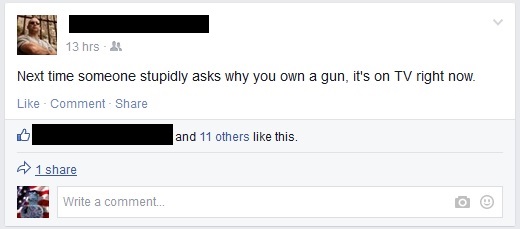
And there you have it, pretty much the only honest argument for mass unregulated gun ownership you’re going to find. I must arm myself to remain safe from marauding Negroes.
Gun advocates remain convinced beyond reason that there is an obscure “other” among us, determined to destroy all that we cherish. At different times and among different people you’ll hear this other described in the form of illegal aliens, marauding urban blacks, or apocalyptic spiritual forces.
Only by relentless vigilance can that other be held at bay. Weak-kneed liberals enable and cultivate this other. Their high-minded rhetoric obscures the presence of this threat, making us all more vulnerable. Any and every effort to curb my access to weapons is a veiled attempt to leave me vulnerable to this other.
Attempts to discuss otherwise sensible gun regulations are skewed beyond all reason by the dark matter of our defining national pathology. Ironically, the Trump trainwreck may promise some relief.
Trump has built an entire Presidential campaign on our otherwise undiscussed racism. By dragging our singular modern pathology into the full glare of the political spotlight, we are being forced to develop the insights, language, and tactics to finally address it. On the other side of this mess, we might find a new capacity to cope with a whole range of issues rendered off limits by our great collective glitch. Once we learn to factor the hidden variables into the debate we might solve the gun control equation.
 Ancient maps often marked their blurry fringes with a warning, “Here be monsters.” Sometimes the warnings were illustrated with charming images of the menace that lurks beyond the reach of the known world. Never did those monsters sport an orange comb over. Time for an update.


 GOPLifer