American conservatives’ Putin man-crush

Pat Buchanan has been defending Putin for years as a successful culture warrior defending civilized values against the growing power of liberal nancies. Social conservatives admired his courage in standing up for besieged heterosexuals.

Isaac Chotiner has a piece about conservatives and Putin in the New Republic:

During the nearly 50 year Cold War, Americans were informed time and again by rightwingers that the Soviet Union did not allow dissent, and could therefore pursue its desired policies without protest. While the Soviets were single-minded, we were, yes, decadent. Soviet leaders could fight wars as they pleased, but freedom-loving presidents like Ronald Reagan had to put up with what Charles Krauthammer laughably called an “imperial Congress.” (Some of the same type of commentary shows up about today’s China: look how quickly the Chinese can build bridges! And, as Thomas Friedman proves, it isn’t coming solely from the right.) But more unique among conservatives is the desire for a tough leader who will dispense with niceties and embrace power.

It will be interesting to see how the recent far-right love affair with the Russian autocrat plays out as he becomes a more aggressive enemy of the West.

Posted in Uncategorized

Adapting to an Age of Global Wealth

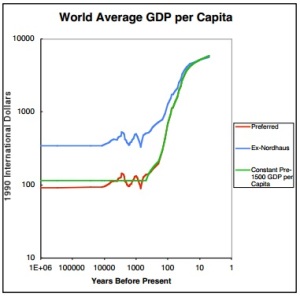
gdpPerhaps a single data point can summarize the shape of the world and the challenge before us. Since roughly 1975, the global economy has added more wealth per capita than we created in all of previous human history. The unlocking of the global economy across the 20th Century has produced an explosion of economic growth so staggering it is almost impossible to take it all in.

Yes, this expansion is also radically unequal, but focusing on that one fact misses an important dynamic that shapes our time. An ordinary human being born anywhere on the planet today has more personal influence on their own life, on average, than they ever have before.

The great story of our age is the sudden, unprecedented expansion in the basic value of a human life. In terms of US politics, this dynamic helps to explain a wide variety of seemingly unrelated phenomenon that are gumming up the machinery of our politics and realigning our political poles. Though this is a happy development, it is introducing new challenges that we are ill equipped to address.

In the US, expanding personal rights help explain the general acceptance of same sex relationships and the growing consensus over basic, universal access to health care. It explains the apparently conflicting yet entirely predictable tension between the expansion of women’s equality and our growing public unease over abortion. It helps explain why the viability of big central governments is crumbling at the same time that our demand for government services is expanding.

Global politics in the 20th Century may have been defined by the great struggle between central authority and personal liberty, but the victory of human rights in that struggle has given us a new paradigm, complete with a vastly more volatile and exciting combination of problems and opportunities. The steadfast refusal of the political right in the US to turn their heads around and look honestly at the future is crippling our ability to shape that future. This is a new ballgame and we are wearing the wrong equipment. Increasingly, we are also wearing the wrong jerseys.

Over the next decade or two we will answer a set of questions which will determine how broadly the prosperity of this era is shared, how many of the world’s people will get to participate, how many people will be killed by the instability created by the new dynamism, and whether the US will be a leader in this new era as by all rights it should be. We haven’t begun to make plans to address these new questions because they have emerged too quickly for us to recognize them.

There are three primary dynamics that are dictating the shape of life in this century:

Growing individual power is rendering old methods for preserving order obsolete.

Civilization is built on managed violence. The most powerful and wealthy civilizations are the ones that can contain private violence while leveraging the lowest possible levels of public or centralized violence. The more individual decision-making power a civilization can tolerate without collapsing into anarchy the wealthier and more powerful that civilization will be.

The rise of individual power is undermining the methods we once used to ensure cooperation at low levels of violence. Ethnic, religious, and tribal identities that once constrained people’s behaviors in ways that made them more compliant are suddenly, radically less effective.

The growth of individual power is a good thing, but every change has consequences. This dynamic is destabilizing traditional institutions everywhere. In the US we see this in the decline of community organizations, organized religion, and the old social-capital infrastructure of participatory government. In short, structures built to govern a slave Republic may not be as effective in serving the needs of a nation dominated by software developers and venture capitalists.

Elsewhere in the world we are seeing an unprecedented collapse in the basic viability of government. In the last century we worried about the seemingly unrelenting expansion of central government power. Now, the greatest threat to global security is the seemingly unstoppable expansion of the “failed state” phenomenon.

This is not just about Haiti and Somalia. Significant swaths of Europe are effectively stateless. There are quirky enclaves like Trans-Dniester, Kaliningrad, and North Kosovo, but the phenomenon includes larger entities. It is unclear when or if Bosnia, Georgia or Ukraine will ever have a minimally functional central authority.

We are seeing shorter cycles of creation and destruction of core institutions.

How long would it take for the world’s most prosperous corporation in 1910 to become obsolete or bankrupt. How long does it take now? Economic dynamism means the world is creating vastly more wealth than it has in the past, but it also destroys older incumbent forms of wealth generation more quickly. It is very difficult for ordinary people to adapt fast enough to keep pace with the demands of a knowledge economy. Though we are creating a lot of wealth, we are doing it the price of constant, extraordinary anxiety.

The “wild” world is gone forever.

Nothing on Earth is unconquered or unaffected by human decisions. There are no truly wild animals or wild places anymore, no matter how remote or uninhabited. The growth of human population and power means that every decision we make has ripple effects not just on other humans, but on natural resources.

Strangely enough, this does not mean that the future will be dictated by scarcity, quite the opposite in fact. It does, however, mean that a host of seemingly insignificant decisions, like whether to get my water from a disposable plastic contain or a reusable one might determine whether seal populations in the North Pacific survive or go extinct.

In other words, now that we have utterly conquered the natural world, we need to make some affirmative decisions about what to do with it. Otherwise, we will simply wreck it arbitrarily with consequences to human health and welfare that will be impossible to predict.

The new value of human life, with its accompanying expansion of personal liberty and prosperity is a fantastic accomplishment, truly the End of History as we once understood it. It is not, however, the end of the human story or an excuse for complacency. We face a whole new set of challenges, a sort of New History based less on ideological conflicts than on basic administration which will determine how rich, how peaceful, and how happy human beings will generally be a century from now.

Not only are we failing to confront these new challenges, we seem not to even recognize them. Especially on the right in the US, our politics has descended into a bizarre spectacle of anachronism, obsessed with supposed issues that have no relevance to the present or the future. To a very large and very frightening extent, the shape of the next century at a global level will be shaped by the success or failure of political conservatives in the US in recognizing and adapting to the world they helped birth. We are not off to a promising start.

Tagged with:
Posted in Economics

A Houston Republican on marriage, fundamentalism and the culture wars

Here’s a little quiz. Which raving lefty in the Democratic Party penned this:

We do not live in a theocracy. Our country is not a church. And that is by design. The Founders of this country insisted upon religious freedom. Obviously, the religious beliefs, or lack thereof, of every voter inform our laws through the people they elect to represent them. But the Constitution guarantees that the majority of voters in any state cannot override the basic protections outlined in the Fourteenth Amendment for any minority group – to do that would require another amendment to the Constitution.

It is time to recognize that homosexuals have the same rights as any other citizen. I suppose that states could simply stop recognizing all marriages, like a state representative in Oklahoma is attempting but that seems to be rather extreme. Short of that, all citizens should be treated equally under the law.

The answer, of course is: none of them. That quote comes from Houston’s Republican blogger David Jennings. Hearing this kind of rational, thoughtful, consistently conservative argument for same sex marriage coming from a Texas Republican grassroots activist is a very encouraging development.

I have no idea why Republicans keep talking about homosexuality in any context. Gay baiting was a briefly successful strategy during the Bush Era, but we have worn it out completely. Now it backfires, further feeding the perception of Republicans as bigoted curmudgeons out of touch with American values.

Perhaps the end of gay baiting in the Republican Party could mark the beginning of a shift toward a more sane agenda. That isn’t happening yet, but as more Republicans like David Jennings recognize the conservative case for same sex marriage, the closer the party will get to that critical mass.

Tagged with: , ,
Posted in Civil Rights, Uncategorized

The First Rule of Foreign Policy: Don’t Panic

American foreign policy has always been a bit short on perspective, but that problem has been markedly worse since 9/11. Somehow our enemies, no matter how weak or pathetic, loom like giant mechanical super-villains in our imaginations. Viewed with a sober, long-term lens, events unfolding in Ukraine could not be more favorable for the US. We have not been so lucky in decades.

Here is what is happening that we are somehow not seeing.

Russia is unravelling. The neo-fascist dictatorship under which the Russians live has been growing more and more brittle as oil prices stabilize and the population grows ever sicker, poorer, and more isolated from global markets. The population is in free-fall, due mostly to staggering mortality rates. The military is grumbling, underfed and underequipped, incapable of sustaining operations against an organized enemy. Their “nuclear deterrent” is a crumbling collection of poisonous garbage that was probably minimally functional in the best of times. The threat it poses now is the toxic waste it is leaking into the environment and the risk that the pieces might fall into the hands of someone capable of using it.

This is not 1956 and Kiev is not Budapest. There are sizable, influential Ukrainian communities in New York, Chicago and London. The Russians have no ideological influence in the world. Zero. No matter what else happens now, by invading Ukraine Putin has slipped a noose around his neck. He is very unlikely to die in his own bed.

Here is a list of forces Putin has set in motion this week in his stupid, short-sighted effort to retain dictatorial control over his own people:

Turkey has now been pushed into the EU. For a decade the Turks have been flirting with the idea of Islamic nationalism as an alternative to integration with Europe. That was never a good fit for an increasingly sophisticated, globalized and secular culture. That experiment died this week.

Turkish resentment of Russia has always been far stronger than their connection to their mostly Arab coreligionists. The Turks just learned where their future lies. The Russians can expect to lose the ability to move the Black Sea fleet and experience significant harassment of their Black Sea trade. They cannot challenge the Turks, partly because the Turkish military is stronger than the Russians, but more importantly because Turkey is a NATO member. Turkey, like several other countries, is about to rediscover its enthusiasm for NATO.

Whatever global leverage the Russians may have accumulated by their resistance to the American wars in the Middle East just disappeared. Whatever people around the world may think about America, they have far more fear of Russian (and Chinese) power than of America. The Iraq invasion may have been stupid, but there was a certain weird logic to it and we got out of there as soon as we could sober up and find a way. This invasion communicates to every country on Russia’s periphery (and there are lot of them) that they could be next, with little warning.

Putin may have just guaranteed that the Keystone Pipeline gets built and Europeans get access to vast new supplies of natural gas from North America. As Russia becomes a naked pariah, new markets for natural resources are going to pour money into the American Midwest. That new flow of resources and money are going to add to the desperation of the Russian people as opportunities dwindle.

All the leverage Iran and Syria have held in their efforts to keep building nuclear weapons or keep murdering their people, respectively, just blew away like smoke. There will no longer be any reason for the US or Europe to continue to defer to the Russian regime on anything, anywhere.

European Union expansion is back on the table. The problems with the Eurozone took some of the luster off of EU membership for many countries on the periphery. At the same time, Russia’s bluster raised the cost to the core EU countries of any potential expansion. This muscle-flexing changes the logic behind EU expansion both for countries inside and outside the Union.

NATO has a new reason to exist. The invasions of Iraq and Afghanistan had placed serious strain on NATO. The unilateral decision US to invade Iraq raised the internal political cost of NATO membership at a time when the logic behind the alliance seemed to be fading away. This week, Vladimir Putin generously rescued the North Atlantic Treaty Organization, giving the organization the energy it needs to remain vital for at least a generation and expand to new members.

What’s more, Ukraine will almost certainly be a NATO member within a decade. It will be interesting to see what happens now with Georgia, but it is now far more likely that Georgia will join both the EU and NATO than it was before Putin invaded the Crimea.

For all of this to unfold to the US’s benefit, we must remain sober and patient. These events validate American power and influence in the world. So long as we don’t panic and don’t overestimate our enemy, everything about this mess turns toward the benefit of the US and the spread of liberty.

We should begin imposing sanctions on the Russian regime in a gradual, but steadily escalating manner. Senator Rubio’s proposals are a good start, except for the ridiculous suggestion to immediately invite Georgia into NATO his pointless political jab about arms control. Putin has placed himself in an absolutely impossible situation. The conflict he has started is one he can neither win, nor extract himself from. It will probably end with him swinging from a light pole in some gray Ural hellhole. The Russian people are likely to pay the highest price in this drama and there’s little we can do for them now. Most of all, we just need to keep our heads and let Putin lose his.

Tagged with: , , , ,
Posted in Foreign Policy

The Chipotle Economy

Matthew Yglesias published a good piece this week explaining the economics that drive the expansion of the low-wage service sector. He used Chipotle as an example, explaining how the process of creating a burrito is hard to automate or export, yet remains stubbornly low-value.

Think about it. You, of course, can assemble burritos in a sweatshop in Cambodia, freeze them, put them on boats and trucks and then reheat them. But microwaved frozen burritos, though delightful when pulling an all-nighter in college, are fundamentally pretty gross. While I wouldn’t exactly say that you can’t replace burrito-making humans with burrito-making machines, I’m not sure anyone’s going to bother any time soon.

The problem is how to adapt to this shift. Instead of having an economy dominated by a large number of middle-income jobs with a few lows and highs, global capitalism is giving us a new paradigm. We have a remarkably large (and increasing) percentage of the workforce engaged in work that earns more than almost any jobs in past. But they are still a minority, maybe 15-25% of the workforce. For everyone else, the bottom has dropped out of the economy.

Yglesias’ prescription would make Republicans smile if they could manage to wipe the froth from their mouths and quit screaming hysterically about whatever paranoid fear has grabbed their attention at the moment. In a rare moment of clarity from the left, Yglesias tackles both income support and deregulation as twin prescriptions for poverty relief. This is trend that could bring left and right together toward something useful if we could seize on it.

Real wages and living standards have both a numerator and a denominator. The most sustainable way to tackle the problem of stagnating or falling working-class incomes is to work on the denominator—on the various regulatory privileges used by the wealthy and powerful to entrench their income and raise costs for everyone else. Snob zoning laws that keep mobile homes out of neighborhoods where land is cheap—and that dense apartment buildings and rooming houses out of places where it’s expensive—are a huge part of the problem. So are rules that make it harder to open new bars and restaurants, raising prices by reducing competition while also reducing job opportunities. Of course, taxing the rich to give everyone free money is also a great idea with a solid historical track record.

If, somehow, the Great Republican freakout could end before the Great Democratic Crackup begins, there are a lot of really frustrating problems that we could fairly quickly solve. What are the odds…

Tagged with: ,
Posted in Economics

Ted Nugent and our culture of cowardice

Democrats are starting to have powerful success painting the GOP as the party of bigots, with good reason. When Ted Nugent channels Bull Conner, delivering a Jim Crow-era rant about our “mongrel” black President the problem gets worse. When Ted Cruz effectively defends him on national TV, the portrait is complete and there is little anyone else can do to fix the damage.

This image of Republicans as the party of racists only touches the surface of the problem. The party’s alliance with bigots is an accident arising from other choices. Bigotry has become a core Republican value not because of racism, per se, but because of the party’s addiction to fear. The GOP has become the de facto home of America’s bigots because it has sought to be the official home of America’s cowards.

Watch Fox News very closely and you will notice one theme present in absolutely every segment – fear. The surface subject may be as dull as fiscal policy, currency, or the weather, but they will find a way to inject fear into the rhetoric. Conservatives are America’s most fiercely pessimistic voting block. They are afraid of almost everything.

Right wing fears are becoming self-realizing. Nowhere is that sad fact more mathematically obvious than in the lunatic obsession with gold. Gold fever has cost ordinary Republicans far more money than they will ever pay to support Obamacare, yet the shiny metal has lost none of its luster on Fox. The ads run all day and night.

In an authentic financial crisis the metal will be as useful as a nice pair of wingtips, but buying gold isn’t about value or financial planning. Like everything else that happens on Fox, buying gold is about buying fear.

Just like Glenn Beck’s favorite scam, Goldline, Ted Nugent and Ted Cruz are selling fear to white people who are watching their privileged place in America and the world melt away. There’s a black man in the White House. Gay people walk around holding hands like its no big deal. Brown people in dirty little foreign countries are getting rich building things the Fox News audience barely understands.

The simple small-town “values” of the past are a ticket to poverty, alienation, and disenfranchisement. In modern America, our most persistent, unsolveable, grueling poverty is found in our overwhelmingly white countryside. The highest rates of food stamp growth are in white suburbs.

Being white and “hard-working” was once enough to guarantee a certain lifestyle. Now South Asian software engineers are our new elite. Women are getting higher education at a faster rate than men. Settling down and having kids with a loving spouse at an early age is a recipe for poverty. Good old-fashioned American values like Sarah Palin espouses will earn you a painful reality show lifestyle.

The “real America” is gone. It has been replaced by something that terrifies a lot of older white Americans. It shouldn’t.

Republicans fought for decades to create this new world. The structural problems created by a dynamic new global economy are a winning lottery ticket compared to the problems we have faced in the past. Unfortunately, confronting these problems requires a level of curiosity and inquiry that frightens a lot of people. Our failure to address these problems in an intelligent way has already destroyed the middle class. It has destabilized the international financial system. Now it threatens to stall economic progress for an entire generation.

Calling out Nugent’s racism is not as important as recognizing where it comes from. As long as Republicans are satisfied living on steady diet of high-calorie, low-fact fear, the country will continue to limp forward. Global capitalism is a complex gift that our ancestors bled to deliver to for us. It is bringing freedom and prosperity we never imagined. It is bringing demands for management and regulation we did not anticipate.

Freedom is forcing us to accept differences in other people that some people find scary. The structural demands of capitalism are forcing us to use government in ways we had not thought necessary. Preserving liberty, humanity, and peace in such a dynamic world will require intelligence, but most of all it will demand courage.

Ted Nugent is a symbol of cowardice. He displays it in his personal life and it soaks every aspect of his public persona. No one with a reasonably secure mind needs to wave guns around. As a party we have to decide whether we still believe in America, whether we still believe in freedom, and whether we still believe in ourselves.

Tagged with: , , , ,
Posted in Civil Rights, Gun Rights, Uncategorized

When liberals abandon science and embrace organic quinoa

Conservatives in our era have a lunatic relationship to empirical reality. The miserably pathetic struggle of the right wing of the GOP to shut out the offensive noises emitted by scientists has become one of the central themes of our time. But they are not alone.

I wish I could reproduce this Daily Beast post by Michael Schulson in its entirety. Better yet, I wish I’d written it:

You don’t have to schlep all the way to [the Creation Museum in] Kentucky in order to visit America’s greatest shrine to pseudoscience. In fact, that shrine is a 15-minute trip away from most American urbanites.

I’m talking, of course, about Whole Foods Market. From the probiotics aisle to the vaguely ridiculous Organic Integrity outreach effort (more on that later), Whole Foods has all the ingredients necessary to give Richard Dawkins nightmares. And if you want a sense of how weird, and how fraught, the relationship between science, politics, and commerce is in our modern world, then there’s really no better place to go. Because anti-science isn’t just a religious, conservative phenomenon—and the way in which it crosses cultural lines can tell us a lot about why places like the Creation Museum inspire so much rage, while places like Whole Foods don’t.

If you want to hear a lefty take leave of all their pretensions about a superior scientific understanding of the world, change the subject to food.

If scientific accuracy in the public sphere is your jam, is there really that much of a difference between Creation Museum founder Ken Ham, who seems to have made a career marketing pseudoscience about the origins of the world, and John Mackey, a founder and CEO of Whole Foods Market, who seems to have made a career, in part, out of marketing pseudoscience about health?

Well, no—there isn’t really much difference, if the promulgation of pseudoscience in the public sphere is, strictly speaking, the only issue at play. By the total lack of outrage over Whole Foods’ existence, and by the total saturation of outrage over the Creation Museum, it’s clear that strict scientific accuracy in the public sphere isn’t quite as important to many of us as we might believe. Just ask all those scientists in the aisles of my local Whole Foods.

The article is a gem. In summary, the attempt (it is always just an attempt) to live a life in consistent contact with the best measures of objective reality means near constant discomfort. None of us really like it, otherwise there would be no Disney World. Perhaps we should all be a little more patient with each other. Yes, I remember what I’ve written and I’m mindful of the pieces I’m planning to write as I make that statement. Will be thinking about it.

Tagged with: , ,
Posted in Uncategorized

Another very hot January

The numbers are in and we just had another scorching January. From the National Climate Data Center at the NOAA:

According to NOAA scientists, the globally-averaged temperature over land and ocean surfaces for January 2014 was the highest since 2007 and the fourth highest for January since reliable record keeping began in 1880. It also marked the 38th consecutive January and 347th consecutive month (almost 29 years) with a global temperature above the 20th century average. The last below-average January global temperature was January 1976 and the last below-average global temperature for any month was February 1985.

That was news to me. Much of my weekend was spent using a one-two combination of snow-shovel and drill to plant campaign signs in the frozen earth. And that’s the problem with climate change politics in a nutshell. We experience weather and we mistake it for climate.

It’s been very cold this year in Chicago, but here’s what’s interesting about that from a climate perspective, again from the NOAA report:

Temperature departures were below the long-term average across the eastern half of the contiguous U.S, Mexico, and much of Russia. However, no regions of the globe were record cold.

Though locally we’ve had some climatologically interesting summers in recent years, this winter was only extraordinary because it’s outside the recent local norm. And also because it has been weird. Extremely weird. That weirdness is the only dimension of climate change that we reliably perceive. That makes it very difficult to communicate the reality and impact of climate change to a public who do not generally understand the underlying science.

Tagged with: , ,
Posted in Climate Change

Sen. Tim Scott is the GOP’s ‘Black Friend’

scottThe environment inside the Republican Party today is a treacherous moral swamp for African-Americans. No black conservative figure has yet managed to remain in a position of influence inside the GOP while speaking honestly about racial questions.

When an NAACP chairman derided Republican South Carolina Sen. Tim Scott recently as a “ventriloquist’s dummy” he touched a deep nerve. Going all the way back to Reconstruction, black conservatives have fought to justify their emphasis on economic progress against those who sought more direct resistance to injustice.

That is a fine line to walk and it has never been easy. When black leaders allow themselves be used as tokens, they will deserve the suspicion they retain in the black community no matter what other sincere goals or opinions they may hold. This is an unfair dilemma that white political figures seldom face, but history has made it unavoidable.

Black leaders cannot expect to be taken seriously so long as they quietly acquiesce to rhetoric and policies openly hostile to minority communities. For black conservatives, the price of credibility is courage.

Standing in front of a white audience and validating their racist assumptions is a fast track to popularity and political opportunity. Few things thrill a white nationalist more than a black man who agrees with him.  Every racist has ‘lots of black friends’ and being one of those black friends offers benefits.

With the GOP in thrall to an ugly Neo-Confederate resurgence, the 2012 Republican Convention featured its lowest percentage of black delegates in modern history. Interestingly, while there were only 46 black delegates, the convention featured eight minority speakers on the main stage alone. Being a black Republican willing to toe the line without question is an outstanding way to gain access to a platform.

It is entirely reasonable to expect that Sen. Scott’s position as a Senator was paid for by his willingness to be used. He has done nothing yet in his career that would be inconsistent with that characterization. Recite the party’s talking points and he gets to be a Senator. Acknowledge the existence of racism in any credible matter and he will be escorted to the exit, where he will be greeted by Colin Powell and Michael Steele.

One of the GOP’s other black friends, former Rep. Allen West, learned that lesson the hard way when he accidentally said something honest about the Trayvon Martin case. He quickly backed down, explained that Martin had it coming because he wasn’t a “respectful young man.” West recognized the value of being a “respectful young man” in the GOP and now he has a nice gig with Fox News.

This dilemma complicates the appeal of black conservatives, making it extremely difficult to communicate a credible, persuasive message without losing access to the political process. To speak honestly about race means being ostracized from the Republican Party. To speak honestly about the role of values and culture in the plight of the black community means being ostracized from the Democratic Party. Black conservatives can accept a humiliatingly subservient role in a Republican Party that wants them to perform like circus animals or sit outside the process, alienated and disempowered.

Not everyone in the black community sees this dilemma. In particular, many black religious fundamentalists do not perceive this problem at all. It is from their ranks that figures like Tim Scott and former Rep. Allen West have emerged. If you believe in a 6000-year-old universe it isn’t so hard to believe that Obama is a Socialist Anti-Christ or that he cheered the attack on the American Consulate in Benghazi.

Black religious fundamentalists feel comfortable walking shoulder to shoulder with Tea Party activists bent on destroying minority voting rights and ending “income redistribution” to black urban moochers in hoodies. They are marching with the far-right far-white in pursuit of higher, apocalyptic goals. If gay marriage is the single greatest threat to civilization then perhaps an alignment with the GOP’s farthest ideological fringe makes sense.

For non-white conservatives with their feet planted firmly in the reality-based community the rhetoric being spewed by Republicans in recent years is more than a little frightening. Some hard-right black evangelicals may have made peace with the Tea Party, but their numbers are very small. That’s why most if not all of the African-Americans at your local Tea Party rally will be speaking onstage.

Whether he likes it or not, Sen. Scott is becoming a national mascot for the efforts of Tea Party Republicans to whitewash the movement’s glaring racism. The dilemma he faces may be unique to black political figures, but as the Republican Party becomes more and more an engine for white nationalism, that burden spreads more broadly to all conservatives, regardless of race.

The same credibility problem faced by black conservatives is becoming a dangerous threat to conservatism at large. If Sen. Scott is a token set up to distract us all from the GOP’s racism, then what is Karl Rove? At what point should all conservatives face the same duty to speak about racism that we justly place on Sen. Scott’s shoulders?

If conservatism is going to survive, conservatives should all take a close look at the dilemma faced by Sen. Scott. The movement badly needs an update to avoid atrophying into a tool of racial and political anachronisms. Conservatism will not survive if it fails to represent something more compelling than the stubborn preservation of white cultural supremacy. A handful of well-placed black friends may obscure the party’s problems, but they are not going to save conservatism from itself.

Tagged with: , , , , , ,
Posted in Neo-Confederate, Race, Tea Party

Robots will create your next job

Since the day someone invented a mechanical loom 400 years ago, pessimists have been claiming that technology will destroy jobs. The reality is far more complex. Technology destroys jobs while creating others that no one anticipated or imagined. In our time innovation is not so much eliminating jobs as changing the shape, duration, and rewards of a career. For many, though not all of us, this has been a very positive development.

The authors of “The Second Machine Age” have offered another explanation of how the process of innovation destroys older forms of employment and brings new, better jobs in its wake. From a review in the Washington Post:

The big winners in this new era will be consumers, who will be able to buy a wider range of higher-quality goods and services at lower prices. The other winners will be those who create and finance the new machines or figure out how best to use them to gain competitive advantage. Great wealth will be created in the process.

To illustrate the point, Brynjolfsson and McAfee cite the example of Instagram and Kodak. Instagram is a simple app that has allowed more than 130 million people to share some 16 billion photos. Within 15 months of its founding, Instagram was sold to Facebook — a company with 1 billion users — for $1 billion. It was only a few months later that Kodak, the Instagram of its day, declared bankruptcy. The authors use this little vignette to illustrate two points. The first is to point out that the market value of Facebook/Instagram is now several times the value of Eastman Kodak at its peak, creating, by their calculation, seven billionaires, each of whom has a net worth 10 times greater than George Eastman ever had. Such is the “bounty” of the second machine age.

But the evolution of photography also demonstrates how unevenly that bounty has been divided — what the authors somewhat inelegantly call the “spread.” Not only has it created a new class of super-rich entrepreneurs and investors, but it has done so with a company that employs only 4,600 workers. Compare that with Kodak, which at its peak employed 145,000 workers in mostly middle-class jobs.

And what do these brilliant minds suggest should be done at a political level to adapt our culture to the opportunities and demands of “the spread.” You may have heard this idea mentioned somewhere before:

To deal with what they see as the inevitable increase in income inequality, the MIT duo would turn to a negative income tax, with which the government would assure a minimum income to anyone who works — an old idea now gaining popularity on both the left and the right.

That’s why business-oriented minds on the right are talking about a new approach to the social safety net instead of endorsing the Cruzian notion of burning the whole thing down. The rapid acceleration of technology present us with opportunities which we could easily fumble if we fail to recognize the meaning of this change.

Tagged with: , , ,
Posted in Economics, Welfare State
Goodreads

Enter your email address to subscribe to this blog and receive notifications of new posts by email.

Join 448 other subscribers