
How Protestant Evangelicals shifted their abortion stance

prolifeJamelle Bouie had a great piece at Slate last week explaining the long strange journey of Protestant Evangelicals from pressing for the expansion of abortion rights to vehement opposition to nearly every aspect of women’s reproductive choices. Bouie correctly identifies the trend, but he misses an important pivot point that calls the rest of his analysis into question.

Bouie correctly points out that political conservatives and Protestant evangelicals were relatively warm toward pro-choice causes until the ‘70’s. The nation’s most liberal abortion rights legislation prior to Roe v. Wade was signed into law by California Governor Ronald Reagan. Barry Goldwater was staunchly pro-choice across his entire career.

In 1971 the Southern Baptist Convention endorsed abortion rights for women in a remarkably bold statement for the time. The Baptists responded to Roe v Wade in 1974 by re-affirming their previous statement in favor of abortion rights.

The Protestant theological mainstream was described in a quote from Bouie’s main reference, a recent book by Jonathan Dudley:

“God does not regard the fetus as a soul no matter how far gestation has progressed,” wrote professor Bruce Waltke of Dallas Theological Seminary in a 1968 issue of Christianity Today on contraception and abortion, edited by Harold Lindsell, a then-famous champion of biblical “inerrancy.” His argument rested on the Hebrew Bible, “[A]ccording to Exodus 21:22–24, the destruction of the fetus is not a capital offense. … Clearly, then, in contrast to the mother, the fetus is not reckoned as a soul.”

Bouie goes wrong in identifying Roe v. Wade as the galvanizing factor that brought Protestant Evangelicals into politics in opposition to abortion and to broader reproductive rights. Anti-abortion politics was almost exclusively the realm of Northern Catholics, mostly Democrats, into the 80’s. Why would a Supreme Court decision in favor of something they generally supported change Protestants’ views on the matter? The answer is that it wouldn’t and it didn’t.

This shift in Protestant politics was a by-product of new alliances inspired by a different controversy. It was not Roe, but an earlier Court decision that created the Religious Right.

In 1971 the Supreme Court ruled in Coit v. Green that the Federal government could revoke the tax-exempt status of private religious schools that engaged in racially discriminatory admissions. This sparked a decade-long legal fight led by Bob Jones University that resulted in defeat after defeat.

That case was the catalyst that would eventually bring a Southern Baptist TV preacher named Jerry Falwell together with a Northern Catholic political operative, Paul Weyrich, to found the Moral Majority. For years Weyrich had been working to bring religious fundamentalists into politics. His efforts were slow to gain momentum and were unaffected by Roe. The Religious Right remained an inchoate force, disorganized, derided, and unpopular in both parties until the Carter Administration gave them the fuel they needed to ignite a populist firestorm.

In the wake of Coit and the long series of Bob Jones decisions the Justice Department had the authority, but not necessarily the will, to take the campaign against school segregation into the private school market. Desegregation had brought a stampede out of public schools. In the North, Catholic parochial schools were the main beneficiary. In the South, Evangelical churches launched into this industry, providing middle and upper income families a place to hide their white kids.

In 1978 the IRS under Carter announced new rules. White private schools that had begun or rapidly expanded under segregation would have to affirmatively prove non-discrimination in order to retain their tax exempt status.

Weyrich’s own description of how the Moral Majority found its feet makes no reference whatsoever to abortion:

“I was trying to get those people interested in those issues and I utterly failed. What changed their mind was Jimmy Carter’s intervention against the Christian schools, trying to deny them tax-exempt status on the basis of so-called de facto segregation.”

It is no accident that 1980 is the first year that the religious right shows up as a force in Presidential politics. It is also no accident that one of the Reagan Administration’s earliest major policy moves was the cancellation of this IRS policy.

Abortion politics, like positions on school prayer, porn, divorce law, and other religious issues followed in the wake of segregation, not the other way around. The Southern Baptists declined to take an unequivocal stand against abortion rights for almost a decade after Roe v. Wade. The culture war got its impetus from desegregation, not from abortion.

By the late ’70’s, overt race-baiting was no longer tolerated on the public stage. The forces threatened by the Carter Administration’s decision were in no position to campaign openly in favor of segregation. They needed a proxy. In time, abortion and school prayer became convenient, race-neutral rhetorical banners beneath which Southern Protestant Evangelicals and Northern Catholics could march together, however uneasily. The tensions that once divided them have not faded away entirely, but have come to matter less and less as the “culture” issues they share in common take center stage.

That awkward marriage has in time produced a unique offspring, best symbolized by Sen. Rand Paul. The modern Neo-Confederate movement has now managed to synthesize an alliance between the conservative Northern Catholics who once supported George Wallace and Southern Dixiecrats on the basis of a shared interest in religious fundamentalism and a resentment of government efforts to strip religious groups of their policy influence.

Bouie is right to point out that evangelical abortion politics has changed dramatically over a single generation, but it was school segregation, not Roe, that provided the catalyst.

Tagged with: , , , , , ,
Posted in Civil Rights, Neo-Confederate, Race, Religious Right, Reproductive Rights, Republican Party

Invasion? What Invasion?

Yet again we are reminded of how much hard-core Libertarians have in common with old-school Communists. Ron Paul’s think tank is striking back at the Students for Liberty founder who broke with the Paulites over Russia. Their reply is hilarious.

They call reports of an “invasion” a conspiracy theory. After all, 93% of the population voted to join Russia. They defend Putin and describe the criticism of the Russian invasion as “neo-con warmongering.” They then proceed through a series of hair-splitting arguments to assert that the Russian troops have done nothing in Ukraine that goes beyond the rights granted in their basing agreements.

When ideology trumps data the consequences are at best absurd, but too often tragic. All the same it’s fun to watch them wrangle. Brings back memories of Trotskyites battling Leninsts over the soul of Communism. And the running dogs of statism look on in laughter.

The full description is over at Slate.

Posted in Uncategorized

White people are poor because of their culture

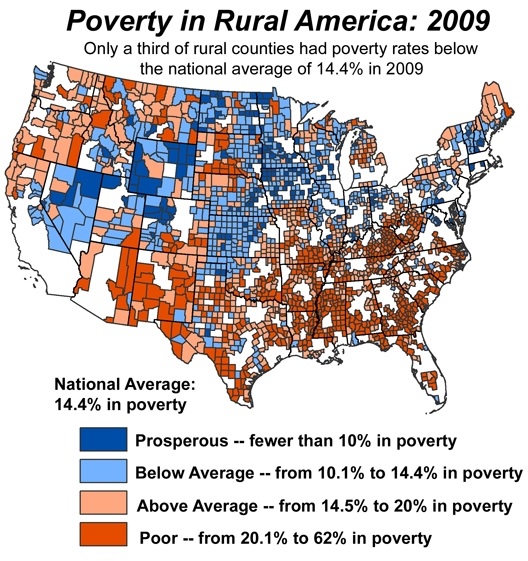
The Atlantic - Map of OpportunityPaul Ryan has been in trouble recently because of his comments about the “inner city” poor and their culture of laziness and dependency. Ryan’s courage in standing up to the PC Nazis is admirable. His stand may finally open up the potential for Americans to confront poverty without hiding behind euphemisms or dodging uncomfortable facts.

Thanks to Rep. Ryan, we may at last be able to confront the last taboo in political correctness. We may finally be able to address the culture of poverty that keeps white people poor.

It is unfashionable to talk about the depths of poverty in the white community, but the truth is that white people are the most persistently and deeply impoverished Americans. Poor whites are far more government dependent than their minority peers. Their poverty is more persistent, stretching deeper into history than any other group. Worst of all, their isolation, drug dependence and decaying culture renders them far more resistant to relief than other groups.

America’s most persistent poverty is found among the benighted white people of the Banjo Belt, stretching in an arc from West Virginia across the mountain South into East Texas and Missouri. Their condition is far worse than their lucky brethren in the urban ghetto. An unemployed Kentucky coal miner may have no place within a five hour drive to find alternative work. Meanwhile, a struggling young person on the hardest streets of Chicago’s West Side is within walking distance of some of the most vital and dynamic economic activity in the world.

This proximity to opportunity is a key reason why persistent poverty is so rare in urban areas compared to the countryside. The largest portion of the poor in cities are in fact recent émigrés, struggling to establish themselves. Since many of these people are not yet citizens, they have little access to the safety net, aggravating their poverty while they make their climb and skewing poverty statistics. The urban poor are many and they are a constantly regenerating pool, but they are temporary.

Compared to the miserable stretches of countryside that have been poor for as long as they have been settled , urban residents experience upward mobility at the same rate as in Western Europe. If you want to find persistent, widespread, inter-generational poverty in America, you need to find Southern mountain whites.

Though the politically correct will punish anyone who mentions it, culture plays as much of a role as geography in keeping Banjo Belt whites poor. Family structures there have always been informal, brittle and transient. The inhabitants are consistently some of the country’s most drug-addicted and the region is a center for crime, violence, drug-production and trafficking going back into time immemorial.

White cultural degradation is readily apparent from generations of their music and art. Cherished traditional songs like Little Maggie celebrate drug addiction and prostitution. The entire catalogue of Hank Williams is a litany of addiction, betrayal and misery. Johnny Cash got his big break with a hit song about a sadistic murder. The most popular sport in the region was originally developed as a competition among drug traffickers. From Lefty Frizzell to Dolly Parton and beyond, the culture elevates habits that destroy prosperity.

The problem is so bad that it has passed barely noticed into popular culture, tolerated by whites at almost every level. The unofficial theme song of the University of Tennessee commemorates drug traffickers who murder anyone foolish enough to wander into their lair. The site of thousands of young students blithely singing this song about drugs and violence should chill the hearts of those who long to see white people reach their potential.

White poverty is fed by other cultural burdens that interfere with their children’s ability to compete. Raised with an almost paranoid fear of outsiders and a resistance to change, many white children never have a chance at a decent life. A religious structure that crushes curiosity and instills a desperate suspicion of science means white children of the Banjo Belt face considerable difficulty mastering technical or scientific fields so essential to a modern economy.

Capitalism demands a global outlook and a willingness to enthusiastically embrace nearly continuous change. The cultural baggage of white people leaves them crippled in this environment, unable across generations to develop the habits and skills that breed success. White children bred in this culture are doomed to failure before they even get started.

Clearly, if the white children of the Banjo Belt are ever to have a realistic chance to break the fetters of a culture of poverty, some intervention will be required. This will be impossible so long as the dictates of political correctness prevent us from describing white poverty as what it is – an illness bred from a sick culture. The PC-police who would characterize such an assessment as anti-white bias are simply ignoring the facts. Their misguided attempt to protect the precious “feelings” of the white community are condemning a new generation of young whites to continue in a cycle of relentless degradation.

We have got this tailspin of culture, in our mountain South in particular, of men not working and just generations of men not even thinking about working or learning the value and the culture of work, and so there is a real culture problem here that has to be dealt with. No poverty relief will succeed until we address the cultural factors that keep white people poor, shiftless, and unemployable. Government programs are admirable, but until white people are ready to confront the ways that their culture enforces their poverty conditions will not substantially improve.

Tagged with: , , ,
Posted in Race, Welfare State

Local regulation and the politics of social conservatism

Time has a story on the impact of state and local regulations on market innovators like Tesla, Uber and Airbnb. There’s an opportunity here for Republicans, but it’s an opportunity we are unlikely to seize.

From the article:

Airbnb, a website that allows people to rent out everything from vacation homes to spare couches for short-term stays, works great for everyone but conventional hoteliers and cities trying to bilk travelers for tourist taxes. Operating in 192 countries and typically showing hundreds of thousands of offerings, Airbnb has faced stiff regulations in towns supposedly famous for their weirdness and openness to lifestyle experimentation, such as Austin, Texas (which charges hosts an annual licensing fee and limits the number of participants) and Portland, Oregon (which has banned the service in residential neighborhoods). In New York, rent-control advocates are teaming up with hospitality-industry heavyweights to try and shut down Airbnb and similar services.

Look carefully for the hand of the notorious Republican bogey-man in this piece and you will not find it. Sure, the Feds play their part in limiting competition and protecting economic incumbents, but it’s an extremely small part. Washington has nothing to do with the fact that I can’t use Uber to get to O’Hare. It’s not Washington that prevents food trucks from revolutionizing dining in freedom-loving, gun-toting downtown Houston.

Where were the “liberty” advocates of the Tea Party when Houston entrepreneurs were trying to break through stifling local regulations? Probably out protesting at abortion clinics and that gets to the heart of the problem.

It is harder than most people think to use use Federal power to build market protections. It happens, like in oil drilling, television broadcasting, and Internet service providers, but it accounts for a minimal fraction of our overall regulatory burden. Federal regulations are the simplest to track, the easiest to fight, the most practical to mobilize resistance against.

The forces that most complicate efforts to introduce innovation, and the creative destruction that accompanies it, are preferential rules, taxes and fees scattered throughout the more than 10,000 local government entities in our country. The City of Wheaton, a Republican bastion here in the Chicago area, issued regulations in 2010 to control the size and placement of RedBox machines. Why? A councilman described it as a “preventive measure.” What they were looking to prevent he did not say.

These kind of regulations exist everywhere, regardless of party or politics. The simple if cynical fact of the matter is that a local councilman is far cheaper to “influence” than a Congressman. It doesn’t take many of these nuisance regulations to gum up the works for a company trying to move into new markets. Though you hear Republicans rail about government intrusions in the marketplace you don’t see them do anything about this class of regulation for good reason.

It is politically expensive on many levels to tackle local regulations that protect established hotels, taxi services, restaurants, and other interests. On the other hand, it is politically cheap to target homosexuals, immigrants, or abortion clinics. There are no entrenched financial interests to confront and no hard choices to make.

It’s a fine formula. Complain about regulation in the abstract, where it matters little while focusing your real energy on poorly organized or financially weak targets who cannot hurt you (in the short run). Talk about EPA rules or government spending, abstract subjects far removed from the bump and grind of the political ground game. Meanwhile your real legislative attention is directed at under-represented scapegoats with little ability to fight back.

Companies keep their politically purchased market preferences while teen girls lose access to a safe abortion. That’s the political calculus that has made the GOP the party of social conservatism and left the party largely toothless in the real world effort to promote a more dynamic, prosperous economy. That’s why there is no major political force in the US championing the kind of economic dynamism that the Republican Party pretends to support.


Tagged with: , , , , ,
Posted in Economics, Political Theory, Religious Right, Uncategorized

Pat Buchanan goes full-Lindbergh

Just as Hollywood liberals have a sweet spot for Socialist dictators like Hugo Chavez, there are those on the far right who just can’t say no to a good Fascist. It’s been a while since they had one. Franco and Salazar have been dead since the 70’s. Milosevic was too buffoonish and brutal to be minimally attractive.

I had expected that Buchanan, Ron Paul and Rand Paul would back off the pro-Putin antics now that he’s set himself up as a solid enemy of the US. So far only Rand Paul is doing it.  He’s late, unconvincing, and entirely off-key. Meanwhile Pat Buchanan is racing in the opposite direction, channeling Charles Lindbergh and Henry Ford in a spirited defense of not only Putin, but the central tenets of Fascism.

In the estimation of this writer, Vladimir Putin is a blood-and-soil, altar-and-throne ethnonationalist who sees himself as Protector of Russia and looks on Russians abroad the way Israelis look upon Jews abroad, as people whose security is his legitimate concern.

Hmm…I wonder, what’s another term for a “blood and soil ethno-nationalist?” Something shorter, pithier, and dressed in a finely pressed brown shirt. And of course, the not-too-subtle tie-in to Israel is a fine rhetorical touch. The man is a pro. Leni Reifenstahl would be proud. So would Brent Bozell.

Even more unfortunate than Buchanan’s poor choice of allies is the effect this is going to have on the last remaining bastion of intelligent conservative thought. Buchanan has a stranglehold on The American Conservative. The thoughtful and intelligent writers at TAG have been a welcome counter to the increasingly paranoid bluster that has infected every other outlet of conservative thought in recent years. Fascism has always been their dirty little weakness and Buchanan is driving them straight off that cliff.

Read more from Buchanan’s most recent pro-Putin apology here, if only as a warning.

Tagged with: , , , , , , ,
Posted in Foreign Policy

NATO is looking better and better

If Putin’s goal was to give NATO a fresh reason to exist then the invasion of Ukraine has already been a success. Through half a century of Cold War Sweden and Finland were fiercely resistant to the alliance. Things have changed.

Finland is publically renouncing their neutrality, clarifying that they are aligned, if not formally allied, with NATO. Joining NATO remains an option on the table.

Sweden is making plans to ramp up military spending. They are exploring the possibility of initiating NATO membership.

NATO is becoming fashionable again.

Posted in Uncategorized

Blaming the Poor Feels Great

povertyAnd the disciples asked Jesus, “Who sinned, this man or his parents that he was born blind?”

Being confronted with the suffering of others triggers discomfort in almost any healthy person. That compassionate urge is particularly nagging when the misery has complex causes and cannot be easily relieved. Our discomfort grows when we have some power to alleviate the suffering we see, but doing so would cost us something we want.

Everyone must confront this dilemma in one way or another. There is more suffering in the world than any of us can address no matter how much angst or commitment we bring to the challenge. Whether it’s generated by the homeless guy at the train station or Sarah McLachlan’s dog commercial, everyone must make some peace with the sadness we see around us. We contribute where we can and sleep soundly.

Some methods of coping with that angst are more constructive than others. One of the oldest, most powerful and most deeply obnoxious ways to escape is to simply blame the victim. Not only does it eliminate our nagging discomfort, it imparts a refreshing spritz of righteous superiority. More than that, it numbs us to one of the healthiest, yet most deeply disconcerting by-products of other people’s suffering – the mortal reminder that “there but for the grace of God…” Blaming the poor stunts the development of humility.

As a form of suffering, poverty is a profound test of compassion because it can seldom be completely separated from personal choices. Poverty is the greatest temptation to calloused disregard. There are opportunities open to most people that would allow them to defeat poverty. And it is true that bad personal choices, sometimes morally compromised choices, are often the gateway to poverty.

When thinking about wealth, poverty, and virtue it is helpful to keep in mind that bad personal choices, sometimes morally compromised choices, can also be the gateway to enormous personal wealth. Some of the people whose fraud engineered the Enron debacle and the mortgage collapse are quite rich and happy. One of Enron’s architects is in prison. Another is living on a mountain he bought in Hawaii.

If we assume that the poor have some character flaw at the root of their condition, there is no reason not to assume the same of the wealthy. We all have a character flaw at the root of our condition. We are human.

We use the organizing power of government to raise the floor of poverty not just from compassion. Extreme poverty is like a virus that reproduces and spreads. No one builds a garden while their house is on fire. The conditions created by severe want preclude the kind of personal investment necessary to change one’s fundamental condition. That’s why we eliminated child labor and sweatshops. That’s why we mandate education for children. That’s why we criminalize prostitution.

When a family is struggling to meet basic needs for food, shelter and clothing, teenage kids drop out of school to pitch in. Mothers and fathers work longer hours to feed the family, leaving them little or no time to be parents. Older siblings take on parenting roles they are ill-equipped to perform. Families, in essence, eat their seed-corn, ever eroding their capacity to make investments in education, health, and mental stability that yield massive returns over time.

In rare situations, a few remarkably talented people emerge from grinding poverty to become successful. Sometimes someone survives a plane crash. That doesn’t mean plane crashes shouldn’t be avoided or that the victims are to blame for their fate.

What makes a guy like Ben Carson, for example, such a tragic figure is the way he turned his own remarkable success into a condemnation of those left behind; those crushed by the same conditions of poverty and racism he endured. Survivors’ guilt can be a terrible torment. The deep conviction that you made it because you were more righteous than the worthless losers left behind in the ruins of Detroit must be a wonderful balm, though the odor is terrible.

Just as only Nixon could go to China, only Republicans are suited to address the structural issues that continue to feed unnecessary poverty in our country. Making poverty relief successful means keeping an eye on wider goals. Our ambition is not to build a bigger, more intrusive government. Our goal is to prevent temporary, unavoidable misfortunes from destroying a family’s capacity to invest in themselves and participate in the economy. It was Republicans under Nixon who first proposed a basic income, which would eliminate poverty while gutting the poverty-bureaucracy. Republicans remain best position to promote such an opportunity agenda.

Republicans often complain about a “nanny state,” then with the same breath urge government to tell us how to live. Poverty rises from many things, but most of all from a lack of money. Until we are willing to spend some money – our money – to address poverty, we should just shut up about it. When Republicans are ready to stop congratulating themselves for being white and affluent and start questioning their obnoxious and frequently racist myths about opportunity, an opening will emerge for the kind of positive structural changes that come along once every century or so.

Unfortunately, Republicans are showing no interest in addressing questions of economic opportunity. Poverty is complicated and there are few things Republicans hate more deeply right now than nuance. Paul Ryan can thrash and flail all he wants, but as long as he continues to coddle Republicans who insist on tying righteousness to wealth he will fail.

Meanwhile, with every poor kid who drops out of high school to take more hours at the restaurant, the country surrenders another opportunity to become freer, wealthier, and better able to compete. Blaming the poor feels great, but it comes with a cost.

Tagged with: , , , ,
Posted in Economics, Republican Party, Welfare State

Life After Future Shock

phaserAt Christmas a few years ago we gave my son a Star Trek phaser and communicator. They were impressive replica toys complete with all the features and details from the original series. He was initially very excited about it, but an interesting thing happened.

Once all the wrapping was cleaned up and the Christmas high descended into the Christmas hangover he disappeared with his new phone. It was nothing special, a flip-phone that came free with our family plan, but it was his constant companion. Near as I can tell the phaser was never touched again after Christmas dinner.

One of the finest technical accomplishments of the imaginary 23rd century pales in comparison to a 21st century give-away. With a few exceptions, the gadgets imagined by the writers of Star Trek are embarrassingly inadequate in comparison to cheap ordinary consumer toys we take for granted. In just four decades we’ve outrun the farthest limits of a prior generation’s technological imagination.

Let’s face it. Captain Kirk’s communicator is a useless piece of crap. You can’t tweet on it. It doesn’t take pictures. You can’t stream music on it or use it to find the nearest Starbucks. It won’t even send a text message.

While the original Star Trek was still on the air, Alvin Toeffler was writing Future Shock. He speculated that a dawning era of permanently accelerating technological advancement would strain human society and personal sanity in ways we could hardly imagine.

Toeffler’s vision has proven remarkably accurate, but he failed to anticipate one important aspect of this transition. The ‘Future Shock’ phenomenon he described would, in a sense, end. It was an experience unique to those who still remembered the old world.

While older Americans rattle apart under the rising pressure of global competition, relentless anachronism and disintegrating social norms, a younger generation shrugs. They are fine.

You can’t miss what you never knew. Americans under 30 have no memory of permanence, stability, privacy, or boredom. They have grown into adulthood as technological natives. The only “shock” they experience comes from power outages.

A recent AT&T commercial spotlights this phenomenon. A couple of twelve year-olds watch younger kids enjoying AT&T cable TV. They muse about the difficulties of their youth, when your set top box could only record two shows at a time and only replay them in certain rooms. The kids they are observing (just three or four years younger) could not possibly relate to the hardships of their childhoods.

We may be experiencing a generation gap larger and more meaningful than the one that rocked our culture in the ‘60’s. For the first time in decades, young people are maturing in a world that bears virtually no resemblance to their parent’s experience. The gap is starkly visible in politics and religion.

The generation at the peak of their power and influence remains deeply marked by religious and political norms that are increasingly irrelevant to Americans under 30. Older voters on the left and right all look more conservative than their younger counterparts.

Where older voters value tradition, younger voters crave authenticity. Politics for older voters is still dictated by race, conservative sexual and religious norms, and a suspicion of government, values that are largely meaningless to younger voters. Today’s young are the most irreligious, post-racial, socially liberal generation we have ever raised.

Anyone who is expecting these kids to mellow and drift right as they age is kidding themselves. This gap is not a universal phenomenon. Contrary to popular myth, younger voters are not always more liberal than their elders. Reagan won massive majorities among the young and voters under thirty remained a solid Republican block until the mid-90’s. Many of those Reagan-era youth, your writer included, have grown disenchanted with the GOP as the paranoid panic of the Future Shock generation has driven the party into reactionary delirium.

Adapting to a world that renders science fiction quaint is a serious challenge for conservatives. Unfortunately, these are times that demand an intelligent, adaptive conservatism more than ever. Credible conservatism could prove to be a vital break, preserving critical institutions and values that might otherwise be cast aside in the headlong chase for efficiency and money.

Conservatives need not immolate themselves in a futile attempt to halt change. Instead they could be working to preserve some of the most critical (and portable) values of an older era, allowing us to carry forward traditional emphasis on family, patriotism, and duty in an era with little room for non-commercial values.

Authoritarian campaigns to dictate personal choices will not accomplish these goals. Today’s conservative agenda merely reinforces to younger voters that conservatives have nothing to offer the world beyond their bottomless drive to crush other people’s fun and block solutions to problems. Remaining relevant will require ingenuity and humility. Those are not traditional conservative strengths.

My kid still has those Star Trek toys. He never played with them, but he stored them. Meanwhile that dumb phone is long gone and forgotten; replaced by the new, new thing. The key to conservatism in the age of Future Shock is preventing essential institutions from being destroyed in the race toward novelty. We don’t have to dictate that everybody goes to church or gets married. We just have to make sure that some space remains for our traditions to survive. With a little care, the real value will weather the storm.

Posted in Political Theory

A Republican Future: Libertarianism for the Reality-Based Community

Marijuana“[Liberty is] that condition of men in which coercion of some by others is reduced as much as is possible in society”
F.A. Hayek, The Constitution of Liberty

A minimum income, Obamacare. Charter schools. Marijuana decriminalization. Cap and trade. These ideas have something in common. They are policy solutions formulated by libertarian economists.

Beneath the roiling surface of American partisan rivalry is an emerging consensus informed largely by libertarian ideas. The left often borrows from libertarians on social policy while the right is drawn to its emphasis on free enterprise, but neither side is seizing the opportunity to bridge traditional partisan boundaries with libertarian proposals.

Potential exists for that kernel of common interest to form the basis of a new political block, one which would obliterate traditional ideological boundaries and dominate politics for a generation. What’s missing from libertarian politics is a willingness to adapt to real world conditions. If libertarians on the right and left of our policy spectrum ever learn how to compromise to produce concrete, effective policy they could tap into an emerging public consensus, unleashing a revolution in American politics which could bring us a radically more prosperous, free, and peaceful world.

This developing consensus is centered on the notion of personal liberty, but not the fantasy-based “liberty” of the conspiracy kooks that have come to dominate “Libertarian” politainment. The Alex Jones’s and Mark Levins of the world are not about to lead a centrist political revolution. We cannot build an effective policy consensus on a shared suspicion of the Federal Reserve or rejection of the Illuminati.

The libertarianism represented by Ron and Rand Paul has developed into an obstacle blocking efforts to build a consensus that can work. Under the influence of the Pauls, particularly Rand Paul, the libertarian brand has been co-opted by Southern religious fundamentalists and paranoid conspiracy theorists, refashioning the movement into a strange, Neo-Confederate monster.

In an ironic twist, libertarian politics has been deployed as a screen for white nationalists who will accept no political compromise that fails to cripple the ability of a central government to remedy racial and ethnic injustices. The term “libertarian” has become synonymous with “weirdo,” creating serious problems for those who would use libertarian ideas to develop credible policy.

The old Chicago-School libertarianism of Hayek and Friedman was dominated by some very serious thinkers. They were willing to wrestle with the real world to in order to move abstract ideas into practical, workable policies. Hayek’s definition of liberty quoted at the head of this piece speaks volumes. First, he recognizes that threats to liberty do not come exclusively from government. More importantly, his definition is relative, not absolute. He acknowledged that some degree of coercion is inevitable in order to maintain civilized society. Early Chicago School scholars sought to make freedom real under the constraints of the world as we experience it.

What made that older generation of libertarian thinkers particularly potent was their willingness tackle the hard-cases; scenarios like pollution control and poverty which resist obvious libertarian solutions. Ironically, those are the fields where libertarian thought has, over time, had the most influence on policy.

Hayek endorsed labor regulations and the minimum wage.  Decades before anyone had imagined Agenda 21 he advocated regulation to insure environmental sustainability. Friedman helped craft legislation that would have created a basic income. For them, ideology informed rather than dictated policy. That kind of pragmatism will be critical if the GOP will once again be more than a support group for resentful aging white men.

Americans recognize that we need the organizing power of government to harness our collective will into action. Without it we would not have schools, roads, airports, a power grid, or the Internet. We would not have police, national defense, or courts. More than that, we are coming to realize that absent the organizing force of government, we will not have a health care system that is reasonably effective or affordable.

At the same time, we want as much freedom to make decisions for ourselves as we can obtain without sacrificing those goals. We want government pushed to the margins of the economy, limited to only the most necessary roles, leaving the widest possible latitude for individuals to control their own lives and own their own fate.

A large majority of Americans, especially among the young, want libertarian social policies paired with a market-capitalist economy that also delivers first-class infrastructure, a robust social safety net and universal health insurance. We can satisfy those seemingly contradictory demands, but it will require us to step outside traditional ideological lines and weaken older political alliances.

Imagine if libertarians actually had to govern and face real world consequences. No more gold standard fantasies or relying on the hand-waving magic of “perfect” markets that do not exist. What policies would libertarians embrace if they were forced to deliver outcomes without excuses?

The best place to observe America’s nascent, cross-partisan libertarian consensus is in Colorado’s experiment in marijuana decriminalization. Colorado’s plan is interesting for the ways it incorporates liberal and conservative priorities over the surface of a fundamentally libertarian policy.

Colorado has not deregulated marijuana. No one is free to simply grow, sell, and consume it without interference. A “liberty” interest in using whatever chemicals one chooses has been limited by Colorado’s government. Conservative social priorities are respected by restrictions on public use and the sale or possession by minors. Liberal interests in health and safety are demonstrated by the close regulation of sale and distribution channels.

Marijuana markets in Colorado are heavily regulated and taxed, not exactly a libertarian textbook strategy. This compromise, however, has the overall effect of expanding personal freedom while protecting the public.

Marijuana decriminalization may or may not prove to be a success in and of itself, but it forms a model for how core libertarian ideas can make their way from imagination to policy. More than that, the cross-partisan consensus developing around this model may form the genesis of a new political block that could disrupt traditional politics.

The civilization that will win the 21st Century is the one that unleashes the creative power of personal liberty to the greatest possible extent while maintaining the core effectiveness of its government institutions. Pragmatic libertarianism, built to expand personal liberty while still respecting the need for government as an organizing and mediating force, may form the core around which a massive new consensus could develop. When the dust settles and the internal fights are over, that is the core around which a potent new Republican majority could be built.

Tagged with: , , , , , ,
Posted in Economics, Republican Party

Are we wasting our time?

I ran across an article this week that inspired me to think a little more carefully about what we are doing here. By “here” I am referring to this little corner of the inter-tubes called the GOPLifer blog. Are we accomplishing something useful with the time we invest in this forum, are is this just another form of entertainment that helps us while away the hours?

Dougald Hine wrote a piece for Aeon magazine questioning the value of the Internet and our endless access to information. The gist of it is that information, in an of itself, has no particular merit. The value comes from our engagement with what we learn.

Information is perhaps the rawest material in the process out of which we arrive at meaning: an undifferentiated stream of sense and nonsense in which we go fishing for facts. But the journey from information to meaning involves more than simply filtering the signal from the noise. It is an alchemical transformation, always surprising. It takes skill, time and effort, practice and patience. No matter how experienced we become, success cannot be guaranteed. In most human societies, there have been specialists in this skill, yet it can never be the monopoly of experts, for it is also a very basic, deeply human activity, essential to our survival. If boredom has become a sickness in modern societies, this is because the knack of finding meaning is harder to come by.

That mass of data can be a tool for enlightenment or a means by which we find the nearest coffee shop. Or it can be a numbing stream that leaves us alienated, disengaged, and frozen.

…if the deep roots of boredom are in a lack of meaning, rather than a shortage of stimuli, and if there is a subtle, multilayered process by which information can give rise to meaning, then the constant flow of information to which we are becoming habituated cannot deliver on such a promise. At best, it allows us to distract ourselves with the potentially endless deferral of clicking from one link to another. Yet sooner or later we wash up downstream in some far corner of the web, wondering where the time went. The experience of being carried on these currents is quite different to the patient, unpredictable process that leads towards meaning.

Personally, I use this space to work out the stream of ideas in my head, weaving them from a mass of twisted fibers into something that seems to make sense, something that can be more neatly stored and used. I suppose, however, that if that process is never paired with action, if this is just an electric journal, I might just as well be watching Gilligan’s Island reruns.

Could an entire blog be successfully devoted to the endless Ginger vs. Mary Ann controversy? Are we sure this isn’t the same thing?

Posted in Uncategorized
Goodreads

Enter your email address to subscribe to this blog and receive notifications of new posts by email.

Join 448 other subscribers