Bernie Sanders: Heartless Scrooge

bernie

A little bird told me layoffs are coming

Bernie Sanders announced layoffs of almost half of his staffers this week as the campaign prepares for the final primaries. The move makes sense. As Sanders himself explained, “We have had a very large staff, which was designed to deal with 50 states in this country; 40 of the states are now behind us.”

For a while the Sanders campaign needed these employees to help meet the goals of the organization. Now it doesn’t. Why should Sanders keep paying for staff he no longer needs? Mitt Romney described this logic well when he said in 2012, “I like being able to fire people who provide services to me.” For some reason Romney’s remarks were received differently than Sanders’.

What if Bernie Sanders had to operate his organization under the rules he’s trying to impose on the nation’s employers? How would he navigate the final months of his campaign if he lacked the freedom to hire and fire employees to fit his organization’s needs?

For starters, it would take months for him to lay off that many employees. Sanders himself has worked hard over the years to stiffen the terms of the WARN Act, which requires 60 days’ notice for any layoffs. Sanders’ campaign meets the requirements of the Act in terms of size and the nature of his employees’ work. Why shouldn’t be have to comply with basic statutes protecting workers from abuse?

If Sanders had to operate under his own rules, his staffers would be protected from his greedy whims by a union. Terms of employment would be dictated by a collective bargaining agreement.

Want to keep or even increase staffers for the coming contests in California while dropping staff in New York? Sorry, no can do.  Almost any collective bargaining agreement in a western country will include rules requiring an employer to protect senior employees over junior ones, regardless of business needs. If your most senior workers are in places you no longer need staff, tough luck.

Think you’re going to ask them to move to place where the campaign needs to focus its efforts? Nope. They will be protected from your heartless effort to dislocate them from their community. You’ll keep paying staff you don’t need in a place that no longer matters as long as the contract says, or pay penalties.

As for the employees who were let go, what retraining has the Sanders campaign offered? After all, these jobs are going away for the next three years or so. They need a fair opportunity to prepare for non-political work. See where this is going?

Why, one might ask, should the Sanders campaign be subjected to the same rules as a corporation? After all, Sanders is running a plucky small enterprise taking on the giants of business. His opponents have bottomless resources while he just has his “small donors.”

Let’s take a look at the numbers.

The average American employer (excluding self-employed businesses) earns revenues of about $5m a year. There are about 6m companies in America that carry employees. About 1% of them earn more than $100m in revenue. A fraction of a percent of US companies employ more than a thousand people.

At its peak the Sanders campaign had more than 900 employees. In this year alone, the campaign has revenues well over $100m. When the latest layoffs were announced, Sanders’ campaign still had over $17m in cash on hand, more than every remaining Republican candidate combined. In fact, no candidate has raised more money than Sanders this year.

Considering revenue and the number of employees, the Sanders campaign is among the largest fraction of a percent of American employers. Sanders is a 1%’er, firing employees he doesn’t need without providing the most basic employee protections.

Is it absurd to ask the Sanders campaign to comply with labor laws designed to protect 19th and 20th century industrial workers? Of course it is. But those rules no longer makes sense almost anywhere else in our economy. The Sanders campaign fits the criteria of a big business enterprise far better than most of the businesses subjected to federal rules.

Does this make Sanders a hypocrite? No, but it might provide some insight into the frustrations experienced by millions of American business owners. It is extremely difficult to design from Washington a dense network of infinitely detailed economic regulations without creating absurd outcomes. Federal worker protections are important, but we should be very careful in how we craft them.

More than 40 years ago an earlier model of Bernie Sanders actually won the Democratic nomination. George McGovern, earned the 1972 Democratic nomination, losing the General Election in a historic landslide. After retiring from the Senate McGovern became a small business owner. It was a brief, failed experiment.

Here’s what McGovern said he learned in the transition from regulator to regulated:

“I do know that if I were back in the U.S. Senate or in the White House, I would ask a lot of questions before I voted for any more burdens on the thousands of struggling businesses across the nation.”

The Sanders campaign should have the right to hire and fire as needed to meet its goals. Burying his campaign under a landslide of half-considered regulations and union rules would be absurd. Perhaps if Sanders were forced to answer questions about the way he has treated his employees he might be less comfortable ranting against the men and women who keep our economy on its feet.

Tagged with: , , , ,
Posted in Election 2016, Uncategorized

Link Roundup, 4/28/2016

From the NYTimes: The Mirage of a Return to Manufacturing Greatness

From the NYTimes (same writer): NAFTA May Have Saved Many Autoworkers’ Jobs

From Quartz: iTunes is 13 years old-and it’s still awful

From Daily Dot: Computer viruses found infecting German nuclear plant

From The Atlantic: A DNA Sequencer in Every Pocket

Posted in Uncategorized

Here’s why Indiana matters

As described in an earlier post, Trump’s wins in the Northeast were already priced-in. No one who has been paying attention is surprised or impressed. This all comes down to two contests, neither of which are very favorable to Trump.

Trump has to score enormous wins in both California and Indiana in order to reach 1237 bound delegates prior to the convention. Take a look at this map projected generated on the website 270towin:

270

Winning in Indiana is not impossible for Trump, but that’s much tougher ground than Pennsylvania or Connecticut. Indiana is closer to Wisconsin or the midwestern states in its political character. Failing to win there sends him into a tougher series of contests without a knock-out punch. California’s size and diversity make it nearly impossible for anyone to sweep all of the state’s Congressional Districts. It still looks like tough sledding for The Donald.

Posted in Uncategorized

Election 2016: The Mythbusters Post

In an effort to fill a 24 hour news cycle while equipped with only 20 minutes of newsworthy content, cable news has veered into some pretty dodgy territory in this election cycle. We are not facing a very interesting or competitive election season. The only real story here is the utter implosion of one of our major political parties.

Here are a few of the popular myths that keep people watching the news for updates.

Hillary Clinton is a weak candidate

Sec. Clinton is an electoral juggernaut. In our modern history no non-incumbent has gone into a general election with a more powerful combination of built-in demographic advantage, savvy, popularity, money, personal political acumen, and overwhelming organization. It is beginning to look like she’d be capable of defeating a solid Republican candidate. And we aren’t going to get a solid candidate.

Trump can win by appealing to Reagan Democrats

There are no Reagan Democrats. Blue collar Northern whites have been voting for Republicans in Presidential elections for at least twenty years. There are none left to recruit. Republicans hit their high-water mark in the Rust Belt in 2004. Pennsylvania and Michigan are gone forever at the federal level. It may take a miracle or a complete party realignment to ever win Ohio again.

The last slender slice of white Democrats vulnerable to racist appeals switched parties when Obama won the Democratic nomination. Here’s a fine map from Vox that shows their final departure. The well is dry.

Trump is attracting new voters or the related; Trump will win by increasing white voter turnout

First of all, the idea that Trump is drawing Democratic voters to the GOP is often presented and never substantiated. An occasional man on the street interview includes a fairly unconvincing self-described lifelong Democrat who likes the Donald, but no one ever follows up to confirm this. Trump’s supporters can be capably summarized as a bloc of Tea Party Republicans who are more motivated by racism than by religious fundamentalism. As an alleged mass phenomenon, the Trump Democrat is a unicorn.

Even if Trump were bringing in new voters, no new voter comes without a price. There is a problem with attracting racists. There aren’t enough of them. Winning one of them causes you to hemorrhage votes elsewhere.

In proportional terms, roughly a third of that net vote you won from persuading Billy Bob McGunrack to show up at the polls this year disappears in increased voter turnout and hostility from Hispanic and Asian voters. Another vote and a half disappears from otherwise disengaged whites horrified by the rhetoric you used to win that vote.

Then you lose roughly another quarter of a vote from younger voters who might have ignored the election altogether if the rhetoric weren’t so toxic. That’s why Republicans have been using dogwhistle tactics for thirty years instead of outright appeals to racism. Be careful which votes you decide to pursue.

BUT THE EMAILS!!! SHE’S A CRIMINAL!!!!

Try this exercise. Name a major political figure that has been examined, subpoenaed, interrogated, investigated, and scrutinized in public and in private for thirty years. Find a politician who has had every one of her communications as a government official disclosed and examined in detail both by law enforcement and by deeply hostile political opponents.

For all of that scrutiny, no one has ever found ANYTHING worthy of so much as a reprimand. Now, while a court decides what to do with Denny Hastert, tell me again about Clinton’s scandals.

The left will desert Clinton

That may be the most amusing myth of this election cycle. They said the same thing about Obama in 2012. How many hardcore Sandernistas are going to throw away their vote in an effort to experience life under Trump or Cruz? Not enough, especially when you consider that Sanders’ support is deepest in states that are not on the competitive map.

Republicans just need to better communicate our message

Right now, our central message is that wealthy white people deserve everything they have and the less wealthy (you know, those “urban” voters) just need to stop complaining and work harder. America would be more successful if government got out of the way, taxed rich people less, and left the unfortunate to fend for themselves. On top of that message is something something gays abortion bathrooms ISIS yada yada yada.

Other than removing the yada yada yada (which only obscures nastier, less appealing rhetoric) describe for me how you restate that message to make it more attractive? The more people understand the Republican message as currently defined, the more they hate us.

The party of Hamilton, Lincoln and Teddy Roosevelt, the party of American capitalism and commerce has become, as Bobby Jindal once explained, the stupid party. We don’t need a new message. We need a brain.

But we control all those state legislatures!

For a little longer yes. So what? We have solidified control across the least populated, least wealthy, least culturally influential patches of the map. That totals a large number of states and a small number of voters, a formula for national irrelevance. And even within those red states a generation of young voters is emerging who are utterly, comprehensively hostile to the party’s message. So, yes. Republicans control every branch of government in Tennessee and Arizona. Congratulations on that achievement. Enjoy it while it lasts.

Kasich or Sanders would be more competitive than the current frontrunners

This myth is interesting for what it says about the nature of political polling in this atmosphere. To be clear, no Republican would be competitive against Clinton in the fall, but Republicans could have a shot against Sanders. Polls today do not show this, unless you look at the right polls.

For a glimpse at what’s happening here, look at a chart of Hillary Clinton’s approval ratings dating back to the nineties. Until she announced her run, she was one of the most popular political figures in the country. Here’s the reality – she still is.

Want evidence of this? Go back and look at national favorability ratings for Sanders and Kasich stretching back to the nineties. See my point?

Why has Clinton’s favorability rating dropped by half since she was Secretary of State? Because now she’s a leading candidate for national office. That’s it. That’s the only thing that has changed. Being a leading candidate in this climate is a drag on overall popularity. No one else in this race on either side has a deeper, larger, more committed base of political support. No candidate in modern times has started a campaign with more built-in strength.

Here’s another reality – whoever wins in 2016 will have a “favorability rating” below 50%. That’s just the nature of politics right now.

A well-known leading candidate will earn the near-unanimous hostility of opposing partisans, roughly 40% of the population. They will also have tepid support from a big chunk of voters who only support them out of a greater loathing for their opponent. And in the course of rising to dominance they will have frustrated the hopes of maybe 20-30% of their own partisans who really wanted another candidate. Any successful candidate will be operating in a favorability range between about 35-45% (Trump, by the way, barely breaks 30%). If Sanders was ever perceived as a frontrunner, his approval ratings would eventually converge with Trump’s.

Guys like Kasich and Sanders don’t earn a lot of hostility because few people know them and, since they aren’t going to be the nominee, no one feels threatened by them. Polls of potential General Election matchups fail to reflect anything approaching the real outcome until after Labor Day. People like novelty until it stops being a novelty and starts being something real that might actually happen.

Sanders and Kasich poll pretty well in a theoretical fall matchup. So would Peyton Manning or Kelly Ripa…unless they were actually running and it was time to start making a decision.

This is a particularly crazy year in national politics. Most of our usual landmarks have stopped making sense. Getting a handle on events will require asking a lot more “why” questions than usual.

Tagged with: , , , ,
Posted in Election 2016, Uncategorized

Harriet Tubman rescues Hamilton

tubman

What do you see in this picture?

When the Treasury announced that Alexander Hamilton might be removed from the $10 bill, it was a gut-punch to many traditional Republicans. Hamilton is the underrated star of the early Republic. The intellect behind George Washington, the first American economist, and the architect of both our constitutional government and our unique form of capitalism, one can make a solid case that Hamilton is the forgotten founder of the Republican Party.

This week Treasury announced a change in direction. The father of American capitalism and the GOP would retain his place on our currency. Instead of replacing Hamilton, Treasury would remove one of the founders of the Democratic Party from the twenty. Andrew Jackson, a slaveholder who dismantled Hamilton’s signature achievement, the central bank, would be replaced on the $20 bill by a gun-toting, freedom-fighting, Republican badass, Harriet Tubman.

Republicans everywhere…well, failed to rejoice.

A full anthology of Republican responses to this move would be too depressing to recount. And it would kill more brain cells than drinking six jugs of hand sanitizer. Here’s a brief, hopefully tolerable summary.

Naturally, Donald Trump who resembles Jackson in nearly every relevant way derided the move as ‘political correctness.’ Fox News called it ‘stupid’ and ‘divisive,’ because nothing is more stupid and divisive than treating black people with dignity. Ben Carson, the GOP’s designated black friend, suggested putting her on the $2 instead. I mean really, does a black woman deserve a whole $20?

Other idiots suggested creating a new bill for Tubman, perhaps a $25. At least they didn’t recommend putting her on a bill worth 3/5 of a $20. Or maybe a “separate, but equal” twenty-dollar bill which in reality could only purchase something worth 30 cents. Perhaps it could be used to pay the salaries of women?

If you think the topline reactions to the Tubman move are unsettling, heed this advice: Do not read the comments section of any article on the subject. Nothing down there will improve your day.

Heading this post is an illustration from a children’s book on Tubman. That image can be treated as a fairly definitive political Rorschach. Assessed at its most empirical, objective level, that is a picture of an armed Republican risking her life to help others obtain their liberty. Yet it seems that few Republicans share that mental response. Something else stirs in their minds when they see an indomitable, armed black woman breaking the law. Reactions by prominent Republicans to this honor bestowed on Tubman speak volumes about the transition the party has experienced.

Perhaps now we can stop pretending that the GOP is still the Party of Lincoln. A political party that derives nearly all of its support from the former slave states, where old tyme religion masks a drive to restore white supremacy, cannot credibly retain its claim to an abolitionist legacy. There is no universe in which The Party of Lincoln can simultaneously be the party of Cruz or Trump. After July, that break with Republican heritage may lead to a more formal, official break in the party’s brand.

Mother Moses just saved the father of the Republican Party. Can anyone lead the modern GOP out of this racist swamp?

Tagged with: , , , , , ,
Posted in Civil Rights, Uncategorized

Trump is in trouble

The Donald had a big night in New York, inspiring a lot of big talk about momentum. Ignore it. The math is pretty ruthless.

We are about to enter the best few weeks of Donald Trump’s life. He can expect to perform very well in Republican contests across the Northeast over the next few weeks. Look closely and you’ll notice two small losses folded into that string of wins.

Indiana (5/3) and Nebraska (5/10) are the contests that tell the real story. Trump has been performing quite well recently in places that don’t have any Republicans. Almost as many people voted for Ted Cruz in Wisconsin as the total number of Republican voters in the New York primary. That matters, because it tells a story about what to expect from the process behind the primary.

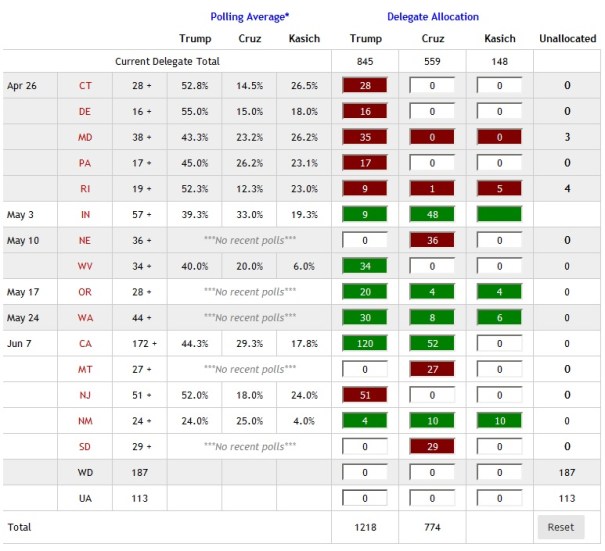
Trump can sweep all of the Republican delegates in the following states – CT, DE, MD, RI, WV, PA – and still go into the final June 7 primaries with the nomination effectively out of reach. And then even a win in NJ won’t be enough. He would have to sweep the races on June 7 to get past the 1237 mark, and that simply isn’t going to happen.

Ted Cruz has been dominant in the Plains and Mountain states. California offers some hope for Trump, but Cruz is strong in the Central Valley and the North. It is very unlikely that Trump can sweep the state in all of its Congressional Districts. It’s far more likely that California ends up being either a loss or a stalemate. Anything other than a complete sweep of California’s delegates almost certainly leaves Trump short of the nomination.

When the dust settles on June 8th, Trump will still be holding a first-ballot delegate lead. There will be about 125 uncommitted delegates he could theoretically recruit to his side prior to the convention. He might be close enough that he would only need 70-100 of them. Chances are a majority of those delegates will have been recruited to their positions by the Cruz campaign, but who knows. At any rate, it looks like we’re in a for a long, hot summer.

See the delegate math play out with this calculator from 270-to-win.

Posted in Uncategorized

Sex and the Modern Republican

Details of former Speaker of the House Dennis Hastert’s sex abuse scandal are becoming increasingly grisly. The prospect of a second Clinton Administration is forcing us to look back on the first one with new eyes.

It turns out that the men prosecuting Bill Clinton for lying under oath about his sexual harassment of subordinates were themselves operating from a remarkably compromised position. A long list of Republican Congressmen who grandstanded on Clinton’s behavior were simultaneously involved in their own similar affairs. Many of of them faced prosecution for those or other matters. Hastert himself is almost certainly headed to prison.

Here are a few legacy GOPLifer pieces that examined sex in politics through a Republican lens.

Sex Tips for Politicians

“Regardless of your party affiliation, policy positions, or the “substantive issues” you think people ought to be focusing their attention on, you will need to have a plan for what to do when (let’s just skip the “if”) those animals in the lamestream media notice what you’ve been doing with your Twitter feed.  I want to help you help me by having your lewd behavior disappear quickly from the headlines.”

Dirty Old Men

“DeMint defended his 2004 statement that homosexuals and women (only women) who are having sex outside of marriage should be barred from the teaching profession.  Why?  To protect religious freedom, obviously.  How can I possibly experience the free expression of my faith if you’re out there shamelessly doing whatever you want with your filthy, shameful, tender, luscious young body?”

Taking a Wide Stance on Gay Issues

This month marks the third anniversary of the Republican Party’s Summer of Love; hot, gay, illegal love.  It was on June 11 that staunch anti-gay Senator Larry Craig was arrested for soliciting gay sex from an undercover officer in the Minneapolis-St Paul airport.  Craig followed the incident with a series of progressively more awkward public statements in which he denied being homosexual and bragged about how incredibly butch he was.  He continues to publicly insist that it was all a big misunderstanding.

Chick-fil-A, Gay Marriage, and Your Grandchildren

“Maybe you can sit across the table from a beloved friend and tell them that your straight family is more legitimate, more right, more legally and politically appropriate than theirs.  Perhaps you can look into the eyes of people you care for and respect and explain that providing their children with the full legal protection of an official family would threaten something important that no one seems to be able to coherently define.

“I am not going to do that.  Eat your sandwich alone.”

Posted in Uncategorized

Thank God for big, faceless corporations

rebelNorth Carolina Governor Pat McCrory is scrambling to rescue his career. In an election year he should have known better than to sign a mindbogglingly stupid bill aimed at intimidating gays and lesbians. Republican Governors in such progressive strongholds as Georgia, Arkansas, and South Carolina have already demonstrated the good sense to resist so-called “bathroom bills” or similar measures.

When Indiana Governor Mike Pence made the same mistake, corporate pressure forced him into a frenzied and humiliating retreat. Pence, however, enjoyed a resource McCrory lacks – time. North Carolina will fix this dumb move, but the ugly process will play out across the span of a particularly difficult election season for Republicans. McCrory’s inexplicable miscalculation will probably cost him his job and take the state’s Republican Senate seat with him.

Then, there’s Mississippi.

A state that raised Jim Crow to a violent art form has taken the anti-gay backlash to new heights. Using religion as a smokescreen, lawmakers there have enshrined into law a personal right to discriminate that extends to virtually any service delivered in public or private spaces. There will be no political consequences whatsoever.

What makes North Carolina so different from Mississippi is that North Carolina is tied into global capitalism. The new Jim Crow will fail in North Carolina as it has in so many other places because of pressure by corporations.

It will remain in place in Mississippi because that state has nothing anyone wants in a modern economy. Boycotting Mississippi is the political equivalent of bombing the rubble.

As our political system grows more frighteningly dysfunctional it pays to live in a place with lots of big corporations. They are among the last remaining political forces with a solid commitment to practical outcomes and the power to make them happen. From civil rights to climate change and education, corporate political pressure is becoming the last reliable force holding back the barbarians.

Be grateful you live in a place where major corporations want to do business. Life beyond their influence can be rather dark.

North Carolina’s Governor is not flailing because of pressure from liberal groups. Marches and protests and boycotts by noisy activists don’t frighten him in the least. Years of remarkable “Moral Mondays” demonstrations at the state capital have yet to move the needle in North Carolina politics. North Carolina is threatened with a loss of legitimacy at a national level by the concerted pressure applied by corporate interests.

In our era, the greatest business advantage doesn’t come from cheap waste disposal, plentiful coal, or access to oppressed workers. The most lucrative capital returns come from building a powerful pool of human talent. It is difficult to maintain talent in an environment where your employees might be harassed for their identity with complicity from government. The death of Jim Crow was an essential key to the rise of the South as an economic player. Businesses will not stand by and let their investments be decimated by a Neo-Confederate revival.

Republicans are finding themselves torn between old interests and new, between business and bigots. Money is going to win that fight 100 times out of 100. The problem is that money doesn’t care about certain places.

Business is almost certainly going to save North Carolina over the long term. In time, corporate interests will also roll back the damage that Neo-Confederates have done to that state’s schools and infrastructure. Other places that are blissfully free from the influence of big faceless corporations will not be so lucky.

No one is riding to the rescue of Mississippi. Left to the mercy of Neo-Confederate bigots, Mississippi will just keep getting poorer. Like the residents of Flint, Michigan who, over time, voted their way into a cascade of catastrophes so severe that even the federal government can’t bail them out, our own domestic Afghanistan is building for itself a landscape of almost irremediable misery.

Beware what happens when you lose the attention of those terrible ‘corporate interests.’ Take a moment today to feel thankful that you live in a place where big corporations still want to do business.

Tagged with: , , , , , ,
Posted in Neo-Confederate, Religious Right, Uncategorized

Link Roundup, 4/15/2016

From Politico: The first meeting of the RNC’s rules committee is next week. Nothing to see here…

From Scientific American: Interesting new theories on the development of human monogamy.

From Quartz: Marijuana legalization is forging strange new alliances.

From the New York Times: The cultural significance of Minecraft.

From mentalfloss: What ever happened to RC Cola?

From Newsweek: How Jerry Brown saved California.

Posted in Uncategorized

Not all racists are racist

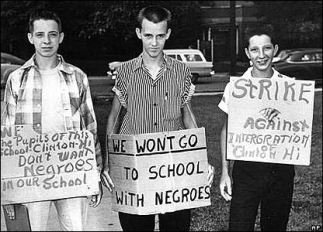
busing“There are no racists in America.” That’s the tongue-in-cheek conclusion reached by Ta-Nehisi Coates in his book Between the World and Me. Americans have generally eschewed public expressions of racism even while actively perpetrating it. From separate but equal to anti-miscegenation campaigns to police brutality to vote suppression, those involved have seldom owned up to any racist intent. We have lots of black friends. Our bodies lack racist bones.

Yet by some alchemy, a society that imagines itself devoid of racists continues to produce consistently discriminatory outcomes. Having a white-sounding name is worth as much on a resume as an additional eight years of work experience. For racial minorities rates of employment, wealth generation, and education continue to lag. Police encounters remain remarkably and unnecessarily dangerous for black and Hispanic Americans.

Our aversion to racism makes sense. A culture premised on freedom and markets demands that individuals be evaluated on their individual merits. One need not care about morality or justice to be troubled by the practical implications of racism. Bigotry skews market outcomes in ways that impose unnecessary costs on everyone. So why has it been so difficult for Americans to shed a legacy of bigotry and violence based on race?

There may be answers in the way our brains work. Understanding how we process reality may help us recognize and weaken the machinery that keeps institutional racism in place. It may also call into question some the tactics that have informed social justice movements for decades. Evolving beyond a racist heritage may require us to move in some counter-intuitive directions in the near term.

Nobel winning psychologist Daniel Kahneman describes two different mental modes in his book, Thinking Fast and Slow. Most of our lives are spent in an automatic or intuitive mode he calls System 1. This intuitive mind uses mental shorthand to make rapid assessments of otherwise complex scenarios. System 1 tells us in a flash who is friendly or which food tastes good or which way to turn on a familiar route to work.

Reason and deliberate thought belong to System 2. Rationality requires concentration. It applies complex computations to difficult problems. Kahneman explains that the phrase “pay attention” typifies both the character and the mental cost of operating System 2. While intuition is nearly automatic, reasoning is effortful and expensive.

Conclusions reached by System 2 can influence System 1, but only by a process of inculcation. If you’ve ever learned to do something, whether speaking a second language or using a sophisticated game controller, you have experienced the way rational thought can train your intuition. If you’re an American who has driven in Britain, you can attest to the mental cost of consistently leveraging System 2 against System 1 to continue choosing to drive in the left lane.

Our cherished anthem, “All men are created equal” is a product of our reasoning minds. It is, as Jefferson claimed, ‘self-evident,’ but only on careful, considered reflection. Almost anyone who has evaluated the question at any length arrived as some version of Jefferson’s vision. We associate racism with ignorance or willful oppression for good reasons. On the level of System 2, racism doesn’t make a lot of sense.

While reason generally rejects race-based biases as false, unreliable, and morally compromised, those conclusions do not automatically transform our intuition. Our brains struggle to cope with aggregates. We use stereotypes to simplify this process, usually to great effect. As Kahneman explains:

“One of the basic characteristics of System 1 is that it represents categories as norms and prototypical exemplars…Some stereotypes are perniciously wrong, and hostile stereotyping can have dreadful consequences, but the psychological facts cannot be avoided: stereotypes, both correct and false, are how we think of categories.”

Parallels can be found in Jung’s archetypes, mental models of reality embedded in stories and myths that shape our understanding of the world at an intuitive level. Perhaps even deeper than culture, some of these models seem to be programmed at a genetic level. Responses to certain colors or odors in food, aspects of facial recognition, and other behavioral responses seem to be entirely innate.

A lifetime of exposure to a fundamentally racist culture builds a mental shorthand that operates largely unnoticed and unquestioned. Perhaps the most troubling example comes from Jefferson himself. Having authored our founding statement of human equality he continued to own slaves. Fathering children with one of his slaves still did not shake his attachment to the institution. Reason does not always move our intuition.

It is possible to neutralize the influence of System 2. Have you ever turned down the volume on your car radio while coping with a difficult driving task? That’s System 2 kicking in, looking to consume more neural resources for concentration. We rely on rational thought to debunk falsehoods and correct intuitive errors, but that process sometimes fails. Distractions, noise, and emotions – especially fear, can close down rational processing. Kahneman observed in a study that:

“Subjects were required to hold digits in memory during a task. The disruption of System 2 had a selective effect: it made it difficult for people to ‘disbelieve’ false sentences…System 1 is gullible and biased to believe. Indeed, there is evidence that people are more likely to be influenced by empty persuasive messages, such as commercials, when they are tired and depleted.”

It is one thing to correct a bias acquired during a moment of suggestibility. It is another thing altogether to recognize and correct a logical fallacy acquired over a lifetime of powerful cultural reinforcement. Pair those falsehoods with deep emotional attachments, particularly fear, and people will cling to a falsehood at significant personal and social cost.

For many who grew up drinking from a white’s-only fountain, President Barack Hussein Obama is a living, breathing challenge to their intuitive reality. Every time he emerges from Air Force One, System 1 tells them, loudly, that something about this situation is frighteningly wrong. When they see pictures of him vacationing in Hawaii or playing golf, they experience something like the alarm bell at a fire station.

Older Americans may be an extreme example, as Jim Crow was engineered to cultivate and reinforce a false System 1 model. However, institutions steeped in racist programming continue to shape our heads today. Look at what happened when Bomani Jones wore a t-shirt satirizing the Cleveland Indians’ logo, transforming it to “The Caucasians.” The hostility he faced was a sadly hilarious exercise in missing the point.

It is possible to use Kahneman’s System 2 reasoning to correct aspects of System 1 processing. The problem is that we find these corrections profoundly uncomfortable. System 2 processing is painful and exhausting. The more we can rely on System 1 to successfully navigate a day, the more pleasant that day was.

We correct errors in System 1 processing through doubt and questioning. We find doubt uncomfortable. Worse, doubt is also slow, reducing the pace at which we react to events unfolding around us. In other words, we pay a functional price for a consistent embrace of doubt.

Imagine going through all of your day’s activities while trying to perform three-digit multiplication problems in your head. That’s what it’s like to constantly question your System 1 assumptions. People who embrace ambiguity are often less “happy” by traditional psychological measures than those who enjoy an unconsidered existence. Those doubters are also, however, better at judging reality. As a consequence, they tend to me more successful at most (though not all) activities. Success and bliss are in some ways incompatible. Our stereotype of the grinning idiot bears a kernel of truth.

Obstacles to achieving an ever more just and meritocratic economy are embedded deep in our heads. One of the most painful examples of this challenge can be found in among police in Maryland’s Prince George’s County.

Ta-Nehisi Coates has written about stunning police brutality and discrimination in one of American’s most prosperous black suburbs. Under black leadership, in a solidly black community, police in Prince George’s have a troubling reputation for violence against black suspects. The problem is fairly universal. Half of the police charged in the killing of Freddie Gray in Baltimore were black. The Mayor, DA, and Police Commissioner were black.

Shocking treatment meted out by a black institution on black youth sounds bizarre absent an understanding of System 1 and System 2. You don’t have to be white to absorb the cultural programming of a racist system. Institutional racism is, as the phrase implies, institutional.

No one inside those institutions needs to carry a conscious, willful, rationalized animosity toward another race for that system to produce a biased outcome. Just as our biases are programmed into our intuition, they are programmed into the machinery of our institutions. Black Americans are subjected to this programming right along with their white peers. Their subtle absorption of racist notions, extending even toward a derogatory self-image, is one this systems’ most perverse and depressing outcomes.

We might reject the idea of racial discrimination at a conscious level in System 2. Meanwhile our unconsidered, embedded understandings of the world, some of which are older than we are, leave us churning out discriminatory practices whether from habit, tradition, or pure thoughtlessness. Consciously revisiting the programming that informs our intuition is inherently uncomfortable and generally unwelcome. The simple inconvenience of leveraging System 2 to interfere with System 1 is often enough to end the process. Add in the social cost of acknowledging racism in any form in any setting, and the strident, often passionate, public resistance to reform makes much more sense.

Complicating our challenge of dismantling racism is our habit of moral shaming. Open displays of racism have always been seen as ill-mannered, but across much of our history they were tolerated. Forcefully de-legitimizing public displays of racial ignorance and hostility has played a vital role in the progress we’ve made in recent decades. Tactics that were helpful in one setting may be posing problems as we advance.

More than ever before, publicly acknowledging racism in any context, even a past context, can have serious negative consequences. We insist on viewing racism in all its forms as a deliberate choice, the fruit of a morally deformed soul.

If racism can be institutionalized, if it can be the product of a culture as much as a choice, then addressing racism solely as a personal moral flaw is itself flawed. Think of the black police officer that exercises cruel and unnecessary force in responding to a suspect solely because that suspect is black. The act is wrong and socially undesirable. Is it racism?

Achieving a fundamentally more just society may confront us with a counter-intuitive next step. We may need to undo something we worked very hard for a long time to accomplish. We may need to destigmatize ‘racism’ per-se and develop a more nuanced language around the subject.

It is often said that the Inuit have a vast vocabulary to describe snow. America, a nation burdened with a long, vexing racial heritage has only one word to describe racism.

In our language a ‘racist’ may be someone who unconsciously passed over a resume with a black-sounding name. A ‘racist’ is also a guy who dragged a black man to death behind his truck. If the same terminology accurately describes Trump fans that beat up black protestors and the clueless, affluent Bernie-Bros who denigrate blacks voters’ support for Clinton, then we have a language problem. One of the things we learn from the interplay between our rational and intuitive thought processes is that language matters.

There is truth in the blanket application of the term ‘racist’ to all of these scenarios, but that truth obscures consequential ambiguities. We may have created an environment in which previously successful strategies are beginning to work against us. The stigma attached to racism had a certain utility when dealing with Klansmen in the 60’s that it loses in many cases when applied to a doctor or a police officer now. Institutional racism residing in the intuitive mind has a different meaning and impact from the violent actions of deliberate, determined bigots.

Despite our best intentions, and occasionally still our worst, American institutions and the people operating in them continue to consistently generate discriminatory outcomes. Achieving truly fair and open access for blacks and other minorities to our economy and society may call for a subtler understanding of how racism actually works. We may be making it unnecessarily difficult for people to explore and reconsider to their discriminatory biases, setting up unintended obstacles to insight.

Coping with the impact of centuries of programming requires a richer language, one capable of sincerely plumbing these depths without sanction or censure. Nothing shuts down System 2 like high emotion and noise. We need vocabulary capable of nuance, communicating wider shades of meaning. Not all racists are racist.

Posted in Uncategorized
Goodreads

Enter your email address to subscribe to this blog and receive notifications of new posts by email.

Join 448 other subscribers