Monday is Confederate Heroes Day in Texas

Enjoy your day off

Enjoy your day off

In 1973 the Illinois Legislature was the first in the nation to create an official holiday for Dr. Martin Luther King’s birthday. That same year, the Texas Legislature responded to calls for a celebration of MLK’s life and work in a very different manner.

Since the ’30’s Robert E. Lee’s birthday on January 19th had been a minor state holiday. In 1973 the Texas Legislature consolidated it with a celebration of Jefferson Davis’ birthday to create a brand new, totally race-neutral Confederate Heroes Day. Take that you Hippie, Commie, agitators. Of course, any overlap on the calendar with MLK’s birthday was pure, race-blind coincidence.

It should be noted that the Legislature in 1973 was under the control of Democrats. Now that Republicans, the Party of Lincoln, control every arm, leg, finger and other appendage of state government, the bill to repeal Confederate Heroes Day is probably working its way through committee as I write this.

It should also be noted that in 1973, Rick Perry was still a Democrat. Again, pure, race-blind coincidence.

Contact your Legislator and ask him or her (probably him, really) about the current status of Republicans’ efforts to either repeal Confederate Heroes Day or move it to a less obviously spiteful location on the calendar. Enjoy the tense silence.

Monday in Texas you’ll enjoy a leisurely rest from your labor, an opportunity to honor a man who gave his life to end racist oppression or to honor those who gave their lives in a bid to preserve violent white supremacy. Take your pick. In Texas you still have a choice. Liberty!!!

Tagged with: , , ,
Posted in Civil Rights, Neo-Confederate, Republican Party, Texas

Why Jeb will probably lose

Jeb Bush is being treated as though he is the presumptive frontrunner for the GOP Presidential nomination, a semi-official title that all GOP nominees take on about two years out from the election. In fact, it looks as though it will be nearly impossible for him to win. Here’s why.

This is what it takes to win the Republican nomination, ranked in order of importance:

Organization

Republicans have a significantly thinner presence on the ground than Democrats. That leaves Republican candidates woefully stretched as they search for bodies to help man the primary process. Ask Rick Santorum how difficult it is to find a local nominee who can qualify to serve as your delegate in every district of Illinois. Win all the primaries you want. They don’t matter unless you can get delegates sent to the convention.

Every state has its own arcane rules for assigning delegates. How do make sure your voters know polling places, dates, and procedures that vary all over the country? How do you make sure they show up and understand the procedures that determine a caucus outcome?

Winning means mastering those rules nationally. Mastering those rules requires more than lawyers. You need an organized presence on the ground – everywhere. That’s probably the single largest reason that Republicans always nominate the guy who finished second in the previous primary – he’s the guy who has built the most capable organization.

No one will go into the 2016 with a powerful organizational advantage and no one has enough money to buy all the ground organization needed for a national campaign. Having a committed following, even if it’s a motley bunch, makes a big impact. That’s why Ron Paul outperformed in 2012. Bush cannot draw an enthusiastic grassroots following. He will have whatever organizational support he can purchase which will leave him desperately short. That brings us to the second most important resource in the campaign.

Money

It costs a lot to run a successful national nominating campaign. Romney spent about $75m to win the nomination in 2012. Romney spent a lot more in ’08 to lose.

A particularly weak field in ’12 combined with a mature organization made for a cheaper campaign. Also, an assumptive front-runner benefits from a battery of dark money contributions by supporters outside the official campaign structure. Not all of that spending is even counted.

Bush will certainly raise more money than the Wacko Birds, but it remains to be see whether he’ll out raise the other Gray Round contenders. With no existing organization and no presumptive frontrunner, the cost of buying this election outright would be stellar. Fundraising advantages will not be enough to sew this up. Without a strong organization in place and with the price of victory far too high to be simply bought with a check, a fundraising edge cannot save him from his worst weakness – his absence of grassroots support.

Grassroots support

Since the Bush I campaign in 1992, the gap between minimally competent candidates and candidates that the base will support has been growing. In ’16 it promises to open into a yawning chasm.

We have always assumed that a candidate with sufficient money and organization can take the votes for granted. Historically, the nominating race is generally over by the third contest in South Carolina, leaving too little time for a dark horse candidate to build the support and recognition needed to establish himself. The outcome of the 2012 race broke that assumption.

Unlike ’08 & ’12, no one enters the ’16 race with a decisive combination of money and organization. For the first time in decades the preferences of the party base actually matter in a way likely to determine the outcome.

Jeb Bush has zero support among the Republican base. In fact, with his comments and legislative achievements on subjects like immigration and education, he has put himself more painfully at odds with the base than Romney did. This bit of bad news for the Bush & Romney campaigns becomes truly serious when considered in light of the final criteria.

Competence

The last bolthole of the establishment candidate in Republican primaries is the assurance that the Wacko Birds will self-destruct. Romney trailed a litany of weirdoes in ’12 without every really facing a threat. Each one choked on their words and actions in steady, drum-beat succession. Dr. Ben Carson’s goofy campaign is already melting and the race hasn’t even warmed up.

It is not easy to operate a national political campaign. No other race compares. If you want to know what the demands of a Presidential campaign do to a person of moderate intellect who is otherwise minimally qualified to be a Congressman, or Senator or Governor, go ask Sarah Palin or Rick Perry.

Neither McCain nor Romney faced any minimally competent competition. Mike Huckabee’s Hee Haw act had broad base appeal, but he was never going to master the basic administrative demands of a national campaign.

Jeb Bush is facing a very different field than his brother confronted in 2000 or that Romney faced the last time around. The Wacko Bird Caucus is stronger than it has ever been. Yes, this field will include a sizable collection of Fox News contributors and talk radio jerks, but they are not the core.

Ted Cruz is dangerous and extreme, but he is no Michele Bachmann. Figures like Cruz, Paul and Walker may be ideologically batty but they are absolutely competent operators.

This year’s clown car primary is likely to produce an ideologically bizarre figure otherwise fully capable of meeting the administrative and organizational demands of a national campaign. That’s a deadly combination we’ve not seen since Goldwater. Figures like Cruz, Paul and Walker are unlikely to disqualify themselves in a way that would matter to Republican primary voters. They may be crazy, but they are not crazy enough to hand Bush the nomination.

When these factors are weighed out, the only Gray Round figure with a shadow of a chance is actually Mitt Romney, and only because he has some administrative experience with a national campaign and a skeleton of an organization remaining in place. And yes, unless everyone else implodes he can’t win.

The person who comes out of this analysis with the best odds is Ted Cruz. He’s crazy enough to line up with every passionately irrational priority of the current GOP base. He’s as well known among Republican primary voters as any other candidate. As ideologically batty as he is, he is a ruthlessly savvy operator who is unlikely to make stupid mistakes. No other wacko bird can stack up the same dark list of qualifications.

Jeb Bush will probably lose because he’s using a well-worn playbook whose relevance has expired. Could he adapt? Yes, but probably the only way a sane, rational Republican candidate can win the nomination in 2016 is to use the 2000 playbook – the other one. McCain’s 2000 campaign would be a blockbuster today.

The atmosphere is absolutely ripe for a Republican candidate willing to unapologetically embrace the four inescapable realities that the base insists on denying. By doing so, a candidate could expand the Republican primary pool in ways that would not only change the outcome, but potentially challenge the assumptions behind the Blue Wall.

Jeb Bush is not that guy. He’s going into this race using the wrong 2000 playbook. We’ll all have to wait for a Republican figure that can finally change the map.

Tagged with: , , ,
Posted in Election 2016, Republican Party

How pluralism threatens lower income whites

flagDemocrats are seeing a steady erosion of their traditional support among low and middle-earning white families. That drift contributed heavily to the outcome of the 2014 mid-terms, but it has been in motion since the Civil Rights Acts of the Sixties.

Voices on the left consistently blame Republicans for duping white voters. They claim that Republicans are using a racially tinted “culture war” to persuade low earning whites to vote against their interests.

People do not generally vote against their interests. When it seems that they are, it generally means we have misunderstood their interests. Under current conditions, lower income and rural white voters are absolutely right to be concerned about the death of white supremacy and oppose it with all their energy.

Replacing white supremacy with a genuine pluralism is not only just, it promises massive cultural and economic benefits. The good news is that white supremacy is dying. Unfortunately, we are threatening to replace it with a long era of racial and ethnic political rivalry. Dismantling white supremacy successfully requires us to recognize its role as a load-bearing wall in the structure of our democracy. Until we take seriously the practical consequences of dismantling white supremacy, an authentically post-racial America will elude us.

White supremacy is not merely an outdated bigotry to be banished by the light of reason. It is a pragmatic ideology that for centuries has protected low income whites from being subjected to the same miserable fate as blacks in this country. If racial justice only delivers an equal opportunity to be looted by a powerful elite, then there is no rational reason for low income whites to get on board.

White Americans have always enjoyed the benefits of a powerful shadow welfare state. Fears stirred by the death of racial preferences have deep roots, but they are also practical and material. Ignoring those practical concerns is just as politically dangerous as stoking them.

In America we have succeeded in delegitimizing racism, but this has had the perverse effect of terminating dialogue. Racism comes from somewhere. Race, after all, is a social construct that has no existence anywhere but in culture. It has a logic and a practical purpose. We have largely lost the ability to discuss it in any constructive way. Now it persists as an undercurrent, unacknowledged and elusive yet deeply influential.

Racism has both an emotional and a practical dimension, like two sides of a coin. Its emotional roots are deep, historic, and practically subliminal, bubbling up from long-forgotten sources. They are entwined with very practical benefits that protect economically vulnerable white communities from being exploited in the same manner as minorities.

We like to imagine that we are all self-created from scratch, a pure result of our individual choices. That idea blinds us to the ways that our social and political assumptions, especially the deepest ones associated with identity, actually form.

What we know about the world, or more to the point, what we think we know, mostly comes to us from places we cannot readily identify. What it means to be a good man or a good woman. What habits, food, even clothes are familiar and acceptable or strange and suspicious. Across most of the country, a man does not simply decide one day that a purple shirt would be better than yesterday’s white one. He doesn’t get out of bed one morning and decide to wear a dress instead of jeans. The “why” of the matter isn’t important. That’s just how it is.

We do not construct these assumptions deliberately on the fly. We don’t generally ask where they come from. When powerful forces from the wider world challenge the legitimacy of these assumptions, few of us take time to reassess them. Instead, we push back as hard as we think we can afford to. We resist with whatever means are reasonably, and sometimes unreasonably, available.

Cultural traditions offer security and stability. Security and stability are particularly vital to communities with few options or opportunities. The more dangerous and exploitative the economic environment, the more stubbornly culturally conservative lower income citizens will be.

White supremacy evolved as an absolutely essential survival strategy for whites with little political power or property. Our history glosses over the fact that slavery did not evolve in North America as an exclusively black institution. As early as the 17th century laws were being enacted that assumed that any dark-skinned person was a slave, but until slavery was outlawed for everyone the only protection against potential enslavement rose from white racial solidarity.

Until the early 18th century one of the main sources of slaves for the American colonies was Ireland. As late as 1800 we have a record of an enslaved white woman in North Carolina appealing to the legislature for freedom. Her request was not granted. At the height of the slave period, the case of Alexina Morrison in Louisiana demonstrated that being obviously white was not an ironclad protection against enslavement.

What made slavery for whites increasingly rare was not legal protection – it did not exist – but rather a generally accepted notion of white racial supremacy. For politically and economically vulnerable white citizens, unquestioned collective acceptance of racist ideology was the only reliable guarantor of their liberty.

No one need even remember slavery to inherit that culture. That tradition refuses to fade away because it continues to be relevant in practical ways.

White drivers are not subjected to “stop and frisk.” White schools get privileged access to the best tax base. Almost every college in the country offers preference to “legacies,” students whose families benefited from an era in which only white men were allowed to compete.

The Civil Rights era has threatened those prerogatives without replacing them with something more just. Efforts at desegregation weakened the ties that gave lower wage white families access to schools supported by the resources of wealthier families. They scrambled to find alternatives to busing while the affluent re-sorted themselves into all white school districts where they could further concentrate their resources.

Affirmative action in government hiring has meant that an entire class of relatively secure middle income jobs which had once been reserved for whites (white males, specifically) were now subject to fierce competition. Affluent whites with ready access to education have been largely unaffected by affirmative action while white families of limited means saw opportunities for their children disappear.

Talk of gun control threatens a loss of security, even if that security is an illusion. With their ties to white elites weakening, suspicion of authority is expressed in a futile race for self-protection.

White supremacy means low income whites don’t worry about their kid being killed by George Zimmerman or Darren Wilson. If their white son foolishly carries his Airsoft gun to the park, they don’t worry that police might kill him. White supremacy grants immunity to many social problems that minority communities are left to endure.

Until a few decades ago nearly every job of any economic or social importance was set aside for white men. Still today, the networks built on that heritage still make it easier for whites to access the best jobs in the economy. Lower income whites have consistently enjoyed better access to economic, social and political opportunities by virtue of their race than they would have had by virtue of their income or education. Race matters less than it used to, but it remains a vital shield, a hidden yet powerful social safety net.

Understanding white supremacy as a sort of shadow safety net helps explain one of the icons of the Obama Era. Tea Party groups angrily protest the President’s supposed “socialism” while just as vehemently threatening anyone who might endanger their Social Security or Medicare benefits. The Tea Party movement makes no sense as a reaction to government spending or social programs. It makes absolute practical sense as a movement to preserve an unofficial white social welfare state with all its stated and unstated benefits.

What remains of that shadow safety net matters enormously because life at lower income levels in this country is becoming increasingly precarious. The Middle Class is largely a dead concept. Access to good paying work is highly dependent on education. Getting an education is more expensive than ever while free public schools are increasingly sorted by household income.

Higher income urban whites might retain some distant recognition of what white supremacy meant at one point in our history, but they have shed most of their overt attachment to it. For them, the end of a monolithic cultural domination has brought new opportunities for profit, new music, great food, interesting movies and cool new places to visit. With their race-based alliance with lower income whites melting, they are more closely aligned culturally and politically with an emerging global professional class than with whites in the exurbs.

For lower and middle income white households that did not make the transition from the old economy to the new over the past generation, the picture is stark and legitimately frightening. For large swaths of rural and suburban America, the decline of white supremacy has meant the arrival of competition they were unprepared for. Big metropolitan centers are growing vastly richer, but they are not growing bigger. They are no longer the kind of places you go to live a middle income existence, but globalized centers of excellence where few people can afford to compete and survive.

The countryside is descending into poverty. Farming and resource extraction, the only economic activities that still make sense there on any meaningful scale, require little or no labor.

As bad as conditions are in rural areas, poverty is expanding most quickly in the suburbs. Cheap to build, expensive to live in and expensive to maintain, sprawling suburbs made sense in an era when successful white professionals were looking to protect their racial dominance by hiding from “urban” problems. Now, suburbs place residents far away from emerging opportunities, making it hard to exploit the best that a new era of globalized prosperity offers.

Just as Republicans are largely blind to the conditions and concerns that affect black communities, Democrats are increasingly baffled by the demands of white voters. In particular, Democrats fail to recognize the ways that their social welfare policies intensify white fears.

The left is blindly tearing down a race-based shadow welfare state that once delivered a reliably middle class existence for whites. They are offering to replace it with a centralized social welfare state that compromises middle earners’ interests while only providing relief to those who are financially ruined.

The Affordable Care Act may be the signal example of this failure. Health care reform could have split low and middle income white workers from their alliance with elite whites. Instead we got a program very much like the rest of the safety net.

Most middle and low income whites have some access to health insurance through their employers. The ACA extended Medicaid coverage to the very poor while middle earners who are disproportionately white were excluded from subsidies. The structure of the Affordable Care Act placed a new mandate on struggling middle-earning households while excluding them from most of the benefits of the Act. No one should be surprised at the political result.

The characterization of the Democratic Party as a force for “dependence” makes perfect sense through this lens. White families struggling to hang on to their economic status correctly understand that Democratic policies will do little for them until they’re destitute. Lower income whites are not voting against their interests. With no political options on the table that could reasonably be expected to level the economic playing field, low income whites are making a rational choice to remain tied in racial solidarity to wealthier white households for as long as possible.

The world will be a better place when the concept of white supremacy becomes a matter for the history books. We could take a large step in that direction by recognizing that white supremacy was never merely a matter of ignorance. Living in an environment that respected white culture above all others created an absolutely real, economically meaningful, and yet largely invisible social safety net that elevated opportunity and dignity for lower earning white citizens at the expense of minorities. Offering to tear down a shadow social safety net based on white supremacy and only replace it with a social safety net for the desperately poor is, and will continue to be, a political non-starter.

To clarify, white supremacy is deeply unjust. Whites benefited in the past and continue to benefit from systematic violence aimed at looting the resources of racial minorities. It is also unjust that lower income whites are being made to suffer largely alone for the end of a white supremacist system while wealthier elites who benefited most from that system escape largely unscathed.

There are no major voices for Civil Rights that respect this valid grievance. That is a problem which is presenting dangerous political opportunities to dangerous people. If either party is going to lead us beyond the politics of racial polarization, they will have to find a way to build a replacement for the white shadow safety net that eases conditions for all. If we could deliver credible access to justice, opportunity, and advancement for everyone with the talent and determination to compete, white fears about the decline of their privileges might ease.

Failing to consider the needs of economically vulnerable whites who are suffering from the decline of racial preferences isn’t just bad policy, it is an injustice. Justice requires us to see the wider picture. Thus far the story of Civil Rights in America has excluded the valid concerns of white Americans who have depended on white supremacy for protection from a fundamentally oppressive system. Genuine pluralism requires more than eliminating bigotry. Pluralism depends on delivering a fundamentally just economic and political system in which those bigotries lose their practical relevance.


Tagged with: , , ,
Posted in Civil Rights, Neo-Confederate, Political Theory, Race, Religious Right, Tea Party

Why is Abbott firing the Director of the TMO?

Over the past two decades Texas, specifically Austin, has developed into a legitimate contender to Nashville as the second pole in the music world. Much of the credit for this development comes from an unusually tight cooperation between the state and leaders in the arts industries.

The Austin American Statesman reports that Abbott has notified the longtime Director of the Texas Music Office, Casey Monahan, that he’ll be removed in February. Monahan was appointed by Bill Clements in 1990. Ann Richards moved the organization into the Governor’s office to raise its profile and influence.

There’s been no statement from Abbott on the reason for removing Monahan. It’s a bit of a puzzle. Anybody have any clues?

Here’s a little Texas music to help you think on it:

Tagged with: ,
Posted in Uncategorized

Staten Island, Ferguson, and the Democrats

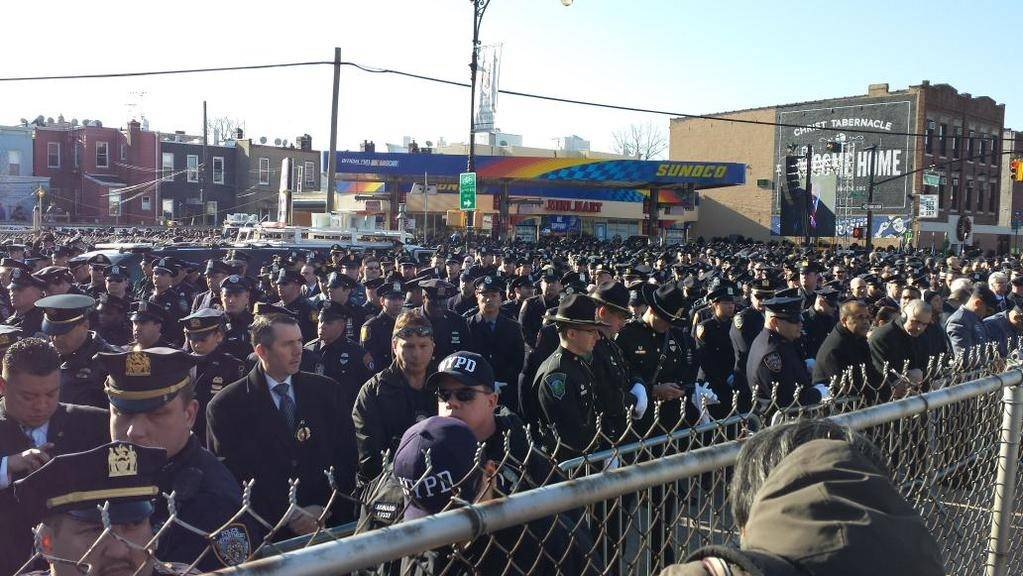
policeWhen Democratic Mayor Bill de Blasio spoke at the funeral of slain New York City police officers, thousands of officers in attendance turned their back on him. Since then they have engaged in a series of work stoppages.

Their grievance? The mayor, in the wake of the Garner case, expressed sympathy toward protestors concerned about police violence. New York police, and more specifically the police officers’ union, is threatening to compromise public safety over the mere suggestion that they be subject to additional oversight by the people they serve.

Police brutality is not the central issue at stake in the wave of demonstrations in New York and elsewhere. Dig deeper and you find a core disagreement about the accountability of our public servants and the unassailable power of public employee unions. Substitute teachers for police officers and this problem has exactly the same contours, featuring the same political alignments and the same exploited victims.

Republicans are being handed the kind of wedge issue that comes along once in a generation and they are utterly oblivious to the gift. The last great Democratic Party constituency, African-Americans, is pitted against the party’s last great organizational bulwark, public employee unions. The waves of protests over police brutality that ignited nationwide over the killing of Michael Brown have focused on race. Protestors so far have failed to appreciate why police, like so many other public employees, are consistently shielded from accountability to the people they serve.

No one seems to have thought to combine the protests over an unaccountable police force with the protests by some of the same people in some of the very same neighborhoods, over the failure to provide a decent public education to poor and minority communities. Both problems have the same root cause – unions that shield their members from accountability.

Media narratives have simplified these protests to fit stereotypical party alignments. Republicans are seen taking their usual law-and-order stance alongside the police while Democrats advocate for social justice and civil rights. That divide is not so clear on the ground.

All of the major officials involved in the Ferguson case, from the Governor down to the local DA are Democrats. The officials investigating the Tamir Rice case in Cleveland (keep an eye on that one) are Democrats. Only in the Staten Island case are there any Republicans in decision-making roles.

Debates over urban access to effective public safety or effective public education are exclusively intraparty fights among Democrats. Despite the black community’s importance as a Democratic voting bloc, African-Americans always lose that fight with the unions. Every. Single. Time.

When the Democratic Party is faced with a conflict between a public employee union and a black urban population desperate to gain access to the public services that union is supposed to deliver, the union wins. This is the civil rights logjam that has blocked black communities from access to the prosperity that they deserve. Republicans do not own this problem and they should not help perpetuate it.

Unions provide workers with higher incomes and job security. They impose costs not only in wages, but in inertia, making it difficult for a unionized industry to adapt to changing conditions and serve its customers. A union collectivizes power, but along the way it also collectivizes accountability, creating an inherent incentive toward mediocrity and shielding the worst actors from the consequences of their actions. It is very hard to fire a worker who is protected by a union.

In an old-fashioned labor union for coalminers or steel workers, the costs of a union are born by wealthy capital owners. The benefits flow to lower income workers who otherwise have little access to power and limited opportunities to support their families. That’s an outdated vision of a union’s mission which died a long time ago.

Now turn those conditions around. What happens when the beneficiaries of the union are college educated, white professionals and the people bearing the cost of unionization are politically powerless and economically exploited? Try to fire an incompetent or crooked police officer and watch what happens.

An institution that collectivizes the benefits and accountability of factory workers imposes some moderate, but generally tolerable costs. An institution that collectivizes the pay and accountability of police officers gets people killed.

African-Americans and other low-income, under-represented constituencies find themselves on the losing end of a carefully structured racket. More-affluent white citizens can flee to suburbs that have been structured to limit the power of public employee unions. Smaller municipalities and school districts combined with well-connected, well-educated voting population help level the playing field for white suburbanites with money. Meanwhile back in the city center, those most in need of public services to enable upward mobility find themselves at the mercy of institutions with far more political muscle than they can match.

This is an historic opening for Republicans to profit by doing the right thing. We could defend the basic civil rights of an oppressed community. Along the way we could we undermine a policy we generally loathe, mandatory unionization of public employees. In the process we would further our goal to broaden the opportunity for all to seize opportunities in a market economy. We haven’t been able to recognize, much less exploit this opportunity due to some very serious problems we are unlikely to address.

Louisiana Republican Congressman Steve Scalise made news over the holidays when his deep, old ties to white supremacist organizations surfaced. This is important because it is the rest of the story.

We are all supposed to pretend that the Republicans won the South because Southerners coincidentally discovered some fresh interest in low taxes and “liberty” at the same time that the Federal government started enforcing Civil Rights legislation. It’s a lie and everyone knows it’s a lie, but it has taken on a Santa Claus quality as a sort of public myth necessary to maintain the basic legitimacy of our political order.

Republicans now control Congress, something that eluded us across most of the 20th century. Almost half of that majority comes from Dixie. Sixty percent of it comes from places that failed to outlaw slavery prior to Lincoln. None of it comes from a major urban area. The party isn’t going to do anything substantive about Steve Scalise because it lacks the leverage to free itself from white supremacist ideology. And that brings us back to our problem.

There are too few Republicans who possess even the most distant understanding of the concerns of the black community to even recognize the shape of this opportunity. And if they did, it would be monumentally difficult to muster a core political bloc inside the GOP that cared. For Republicans, white supremacy will not pay the bills forever. Somehow the party will have to find a broader base on which to build a political appeal. Despite the sugar-high of the 2014 election, the clock is ticking and the outlook is miserable.

An opportunity exists and there are a few Republicans in the North with some potential to tackle it. New Gov. Bruce Rauner in Illinois could be particularly well-positioned to win on this issue if he has the insight to even recognize it. That remains to be seen. Most Republicans seem content to respond this historic political opening by keeping their backs turned.

Tagged with: , , , ,
Posted in Civil Rights, Neo-Confederate, Race, Republican Party

Random facts for a slow week

As college bowl season cranks up, here’s an interesting random fact. Of the NFL’s 32 teams, 11 have a starting quarterback who played high school or college football in Texas (two from Westlake High if you count the injured Nick Foles). With oil prices cratering, NFL quarterbacks may soon be the state’s most valuable export.

Nineteen of the NFL’s starting QB’s come from a Southern state. Mississippi produces seven times as many NFL players per capita as Massachusetts and almost four times as many as New York. America’s favorite sport is overwhelmingly Southern.

Another interesting note. Every year about 80 college players make an NFL roster. About 30-35 college students earn a Rhodes Scholarship. Louisiana has by far the largest number of players who make an NFL squad, almost twice Texas’ percentage. Going back through more than a decade of listings I can’t find a single Rhodes Scholarship winner from a Louisiana university.

More detail comes from this analysis from Sports Illustrated:

nfl

Sports Illustrated


Happy New Year.

Posted in Uncategorized

Between the two Christmas stories

For Christians, Christmas is a celebration of hope amid darkness. Its setting in December reminds us of the bold promise of new life born at a moment when so little light and life surround us.

Christmas hides another message, one that brings hope of renewal in an era so steeped in fear. The twin Christmas stories, with their glaring contradictions, highlight perhaps more brightly than any other Biblical passages the weakness of a rigid interpretation of scripture. In a strange twist, Christmas may hold the key that unlocks the stranglehold of religious extremism on the spiritual and political dimensions of our culture. Christmas offers a unique hope for a better world.

Of the four Gospels, only two include a story of Jesus’ birth. The authors of Matthew and Luke set their nativity stories more than a decade apart, under different governments, shaped by a starkly different set of themes and challenges. The differences between them are too obvious and well-attested to be reconciled.

History plays an important role in understanding these two stories and their separate meanings. The widely hated Jewish king Herod the Great reigned from 37-4 BCE. He owed his throne to the military support of the Roman Emperor, but he ruled on his own, a sort of imperial franchise anchoring the eastern Mediterranean.

When he died, his son Archelaus took the throne with the endorsement of the Emperor Augustus. He ruled poorly until he was deposed by Augustus in 6 CE and replaced by direct Roman rule. Herod’s old kingdom was broken into pieces. Judea was governed by a Roman prefect accountable to the Governor of Syria. Galilee and portions of the kingdom in the north and east of the Jordan went to Herod the Great’s other sons, Antipas and Philip.

The first order of business after annexing the kingdom was to take a census and impose new direct taxation. For the Jews, this was intolerable both in political and religious terms. That census initiated around 6 CE inspired a decade-long rebellion led by a messianic figure called “Judas the Galilean.” The rebellion would fail and Judas himself was killed, but his sons and grandsons would play starring roles in future rebellions against Rome. The unfinished business of that rebellion would fester for decades, erupting every few years in minor disturbances stirred by a series of messianic aspirants until the Romans finally snuffed out Jewish nationalism in two major wars.

Matthew’s birth story is set under Herod’s rule, sometime before 4 BCE. The author paints Jesus as the rightful, just Jewish King set against the wickedness of an unjust pretender. In Matthew, Jesus is a Judean whose family flees to Egypt and then Galilee to escape from Herod and then Archelaus. Matthew’s Jesus is Jewish from head to toe, in a Jewish setting, with the Romans a distant and largely unmentioned presence.

Luke’s Jesus is a dutiful, obedient subject of the Empire. Jesus in Luke has family ties to both the royal (through his father) and the priestly (through his mother) lines; the perfect symbol of Jewish political authority. Yet, at a time when Jewish nationalism was reaching violent heights, Luke portrays Jesus’ family submitting willingly to the census, even at great personal cost. Luke’s birth story paints Jesus as the ideal imperial subject, blameless against charges of political rebellion from birth to death.

Matthew had three wise men and the flight to Egypt. Luke featured singing angels, shepherds, and a manger. The truth in Luke’s account was his theme of Jesus as a faithful Roman subject pursuing a mission beyond politics. The truth of Matthew’s nativity story was Jesus’ role as the fulfillment of the law, the perfect Jewish King sent to end injustice, oppression, and misery. Each writer used the relatively minor backdrop of a chosen history to emphasize what for them was a more important theological message.

Neither of them likely knew much at all about Jesus’ origins, apart from some seamy rumors about an out-of-wedlock birth and the theological problem of his Galilean origins. The history they cobbled together was the necessary outcome of their conclusions about his identity. History, in that context, followed theology, not the other way round.

These twin nativities provide a useful opening for relief in an age burdened by the oppressive hand of global religious fundamentalism. As our world shrinks, those who feel threatened by the accelerating pace of change and the relentless onslaught of the unfamiliar are desperate for certainty. They are taking whatever form of scripture they rely on and converting it into a bulwark of stability, insisting on rigid unthinking adherence and using every available means to impose that simplified understanding on the world around them.

The twin Christmas stories are a reminder of the brittle weakness of a religion based on fear. There is no shelter from ambiguity or uncertainty. Our hope amid the darkness comes not from an unthinking application of Bronze Age commandments, but from a commitment to explore the universal meanings in those texts, so similar regardless of religious heritage. Our hope comes from our commitment to resist oppression, pursue justice, celebrate kindness and protect the vulnerable.

The twin Christmas stories in our Christian heritage remind us that there is hope, even in an age marred by terrorism, paranoia, and lingering oppression. What is the meaning of Christmas? No matter the darkness that threatens, the world has as much light, as much promise, and as much justice as we have the courage to deliver.

Merry Christmas.

Luke 17:20-21

Once, on being asked by the Pharisees when the kingdom of God would come, Jesus replied, “The coming of the kingdom of God is not something that can be observed, nor will people say, ‘Here it is,’ or ‘There it is,’ because the kingdom of God is in your midst.”


Tagged with: , , ,
Posted in Religion

Tell me again about the Socialism

Since 2007 we’ve been hearing about the horrors that might loom if a certain Kenyan Muslim Communist seizes control of the White House. With each year that passes those predictions become increasingly absurd, but somehow the folks who issued them keep cranking them out.

Let’s look back at some of the less batty predictions of what Obama’s term in the White House would produce and compare them to reality:

Obama is going to destroy the economy
http://www.cnbc.com/id/102291457#.

Obama is going to soak us in taxes
http://www.nydailynews.com/news/money/share-u-s-economy-taxes-hit-lowest-point-century-article-1.135451

Obama will trigger runaway inflation
http://www.bloomberg.com/news/2013-06-12/inflation-at-53-year-low-belies-u-s-demand-strength-economy.html

Obama will wreck the health care industry
http://www.forbes.com/sites/dandiamond/2014/06/06/since-obamacare-passed-50-months-ago-healthcare-has-gained-almost-1-million-jobs/

Obama will blow out the Federal budget
http://www.bloomberg.com/news/2014-11-04/u-s-deficit-decline-to-2-8-of-gdp-is-unprecedented-turn.html

Obama is going to shut down oil drilling
http://dailycaller.com/2014/12/12/the-us-oil-boom-will-continue-despite-low-prices/

Obama is going to ruin the stock market
http://money.cnn.com/2014/11/10/investing/stocks-market-record-dow-sp500/

Obama is going to take our guns
http://www.npr.org/2014/11/30/367544540/black-friday-gun-sales-soar-straining-background-checks

Better stock up on gold
http://www.bloomberg.com/news/2013-04-15/gold-extends-bear-market-losses-as-investors-reduce-etp-holdings.html

The most enduring trait of the apocalypse is that it’s always right around the corner. The apocalypse, therefore, never fails. So expect the predictions to continue, perhaps even after the guy has left the White House. In the meantime, enjoy the misery that is low inflation, increasing employment, accelerating economic growth, low oil prices, a recovering housing market, and, and, and…

Tagged with: ,
Posted in Uncategorized

Using markets to protect the environment

Operating an industrial boiler requires skill and experience in addition to the significant capital outlay required to obtain them. It also requires something else – adherence to a lengthy set of operating rules laid out and frequently updated by the US Environmental Protection Agency.

Hardly anyone with the requisite skills to manage an industrial boiler is also gifted with the specialized knowledge required to fully understand nearly a hundred pages of detailed operating rules from the EPA, or to properly interpret their intentions and implications. Thanks to the approach to environmental regulation we have adopted, no one can safely operate an industrial boiler without seasoned technicians with the proper experience and protective gear. And a clever attorney.

Virtually no corner of industrial operations in the United States is free to operate without consulting a dense thicket of operating rules issued by regulators at the state, federal, and even local level. Those rules are designed to protect workers from injury, reduce pollution, prevent fraud, or accomplish any number of other laudable goals.

It is very difficult for a highly educated and trained scientist with a keen understanding of the impact of sulfur dioxide on the atmosphere to draft detailed operating instructions for a power plant without wreaking havoc on that plant’s operations. The challenge comes less from understanding how a smokestack works than from a different source.

A regulatory code, like a package of computer code, is stupid. It does not think or adapt or evolve on its own. It is a machine. The process of developing a code of regulations for something as complex as an industrial boiler is extremely time consuming. In an economy as dynamic as ours, those rules are often dated by the time they come into effect.

As the complexity of our economy and our lives accelerates, the cost of regulation is skyrocketing while it’s effectiveness declines. Fortunately, there is an alternative. We have already used it successfully in a few limited settings and it is perfectly suited to tackle our most challenging, complex, and dangerous pollution challenge – climate change.

Markets are much smarter than regulatory codes because they are, essentially, alive. If the rules of a market can be set to include the price of pollution, then markets could be made to do much of the work that otherwise falls to regulators. In many cases, this approach is already working.

Trading in pollution credits has been the key to a massive reduction in acid rain caused by sulfur and nitrogen oxides released from coal burning power plants. The program worked like this. Instead of issuing a new set of detailed regulations forcing power plants to adopt this or that technique for reducing emissions, the EPA set a new cap on sulfur dioxide emissions.

Companies that lowered their emissions below the cap could sell their additional polluting capacity to other companies that had failed to meet the targets. This created a market in pollution reduction with a very impressive side-benefit – new capital investment in innovation aimed at pollution reduction.

Regulators were freed from the tedious and increasingly futile challenge of writing rules that subject companies were constantly working to evade. Companies were released to find the best possible solution to their emissions problem and a new business model emerged around emissions reduction.

Since the plan was placed into effect, sulfur dioxide emissions from the plants covered by the program have decreased by more than half. It is difficult to determine precisely how much of the reduction was due to the trading scheme as opposed to continuing regulation and changes in the energy market, but it has clearly had a significant, sustained, positive impact. Along the way, the cost and misery associated with regulatory compliance also declined, adding to productivity and enabling faster innovation.

Challenges still exist in implementing such a scheme. A cap and trade approach does not immediately ban pollution. Pricing can be complex. It is possible to set the cap too high, which allows polluters to “bank” credits, slowing pollution reduction over time. Set the cap too low and the costs could become ruinous.

Non-profit organizations have participated in these markets by purchasing pollution credits, raising the price of the credits and taking additional sulfur pollution out of the system. This gives environmental groups an additional avenue of participation, having a direct impact on levels of pollution.

How much has cap and trade added to the cost of energy in the US? Slashing sulfur pollution by more than half has cost a few cents per kilowatt hour. The cost has been virtually invisible to consumers, a fraction of the cost of an ongoing dance between regulators and polluters. And it has been radically effective.

Instead of saddling power plants with the burden of additional operating rules that could not possible have adapted fast enough to keep pace with innovation, plant owners were able to capitalize on the most suitable remediation for their needs. This approach would not entirely replace traditional regulation, but offers an opportunity to meet public needs in an increasingly complex economy not just around pollution, but in banking, employment safety and other efforts.

Tagged with: , , , ,
Posted in Economics, Environment, Ownership Society

About that commodities bubble…

Two weeks ago I regretted, with some relief actually, that my earlier predictions about a bubble in commodities derivatives seemed to have been inaccurate. More to the point, the oil price collapse triggered by the Saudis had not led to a broader avalanche in other commodity prices or the failure of any big hedge funds.

I may have jumped the gun.

Collapsing oil prices may be starting to kick off just the kind of broader financial crisis that I had worried about. The first evidence is beginning to show up in prices of food, aluminum, copper and other goods. This could get ugly, but it might yet fizzle out.

The problem has been evident for a long time. Commodities prices have been on a steady upward swing since we expanded speculators’ access to the market fifteen years ago. This inflation has happened in spite of steadily rising surpluses and modest demand in almost all of these commodity categories. As I wrote three and half years ago:

We aren’t talking about our supply problem because our economic reasoning says that it must not exist.  But we have an oil glut, just like we did the last time prices spiked in 2008.  So if the world has more oil than it can burn, why are prices so high?  You could have asked that same question in 2008, and you could ask it about any number of commodities that were bubbling then from iron to houses.  The answer then is the answer now.

The gist of the original argument was that efforts to open up commodities markets to broader participation by speculators had created some perverse effects. Basically, it had tamped down the notorious beta of those markets (the vast, rapid value swings), but in the process had created extraordinary risk.

Sloppy efforts at deregulation in 2000, and again across the Bush years, had made the markets more accessible to institutional traders and derivatives speculation. This had, as predicted, flattened out some of the previously troublesome unpredictability of those markets.

The problem was that the new structure of those markets created an inflationary bias. Big institutional traders don’t have the freedom to take heavy short-bets. They had a bias toward long trades that prop up asset prices long past the point when the market fundamentals have shifted away from them.

My argument, basically, was that 20th century regulators were right. Commodities markets are too inherently volatile to be opened up to speculation by day traders, pensions, banks, and sovereign wealth funds. If they are going to participate, they should not be publically insured and they should have no access to derivatives.

When combined with the rise of derivatives, CDO’s, CDS’s and other largely unregulated forms of investment insurance, commodities deregulation created three conditions:

1) A market that can’t react quickly to changes in supply and demand, which means prices tend to balloon long after real value has disappeared.

2) Forms of leverage that create no economic value while exponentially magnifying the cost of a bad trade.

3) Publicly insured institutions participating both in inflated commodities markets and hyper-dangerous derivatives trades based on those markets.

Once again, just like the last decade, we’re left with financial institutions critical to the survival of global capitalism risking their solvency on trades they don’t understand based on commodities they don’t intend to use. At least this time the exposure is slightly smaller. Nearly every American family was affected by home prices and the mortgage market. This crisis is modestly more limited in scope.

If my predictions were right then the collapse of one broadly owned commodity should create losses that force investors to sell off others as well, without any connection to a broader economic change. That’s pretty clearly happening as every commodity, even food, has started a decline.

The next step should be a collection of moderate to large hedge funds collapsing under their investment losses. That hasn’t happened yet. If we don’t see some headline-grabbing fund failures by about the end of February then this whole mess may prove to be relatively localized and I may be wrong.

Even if broader institutional failures materialize, a few firewalls might hold. For the theory to hold, then the failure of a few hedge funds should be followed by the failure of one or two major financial institutions. Their collapse should be due to the size of their CDO obligations against failed commodities bets. Again, if these institutions have figured out how to manage and regulate their derivatives trading better than they did in the last decade then I was wrong and this might not materialize. Maybe they will just experience a couple of bad quarters before stabilizing.

If commodities derivatives create yet another economic crisis, then we deserve it. We had every opportunity to shut down the perfectly pointless though lucrative speculation that created the last crash. Blame Wall Street all you want, but they don’t make the laws. Merrill Lynch doesn’t cast a single vote.

By the way, the budget bill passed by Congress last week contained a minor provision, pointed out by Senator Warren, which strips the Dodd-Frank financial regulations of just about the only meaningful provision it contained. Once the law takes effect then publicly insured banks can resume derivatives trading on their own books. America, you’re welcome.

Tagged with: , , ,
Posted in Economics
Goodreads

Enter your email address to subscribe to this blog and receive notifications of new posts by email.

Join 448 other subscribers